
You're standing in Bled with a bag on your shoulder, a free day ahead, and too many options pinned to the café wall. Rafting, canyoning, hiking, ski school, lake kayaking, valley transfers. Most travellers waste half a morning trying to “figure out Slovenia” when the smarter move is to pick one anchor activity and build the trip around it.
That's the shape of active holidays Slovenia. The country isn't just a scenic backdrop for a one-off adrenaline fix, it's a place where outdoor trips have become a mainstream reason to visit, alongside the lakes, mountains, and alpine valleys that make planning simple if you know where to start. Slovenia's tourism hit a new high in 2024, with 6.6 million visitor arrivals and 16.9 million overnight stays (Slovenian tourism on the rise), and the mountain product remains central to that demand because it ties together Bled, the alpine belt, and the country's best-known active terrain. If you book well, you can use that same compact geography to your advantage.
Table of Contents
- What Active Holidays in Slovenia Actually Look Like
- The Main Activities and Who Each One Suits
- Where to Go by Region and Season
- Sample Itineraries Around Bled and Triglav
- Skill Levels, Safety, and Why Guides Matter
- Packing, Booking, and Choosing a Provider
- Why Shoulder Season Often Beats July and August
- Picking Your Slovenia Adventure in One Decision
What Active Holidays in Slovenia Actually Look Like
A first-time visitor steps off the bus in Bled and does exactly what I see every week. They look at the stack of leaflets outside the tourist centre, scan rafting, canyoning, paragliding, and ski school, then ask the same question: “What should we do?” The answer is simple. In Slovenia, an active holiday is a trip built around movement, usually for at least two consecutive days, with a lake, alpine valley, river, or ski area as the base.
The trip is activity-led, not sightseeing-led
That's the key difference from a standard city-and-lake break. Passive sightseeing gives you a postcard route, maybe a castle, maybe a church, maybe a stroll. An active holiday gives you a rhythm, one day on water, one day on trail, one day on snow, or a full itinerary stitched together by guides, transfers, and weather windows.
The pattern is especially clear in the Bled and Triglav area. Travellers anchor themselves here because it keeps logistics tight and the options broad. You can spend one morning on the lake, one afternoon in a canyon, then come back for dinner without turning the day into a transport project.
Research on active sports tourism in Slovenia found that 58.3% of respondents wanted active holidays, defined as sport holidays and relaxation in nature, which tells you this isn't a fringe market anymore (research on active sports tourism in Slovenia). That matches what I see on the ground. Families want guided days that feel safe. Couples want a bit of thrill without turning the holiday into a training camp. Mixed groups want one plan that keeps everyone moving and doesn't punish the least confident person.
Practical rule: If your trip doesn't already have a clear base, a main activity, and a rough weather backup, it isn't an active holiday yet. It's just a collection of ideas.
The five choices that matter are always the same, even if travellers don't realise it at first. Pick the anchor activity, choose the base region, lock the season, decide whether you want a guide, and be honest about the skill ceiling in your group. Get those right, and Slovenia becomes very easy to book.
The Main Activities and Who Each One Suits
The fastest way to choose well is to stop thinking in labels and start thinking in feel. Some activities are about silence and pace. Some are about splash and teamwork. Some are about confidence, not courage. A good Bled-base trip works because it matches the activity to the person, not the other way around.
Match the activity to the traveller, not the ego
Hiking is for travellers who want room to breathe. Hut-to-hut routes in the Triglav area suit people who like long views, photo stops, and the freedom to go slower when the light gets good. That usually suits solo hikers, couples, and older travellers with solid general fitness.
Canyoning is a different animal. In the Julian Alps, routes such as Fratarica, Sušec, and Jereka suit mixed-age groups far better than many people expect, because the guide handles the rope work and the pools stay warm enough into September to keep the experience comfortable. It works for confident swimmers, nervous first-timers, and families with older children who want one real adventure without needing technical skills.
Rafting is the cleanest “yes” for groups who want energy without specialist training. The Soča gives you that classic whitewater feel, but the core point is not the grade, it's the shared pace. Everyone rows, everyone gets wet, and no one needs to be an athlete.
Kayaking splits into two very different trips. Lake Bled flatwater suits absolute beginners who want calm water and scenery. Soča play spots suit paddlers who already have some confidence and want a little more movement under the boat. Skiing lives in its own lane, with Vogel, Kranjska Gora, and Krvavec each fitting different travel styles. Cycling does the same thing, road on mountain passes, gravel on valley loops, and easier family e-bike rides along the Radovna.
| Slovenia Activities Matched to Traveller Type | Best For | Min Age | Skill Needed | Season |
|---|---|---|---|---|
| Hiking | Solo hikers, couples, retirees | No fixed minimum | Steady pace, basic fitness | Spring to autumn |
| Canyoning | Families, mixed-age groups, first-timers | 12+ | Swimming confidence, comfort with heights | Summer to early autumn |
| Rafting | Families, groups of friends, active couples | No fixed minimum | Beginner-friendly with a guide | Late spring to early autumn |
| Kayaking | Beginners on the lake, intermediate paddlers on moving water | No fixed minimum | Calm-water ease or basic boat control | Spring to autumn |
| Skiing | Families, lesson-seekers, winter travellers | No fixed minimum | Lesson-based for first-timers | Winter |
| Cycling | Families, road riders, gravel riders | No fixed minimum | From easy to demanding | Spring to autumn |
If you're unsure, start in water. It's the easiest way to get an active holiday right on day one, especially if the group includes mixed confidence levels.
The most direct option for a rafting-first trip around Bled is rafting the Soča River, especially if you want a clear water-based anchor and don't want to build the day around a long hike.
Where to Go by Region and Season
Bled and the Triglav National Park area are the obvious base for first-timers, and I say that without hesitation. The region works year-round because it sits close to trails, lake water, and winter slopes, and the transfers stay short enough that the day still feels like a holiday rather than a commute. For most mixed-age groups, this is the smartest place to start.
Region choice decides the kind of trip you'll have
The Soča Valley is for travellers who know they want water to be the star. Bovec and Kobarid own the big rafting, kayaking, and harder canyoning days, and they work best for repeat adventurers or anyone who wants a more dramatic river setting. Kranjska Gora and the Julian Alps north of Bled are the better winter choice for ski families, with a summer side that also suits paragliding and mountain access. The Karst and Postojna side is a useful add-on if you want cave walks, climbing, or a riding day to stretch the trip.
Triglav National Park matters because it gives Bled a practical gateway network. The park is the only national park in Slovenia, and its visitor pages list information centres in Bled, Bohinj, Trenta, Mojstrana, and Kobarid, which is exactly why this area works so well for guided trip planning (Triglav National Park visitor information). If you want trail access, valley flexibility, and one base that can handle families and first-timers, start there.
The Soča Valley becomes the right answer once your group cares more about current, gorge drama, and full water days than about convenience. Kranjska Gora wins when the priority is ski quality and family pacing. That's the simple split.
Useful shorthand: Bled for mixed groups, Soča for water lovers, Kranjska Gora for ski weeks.
The seasonal map is just as blunt. Water trips make most sense from late spring into autumn, snow trips sit in winter, hiking runs from spring into autumn, and cycling stretches broadly across the warm months. The sweet spot is always the overlap, when conditions are good enough for your chosen activity but the crowds haven't fully taken over the valley.
| Slovenia Regions by Activity and Season | Signature Activity | Peak Season | Best Traveller Type |
|---|---|---|---|
| Bled and Triglav National Park | Hiking, easy canyoning, lake kayaking, Vogel skiing | Year-round, strongest in summer and winter windows | First-timers, families, mixed-age groups |
| Soča Valley | Rafting, kayaking, harder canyoning | Late spring to early autumn | Repeat adventurers, water-focused travellers |
| Kranjska Gora | Skiing, family winter trips, summer mountain activities | Winter for snow, summer for alpine access | Ski families, mixed-skill winter groups |
| Karst and Postojna | Caves, climbing, riding, cycling extensions | Spring to autumn | Trip add-ons, slower-paced explorers |
Sample Itineraries Around Bled and Triglav
A good day plan around Bled does two things at once. It gives you a strong activity and it leaves enough margin for weather, transport, and tired legs. The mistake most visitors make is stacking too much into one day, then wondering why the afternoon feels rushed.
Summer water day for first-timers and families
Start early in Bled and treat the morning as your best weather window. A sensible meeting time is around 8:00, which leaves room for transfers, kit fitting, and a calm start before the day gets hot. If you're heading for a guided rafting or canyoning session, don't plan a demanding hike afterwards. You'll be wet, you'll need a change of clothes, and the transport time is part of the experience, not wasted time.
Use the morning for the water and the late afternoon for a proper meal back in Bled or Bohinj. Keep lunch local and unhurried. That matters more than squeezing in another attraction, because beginners do better when the day has a single clear focus.
If you want a pre-built active day that combines driving, walking, short hikes, and sightseeing, the Adventure Day Slovenia tour in Triglav National Park is the right kind of structure for travellers who want movement without having to plan every transfer themselves.
Winter ski day for mixed-ability groups
For winter, I'd send most mixed groups to Kranjska Gora first. Fit equipment before a 9:00 start, then let novices take a lesson in the morning while stronger skiers warm up on easier terrain. The lesson matters more than people think, because a confident start keeps the whole day calmer.
Build in a long lunch. That's not laziness, it's good pacing. Beginners usually do better with a second, shorter session in the afternoon, while more experienced skiers can add a second area if conditions are right. Keep a non-ski option ready, such as a lake walk or spa visit, so nobody feels trapped by the snow plan.
You can also use the Ljubljana to Bled transfer logic in reverse when organising transport, because the same basic mistake keeps showing up, travellers underestimate how much calmer the day feels when the logistics are fixed before breakfast.
Skill Levels, Safety, and Why Guides Matter
Labels like “easy” and “hard” are useful, but only if you interpret them accurately. A beginner-friendly hike can still become uncomfortable if someone turns up in poor shoes and tries to rush the pace. A rafting trip can be suitable for novices, but only when the guide is managing the river, the group spacing, and the landing points correctly.
Ability matters more than bravado
Canyoning asks for more than enthusiasm. You need comfort with heights, some swimming confidence, and a willingness to follow instructions without improvising. Cycling is the same. A flat lakeside loop is one thing, a steep mountain road or technical trail is another. Ski lessons are a great entry point for first-timers, but off-piste terrain is not a beginner upgrade. It's a separate discipline.
Families should ask harder questions before they book. Minimum age, maximum group size, water temperature, and whether an adult has to accompany children are not optional details. They tell you whether the day fits the people going on it.
Triglav National Park's river rules make this even more important. The park allows activities on the Jezernica and Sava Bohinjka only in specific time windows, and only when the flow is suitable, with permitted times of 10:00 to 17:00 from 1 April to 31 May, 09:00 to 18:00 from 1 June to 31 August, and 10:00 to 17:00 from 1 September to 31 October (park flow-window rules and Upper Sava basin access notes). That's not a suggestion. It's a hard scheduling limit that changes how operators plan departures, especially after rain.
Rule of thumb: The better the guide, the less the day depends on luck.
Before you book, check certifications, insurance, emergency procedures, equipment standards, and cancellation terms. If a provider can't explain what happens when conditions shift, walk away. Good operators don't pressure guests to continue when the weather or the river says otherwise.
Packing, Booking, and Choosing a Provider
Pack for movement, weather, and the fact that Slovenia can change fast once you leave the lake level. Broken-in hiking shoes or cycling shoes matter more than flashy gear. So do moisture-wicking layers, a waterproof shell, spare socks, sun protection, a refillable water bottle, and a small daypack.
Bring the right kit and leave the rest behind
For water trips, use the provider's recommended swimsuit or quick-drying base layer, then add secure footwear and a dry change of clothes. Cotton is the wrong choice because it stays wet and cold. Loose jewellery is another bad idea, especially if you're canyoning or rafting.
Winter travellers need helmet-compatible layers, gloves, goggles, and a neck warmer. Don't overpack, but don't underprepare either. Medication, a basic first-aid item, identification, and the operator's emergency contact should all stay in your day bag.
Practical packing line: If something can freeze, soak through, or get lost on a river bank, keep it simple or leave it in the hotel.
Booking is easier when you do it in the right order. Choose the anchor activity first, then fit accommodation and transport around it. After that, compare providers by meeting location, guide-to-client ratio, equipment quality, language support, insurance, and what the price includes. Transfers, photos, lunch, changing facilities, and taxes can all be separate, so ask before you pay.
One option travellers often compare against is Outdoor Slovenia Activities, a Lake Bled-based operator that runs guided canyoning, rafting, kayak trips, and winter ski and snowboard lessons, with hotel pick-up, technical equipment, and route planning built into the day. It's the kind of provider that suits travellers who want the logistics handled and the pace kept beginner-friendly.
Why Shoulder Season Often Beats July and August
July and August get the attention, but they're not always the smartest months to book. Slovenia's 2025 demand pattern shows the destination staying active beyond the peak, with almost 6.9 million overnight stays and 2.8 million arrivals in January to June 2025, up 8% year on year, and the first eight months reaching more than 5 million arrivals and 13.2 million overnight stays (overnight stays up 8% in first half of 2025). That's the opening for shoulder season.
The best months give you more room to breathe
May, early June, September, and early October are the months I push hardest for families and beginners. The weather is usually friendlier for hiking, the water is still good enough for rafting and canyoning in the Julian Alps, and the trails are far less crowded than in high summer. You also get more flexibility if a river session or hike needs to move by a day.
Peak July and August have their own problems. Popular spots get crowded, rafting slots fill up fast, and afternoon storms can wreck a canyon plan. That's when booking early stops being advice and becomes survival.
| Slovenia Active Holiday Months Compared | Weather & Water | Snow / Ski | Crowd Level | Best For |
|---|---|---|---|---|
| May | Good for hiking and early water trips | No ski focus | Lower | Families, beginners, flexible travellers |
| June | Strong for water and trail combinations | No ski focus | Moderate before peak summer | Mixed groups, first-timers |
| July | Warm, busy, water trips still active | No ski focus | High | Travellers who booked early |
| August | Warmest and busiest feel | No ski focus | Highest | People who don't mind crowds |
| September | Excellent shoulder-season balance | No ski focus | Lower than peak summer | Families, hikers, water-sport travellers |
| Early October | Crisp, scenic, reliable for many trail days | Ski fields may start to matter later | Lower | Hikers, photographers, quieter trips |
If you want the best mix of weather, space, and re-booking flexibility, pick May or September first. Those are the months where Slovenia feels open without feeling empty.
Picking Your Slovenia Adventure in One Decision
Stop trying to build the perfect everything-trip. Pick one anchor activity, then choose the region that does that activity naturally, then lock the season that gives you the least friction. That's the whole game.
Use three filters and the decision gets easier
First, name the priority. If it's rafting, the trip should revolve around water. If it's skiing, winter has to lead. If it's hiking, the base needs to make trail access easy. Second, choose the region. Bled and Triglav suit first-timers and families, the Soča Valley suits water lovers, Kranjska Gora suits ski-and-hike combinations, and the Karst side suits cycling and caves. Third, fix the season, then let weather and skill level narrow the rest.
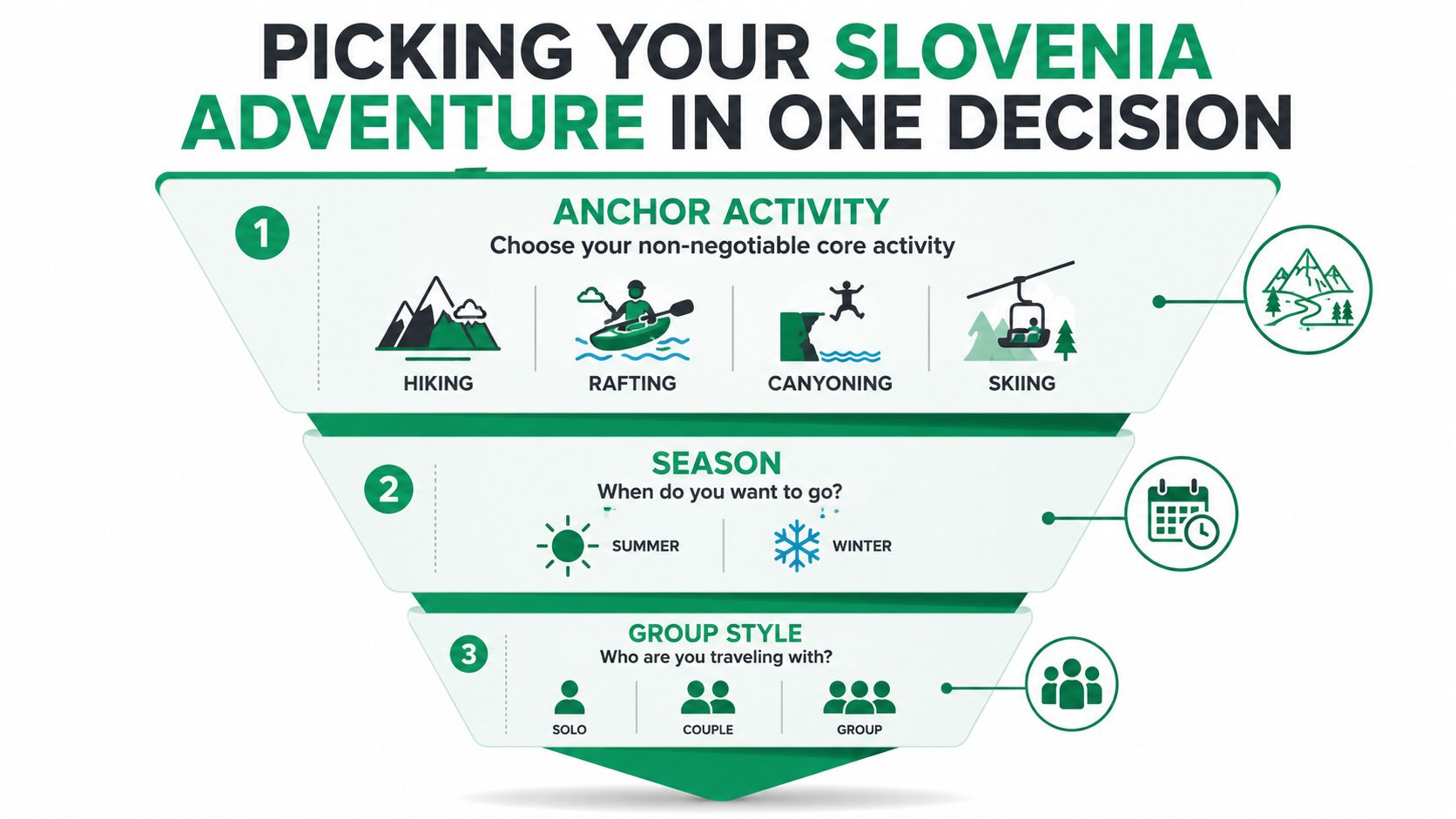
A family of four who wants canyoning in the Soča Valley in early June has already made the right core choice. Base them in Bled, give them three nights, and keep one backup hiking day in case the river or weather shifts. That's a stronger plan than trying to squeeze in five activities and hoping the week organises itself.
Book the anchor activity before flights, not after. Once that's fixed, the rest of the holiday gets easy.
If you want a Bled-base trip that's organised properly, start with Outdoor Slovenia Activities and choose the day that matches your group's confidence, season, and pace. We'll help you keep the plan tight, safe, and realistic, so you spend less time juggling logistics and more time on the river, trail, or snow.