
You've probably had this moment already. You step out near Lake Bled early in the morning, the air is cool, the lake is still, and the mountains look almost unreal. Or you arrive deeper in the Julian Alps, pull on a wetsuit for your first canyoning trip, and realise the water is so clear you can trace every stone on the riverbed.
That first reaction is always the same. Excitement, a bit of disbelief, and then one quiet question in the background. How does a place stay this beautiful when so many people want to experience it?
That's where the benefits of sustainable tourism stop being abstract. Around Bled and Triglav National Park, sustainability isn't a slogan for brochures. It's the practical difference between a river that still feels wild and one that feels crowded, between a village that thrives from tourism and one that only carries the costs. If you're here to raft, hike, kayak, canyon, or breathe properly for the first time in months, sustainable tourism is what helps protect the experience you came for.
Table of Contents
- Keeping Slovenia Magical For Generations to Come
- What Sustainable Tourism Really Means in Slovenia
- The Triple Win Environmental Economic and Social Benefits
- A Sustainable Adventure Day in Triglav National Park
- Your Guide to Being a Responsible Traveller in Slovenia
- How Outdoor Slovenia Upholds Our Commitment
Keeping Slovenia Magical For Generations to Come
A lot of first-time visitors think sustainable tourism means being told “no” all day. No stepping here. No swimming there. No parking here. No touching that. In reality, the good version is much more useful than that. It helps people enjoy Slovenia properly without slowly loving the place to death.
The moment visitors understand it
On a normal summer day around Bled, you can see two versions of tourism happening at once. One is rushed, crowded, noisy, and focused on ticking off the obvious viewpoint before moving on. The other is slower and better organised. Small groups head out with guides, learn where they are, and leave the place looking much the same as they found it.
The second version usually feels better for everyone involved. Visitors get more space, clearer guidance, and a stronger sense of the environment. Locals keep living in a functioning place rather than a stage set built only for photos.
Sustainable tourism works best when visitors hardly notice the system behind it. They just feel that the day runs smoothly, the site isn't overwhelmed, and the experience feels more real.
Why it matters more in mountain and river regions
This matters especially in places like Lake Bled, the Sava Dolinka, and the valleys leading into Triglav National Park. Rivers, trails, canyon entrances, lakeshores, and fragile alpine ground don't absorb unlimited pressure. Once too many people funnel into the same access points, the damage appears quickly. Muddy edges. Trampled vegetation. More waste. Less calm.
That's why the best local operators and the most thoughtful travellers treat nature as the foundation of the whole trip, not as scenery in the background.
A guided rafting or canyoning day should still feel adventurous. It should still be exciting, splashy, and memorable. But it should also leave the river clean, keep access points respected, and make sure the communities around these environments still want tourism tomorrow, not just today.
Shared responsibility works better than blame
Visitors aren't the problem by default. Poor planning is. Weak management is. Careless habits are. The encouraging part is that small choices add up fast when thousands of travellers make them well.
A family that books a local guide instead of a generic intermediary helps money stay nearby. A group that chooses a less pressured time slot reduces crowding. A traveller who sticks to marked access and doesn't leave litter saves the next group from arriving to a degraded site.
That's the promise here. Slovenia can stay magical, not by freezing it in time, but by managing tourism with care.
What Sustainable Tourism Really Means in Slovenia
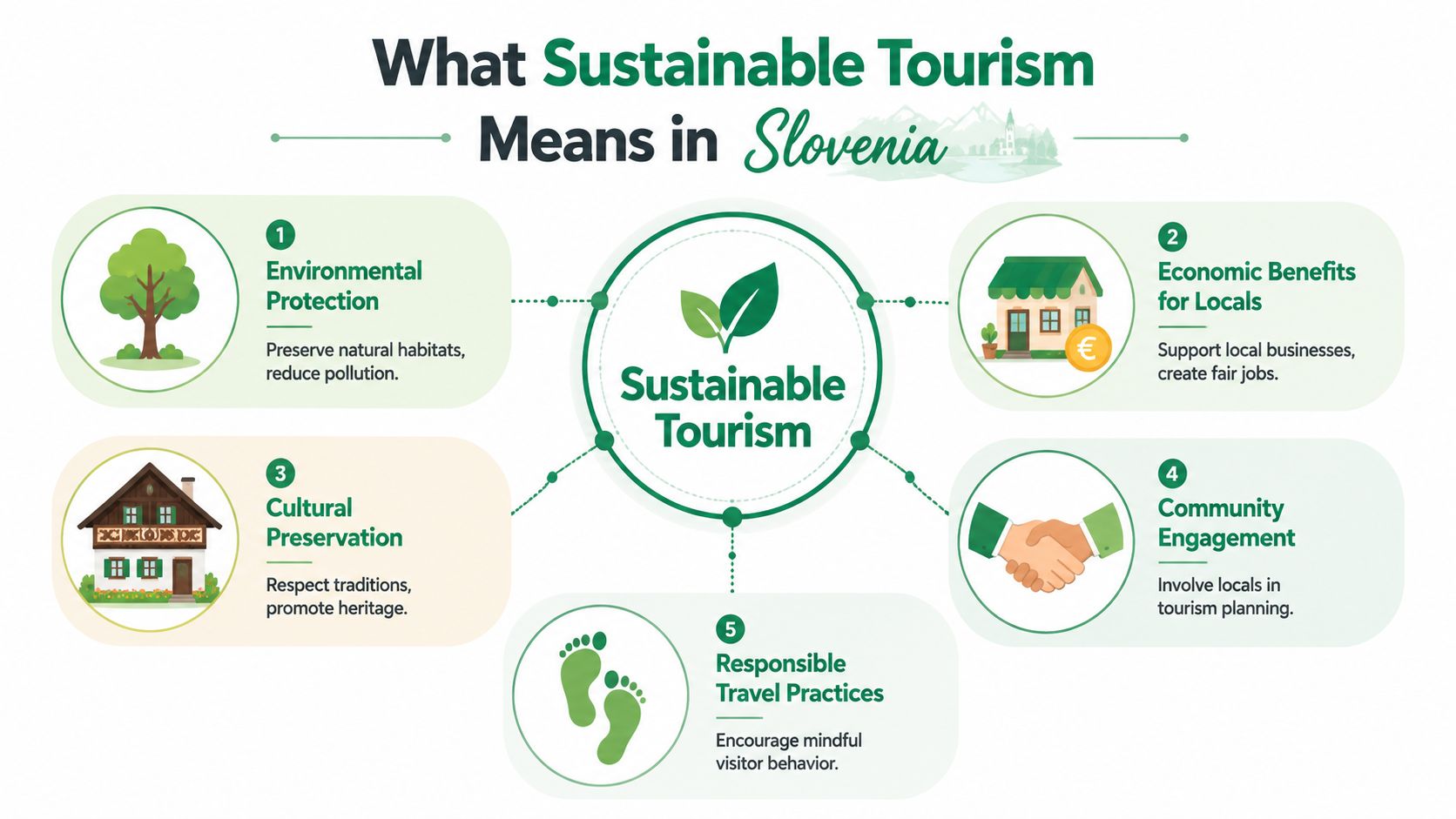
In Slovenia, sustainable tourism has a clear practical meaning. It means tourism should create local value, protect nature, and respect culture at the same time. If one of those pieces is missing, the model starts to wobble.
This isn't just a nice idea that operators mention because travellers like green language. Slovenia's broader policy framing connects tourism directly to sustainable development goals. The UN's tourism framework states that target 8.9 calls for policies that promote sustainable tourism that creates jobs and supports local culture and products, while target 12.b calls for tools to monitor tourism's sustainability impacts in the UN overview of sustainable tourism.
What it looks like on the ground
For travellers in Bled or the Julian Alps, that definition becomes very concrete:
- Nature is treated as the core asset. Clean water, healthy forests, quiet trails, and protected habitats aren't optional extras. They are the reason people come.
- Local communities should benefit. Tourism should support guides, drivers, guesthouses, restaurants, food producers, and other small businesses nearby.
- Culture shouldn't be flattened. Sustainable tourism protects the local character of a place instead of turning every destination into the same polished product.
- Impact should be managed, not guessed. Good operators watch timing, group size, route choice, and pressure on sensitive access points.
That last point is important. Sustainable tourism in Slovenia isn't only about good intentions. It's about making practical decisions before a problem appears.
What it does not mean
It doesn't mean every trip has to feel serious or restrictive. It doesn't mean adventure disappears. And it certainly doesn't mean visitors have to become field scientists before joining a rafting trip.
It means the fun is organised in a way that doesn't wreck the setting.
A sustainable canyoning trip still includes jumps, slides, ropes, helmets, wetsuits, and plenty of laughter. A sustainable kayaking afternoon can still be playful and beginner-friendly. The difference is in how the activity is run, where groups enter, how waste is handled, how transport is organised, and whether the operator understands the place as a living environment rather than a consumable backdrop.
Simple rule: sustainable tourism is tourism that leaves both the place and the community stronger, not just busier.
If you want a broader beginner-friendly explanation of how this mindset applies to different kinds of travellers, this guide to sustainable travel for families and nomads is a useful companion read.
Why Slovenia takes it seriously
Slovenia's appeal is tightly linked to its natural environment that can be damaged by careless popularity. Visitors don't fly in for giant artificial attractions. They come for emerald rivers, mountain views, quiet forest roads, traditional towns, and outdoor experiences that still feel genuine.
That's why sustainable tourism works here when it's treated as a practical operating system. The aim isn't to keep people out. The aim is to keep the experience worth having.
The Triple Win Environmental Economic and Social Benefits
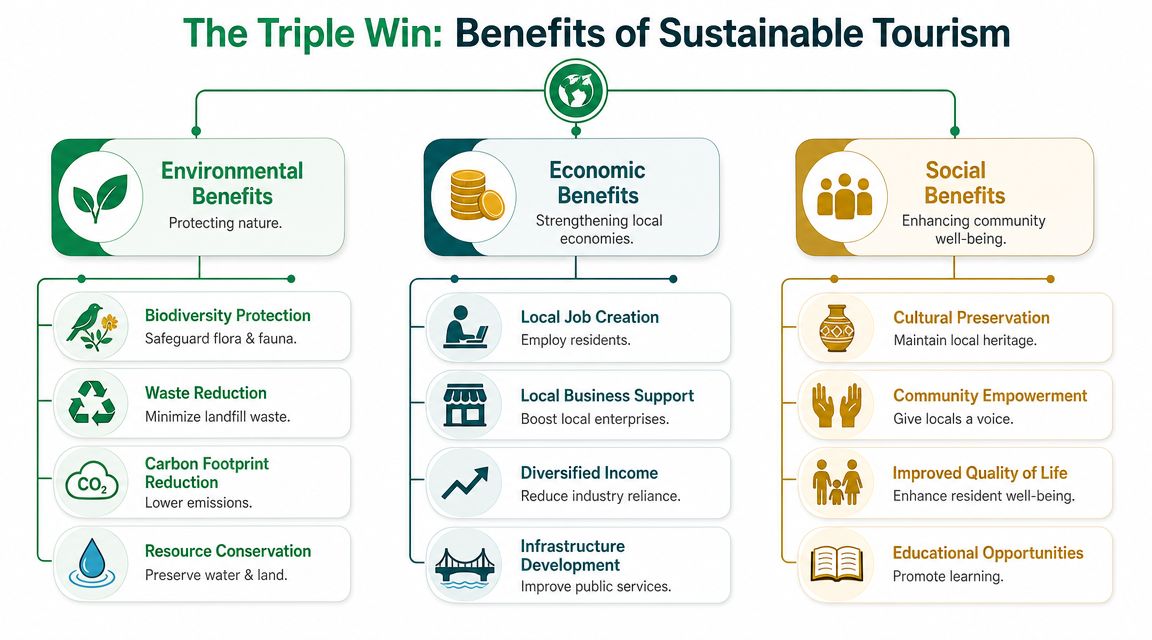
The strongest argument for the benefits of sustainable tourism is that it isn't only about conservation. When it's done properly, three groups gain at once. Nature gains. Local businesses gain. Visitors and communities gain.
Environmental gains that visitors actually feel
The environmental side is the easiest to picture because you can often see it with your own eyes. Cleaner water makes a rafting trip better. Intact canyon walls, healthy riverbanks, and less crowded access points make a canyoning route feel wilder and safer. Quiet forests and well-managed paths improve hiking days before anyone says a word about policy.
The technical logic is straightforward. When tourism avoids unnecessary damage, the natural asset stays attractive and usable. That matters in mountain regions because the experience depends on ecological quality. If the river is stressed, if banks erode, if entry points become chaotic, the product itself gets worse.
Economic value that stays closer to the destination
The economic case is just as strong, which is precisely what generic travel articles often overlook. It's not enough to say tourism creates jobs. The better question is whether visitor spending stays in the region or leaks away through external intermediaries.
The World Bank gives a powerful benchmark in its briefing on nature-based tourism. It reports around 8 billion unique visits each year to protected areas worldwide. It also found that every tourist dollar increased local incomes by $2.48 in Madagascar's Nosy Be economy and by $2.03 around Queen Elizabeth National Park in Uganda. In Zambia, tourism generated jobs for 30% of the working-age population around South Luangwa National Park. In Bwindi Impenetrable National Park, nature-based tourism generated $31.7 million in economic benefits compared with a park budget of $2.3 million.
Those examples are not Slovenia-specific figures, so they shouldn't be copied directly onto Bled or Triglav. But they show something important. Well-managed nature tourism can multiply through local economies rather than stopping at the first transaction.
What that means around Bled and Triglav
A rafting booking doesn't only pay for time on the water. If the operation is local and well structured, that spending touches transport, accommodation, cafés, food suppliers, gear services, and nearby producers. The same logic applies when travellers pair an activity day with a local stay, such as glamping near Bled, rather than treating the region as a quick stop between bigger hubs.
The healthiest tourism economy isn't the one with the loudest volume. It's the one where more of each visitor euro circulates locally.
Social and cultural benefits that keep a place real
The social side matters just as much, even if it's less visible in a spreadsheet. A destination keeps its character when tourism supports local life rather than replacing it. Guides share stories that connect visitors to the natural environment. Families continue running accommodation or food businesses. Traditional products and local identity stay part of the visitor experience because they still have value.
The GSTC also highlights destination benefits such as job creation, cultural heritage preservation and interpretation, wildlife preservation, and environmental restoration in the UN-linked sustainable tourism framing noted earlier. Around Slovenia's outdoor regions, that means tourism can support not just activity providers, but also the cultural context that makes a day here memorable.
Where the triple win breaks down
Sustainable tourism is not automatic. Some models look busy but deliver weak local value. Big-volume, low-context tourism often creates crowding first and local benefit second. It can push too many people into the same places, flatten local identity, and route too much spending through outside platforms.
What works better is usually more intentional:
- Smaller guided formats that reduce pressure on sensitive sites
- Locally based logistics that keep spending near the activity area
- Clear visitor guidance so guests understand where they are and how to behave
- Quality over throughput so operators don't need to overload rivers, trails, or canyon entrances
When those pieces line up, the triple win is real. The ecosystem stays healthier, the local economy captures more value, and visitors leave with a better story than “we saw the famous spot and moved on.”
A Sustainable Adventure Day in Triglav National Park
A good sustainable adventure day doesn't feel like a lecture. It feels like a well-run day outside. The sustainability shows up in the rhythm of the trip, the way the group moves, and the choices made before the first splash.
Morning starts with group design, not just gear
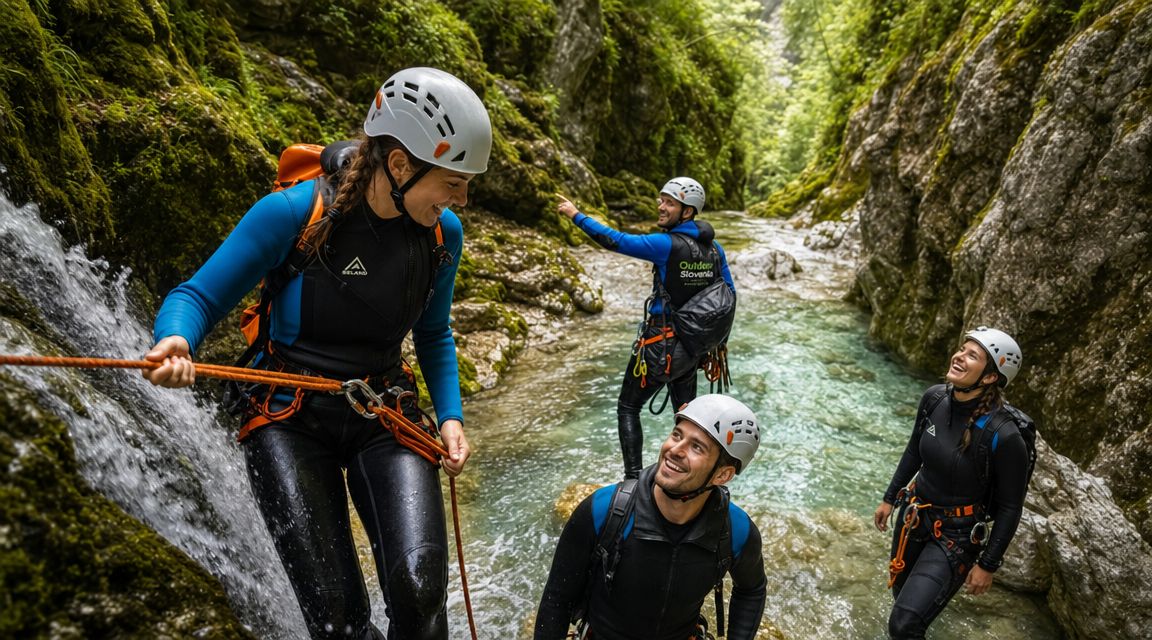
Say you're joining a canyoning and rafting day in the wider Triglav area. The sustainable part starts before you ever zip up the wetsuit. Group size matters. Timing matters. So does route choice.
If too many people arrive at one canyon entrance at once, the atmosphere changes immediately. There's more waiting, more noise, more pressure on the access point, and less sense of discovery. Smaller groups avoid that spiral and make safety management easier too.
That fits a broader challenge in Slovenia. Popular destinations need to manage visitor pressure carefully. One practical approach is dispersing visitors, promoting smaller groups, and favouring lower-impact activities, as discussed in this tourism management perspective on visitor pressure and sustainable tourism.
What the day looks like when it's done properly
The best version of the day feels smooth rather than rushed.
You meet your guide. Equipment is fitted carefully. The briefing covers safety, but also the basics of moving through the environment without leaving damage behind. On the walk in, people naturally quiet down because the setting invites it. Along the route, the guide points out how water shapes the rock, why certain access points matter, and why staying with the group protects both people and the site.
Then the fun begins properly. Slides, jumps, rope sections, cold water, big smiles.
And because the day has been designed well, the canyon still feels like a canyon instead of a queue.
Why guided experiences can reduce impact
Some travellers find this surprising. They assume independent exploration is always the lighter option. Sometimes it is. Sometimes it isn't.
In sensitive mountain and river areas, a trained guide often reduces harm because the group uses established access, follows better timing, avoids bad habits, and learns what not to do without trial and error. That's especially true for first-time adventurers.
For visitors who want to combine active days responsibly, a guided option like Triglav National Park hiking trips can work well alongside water activities because the route planning and site choice are already thought through.
Good guiding protects more than safety. It protects pacing, access, site condition, and the mood of the whole experience.
Small choices that change the whole outcome
A sustainable adventure day usually includes choices that many guests barely notice:
- Staggered departure times instead of everyone starting together
- Clear transport coordination so roadside pressure stays lower
- Behaviour briefings that keep riverbanks and trails cleaner
- Route selection that suits the group rather than forcing every group onto the same famous line
None of that makes the day less exciting. It usually makes it better.
You spend less time waiting. You hear the river more than other groups. You remember the colour of the water and the smell of the forest, not the chaos of a congested starting point. That's one of the most practical benefits of sustainable tourism in Slovenia. It protects the sense of wildness that people travelled here to find.
Your Guide to Being a Responsible Traveller in Slovenia
You don't need to overhaul your whole personality to travel responsibly here. Most of it comes down to a handful of decisions that are easy to make once you know what to look for.
The choices that matter most
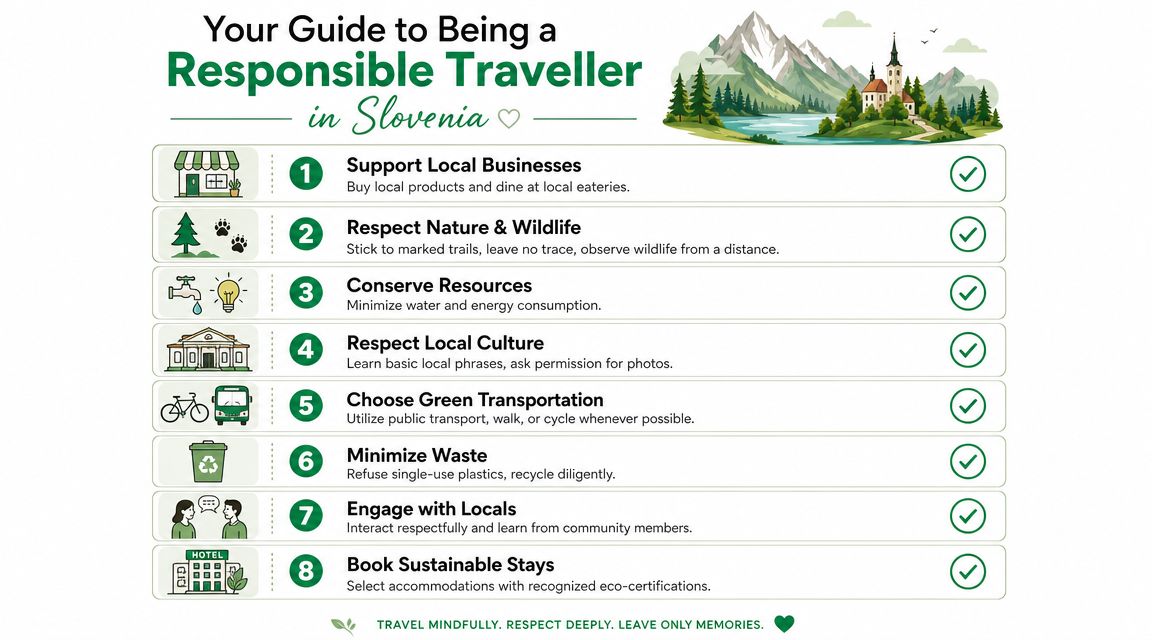
Some actions carry more weight than others because they directly affect local value, site pressure, and the quality of your own trip.
| Area | Sustainable Choice | Why It Matters |
|---|---|---|
| Accommodation | Choose locally owned stays when possible | More of your spending remains in the destination and supports local livelihoods |
| Activities | Book trained local guides for river, canyon, and mountain trips | Guides help manage safety, access, timing, and respectful behaviour |
| Transport | Walk, cycle, share transfers, or use lower-impact options where practical | Fewer cars around busy access points helps reduce congestion |
| Food and shopping | Eat locally and buy authentic local products | This supports nearby producers and keeps regional character alive |
| Waste | Carry a reusable bottle and avoid unnecessary single-use packaging | Less rubbish ends up around trails, rivers, and car parks |
| Nature access | Stay on marked paths and use designated entry points | This protects vegetation, riverbanks, and sensitive ground |
| Culture | Learn a few local words and be respectful in villages | Better interactions create better tourism for residents and guests |
| Timing | Travel off-peak or pick less pressured time slots when you can | Spreading demand helps protect popular sites and often improves the experience |
A practical checklist for active days
For rafting, hiking, canyoning, and kayaking days, these habits go a long way:
- Bring reusables: A refillable bottle and a small snack container reduce waste over a full day outdoors.
- Follow access instructions exactly: Shortcuts might save a minute, but they often damage banks, trails, or private land.
- Dress properly the first time: Good footwear and suitable layers mean fewer avoidable problems and less temptation to break site rules for comfort.
- Ask before taking close photos of people or homes: Villages near tourist routes are living communities, not open-air museums.
- Buy fewer, better souvenirs: Local food products or handmade items usually give more back to the place than generic imports.
Responsible travel also means choosing the right pace
Many visitors try to fit too much into too little time. That often creates the least sustainable version of the trip. More driving, more rushing, more crowd-following, less understanding.
A better approach is to slow the itinerary slightly and choose activities that let you experience the environment from inside it. Hiring an electric bike in Slovenia can be one practical way to move through the area with less pressure on busy road access while still covering a satisfying distance.
On-the-ground advice: if a place feels overloaded when you arrive, don't add to the problem out of stubbornness. Adjust your timing, choose another route, or come back later.
What works and what doesn't
Responsible travel is not about performative gestures. It's about useful ones.
What works:
- Booking local
- Respecting access rules
- Travelling with awareness of timing and crowding
- Spending money in ways that strengthen local businesses
- Letting guides guide
What doesn't work:
- Calling something eco-friendly without changing behaviour
- Driving to every viewpoint because it feels quicker
- Leaving tiny bits of litter because “it's only one thing”
- Treating quiet natural places like amusement parks
- Assuming your holiday exempts you from local norms
The reward for doing this well is not only moral satisfaction. You usually get a calmer, richer, more memorable trip.
How Outdoor Slovenia Upholds Our Commitment
Sustainability in outdoor tourism only means something if it changes operations. Nice wording doesn't protect a riverbank. Systems do.
For outdoor operators in Slovenia, sustainability works best as an operational control system. Research on smart sustainable ecotourism points to tools such as real-time counts, route and capacity management, environmental monitoring, and data-informed decisions that help reduce pressure on sensitive natural areas in this review of smart sustainable ecotourism practices. That same context matters in Slovenia because travel and tourism generated 11.6% of GDP in 2019 and supported 13.2% of total employment, as summarised in the verified sector context above. Protecting the asset base is not a side issue. It's core business.
What that looks like in practice
Around Bled and the wider alpine region, the right approach usually includes:
- Small-group planning so guides can manage safety and site impact properly
- Thoughtful scheduling to avoid sending everyone to the same place at the same time
- Route selection based on conditions rather than forcing one fixed itinerary
- Clear guest briefings that explain behaviour around water, trails, and access points
- Local coordination with nearby services so tourism supports a wider network, not one isolated business
Outdoor Slovenia Activities operates in that practical space. The company runs guided rafting, canyoning, kayaking, hiking, and winter instruction around Bled and beyond, with professional guides, technical equipment, and organised logistics built into the experience. In sustainability terms, that sort of structure matters because guided, managed outdoor activity is easier to run responsibly than ad hoc, loosely coordinated volume tourism.
What we believe works best
The strongest model is not the busiest one. It's the one that keeps quality high enough that the place still feels worth visiting next season and next year. That means accepting trade-offs. Sometimes a route shouldn't be pushed. Sometimes group flow needs adjusting. Sometimes the most responsible option is not to overload the obvious hotspot.
That approach serves guests as well. Cleaner sites, less crowding, and stronger guiding create better days outside. People feel safer, learn more, and connect with the natural environment instead of skimming across its surface.
Protecting experience quality and protecting nature are often the same job.
If you want to explore Slovenia actively and with care, browse the full range of Outdoor Slovenia Activities and choose an adventure that fits both your energy and the places you've come to enjoy.