
You're probably doing what most travellers do the evening before an activity. You open your phone, type Il Meteo Pivka, see a sun icon, glance at the temperature, and assume tomorrow is sorted.
In Slovenia, that's only the first layer. A clear symbol on a weather app can still mean cold water in a shaded canyon, rising flow after recent rain, gusty wind on an exposed section, or air that generally feels fine but irritates anyone with pollen or smoke sensitivity. In karst country, mountain weather and local terrain turn a simple forecast into a decision that needs context.
That's why experienced guides don't read weather as a yes-or-no box. We read it as a chain of consequences. What happened yesterday matters. What the nearby ridges are doing matters. What the river is carrying matters.
Table of Contents
- Why a Simple Weather App Is Not Enough for Slovenia
- Decoding Pivka's Weather Forecasts Like a Local
- Pivka's Climate Through the Seasons
- How Weather Governs Your Adventure Activity
- Beyond Rain and Sun What Our Guides Really Watch
- Packing Smart and Staying Safe in Pivka's Climate
- Frequently Asked Questions About Weather and Bookings
Why a Simple Weather App Is Not Enough for Slovenia
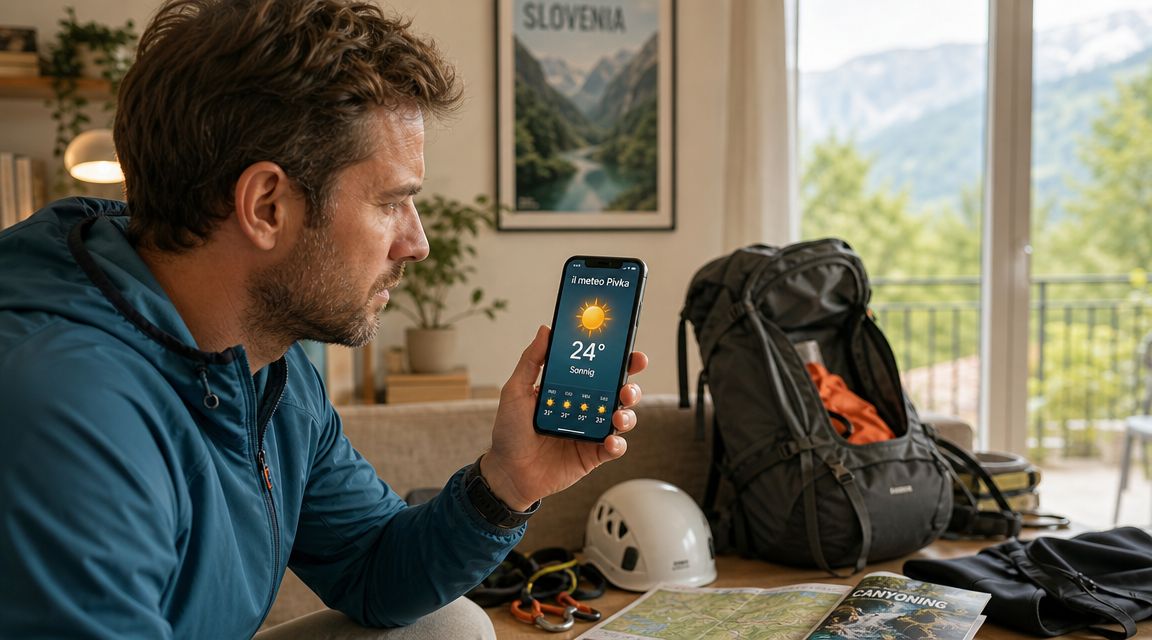
A generic forecast is useful for broad planning. It tells you whether to expect heat, cold, or rain. It does not tell you what that weather means inside a narrow canyon, on a river section, or on a road that changes elevation quickly.
Pivka sits in a part of Slovenia where microclimates matter. Karst terrain drains and reacts differently from a city street. Nearby higher ground can create fast changes in cloud build-up and wind. A day that looks stable on your phone can still produce very different conditions between a car park, a river entry point, and a shaded descent line.
That gap matters most when people are new to outdoor sports. Beginners often look at temperature first. Guides usually look at timing, terrain, exposure, recent rainfall, and how fast conditions can deteriorate if the wrong signal appears.
A practical way to think about it is this:
- Temperature is only comfort data if you don't also know wind, shade, and water temperature.
- A rain icon is incomplete if you don't know whether the catchment area upstream received more water than your current location.
- A sunny forecast can still be risky when afternoon instability lines up with a canyon schedule.
Practical rule: In Slovenia, the forecast on your screen is the starting point. The go or no-go decision comes from how that forecast interacts with terrain.
If you're still shaping your wider itinerary, a well-made Slovenia travel guide helps put places like Pivka, Bled, the karst region, and alpine valleys into one realistic route. That context matters, because moving a short distance in Slovenia often means moving into different weather behaviour.
Decoding Pivka's Weather Forecasts Like a Local
Start with the app you know
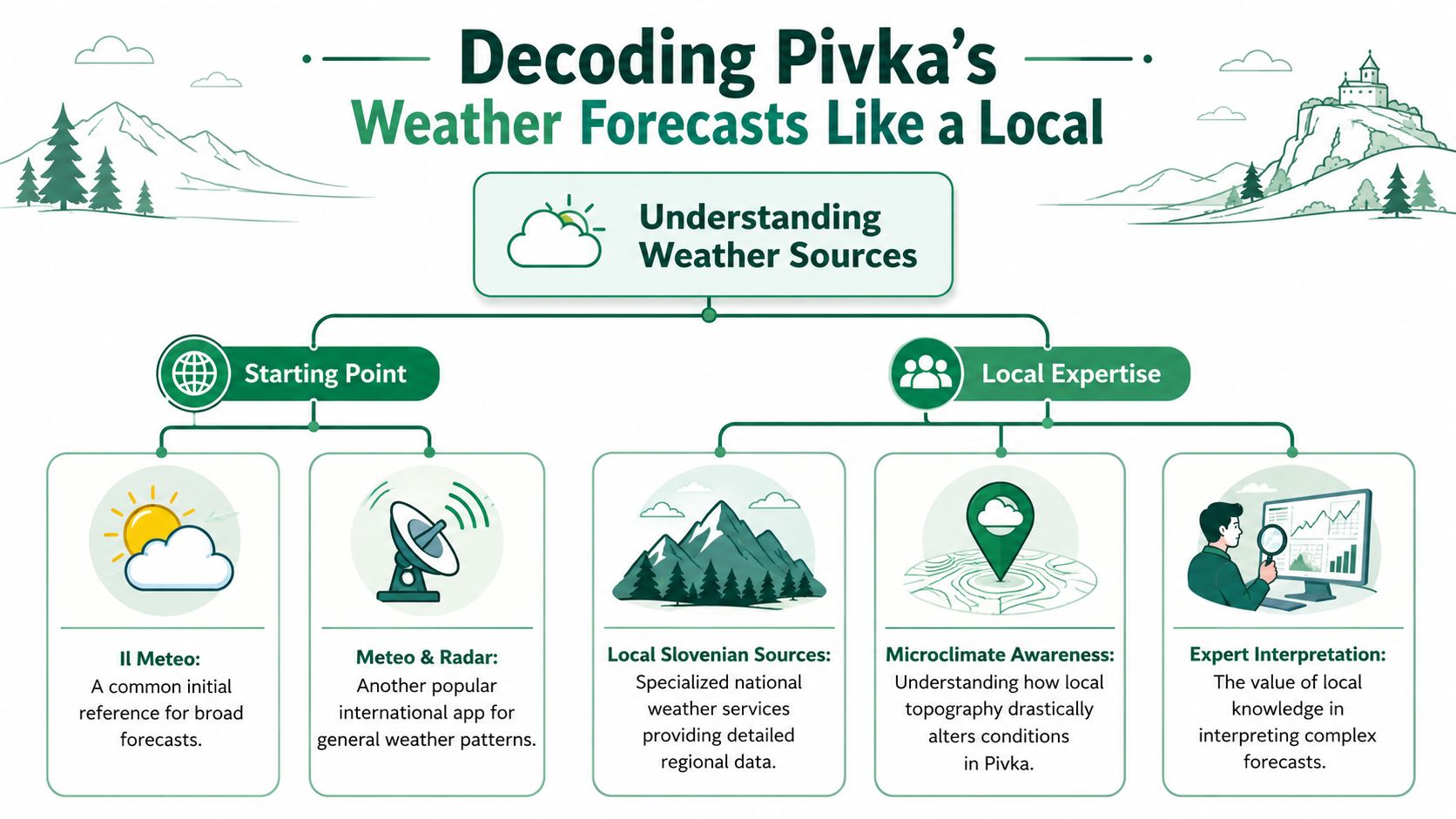
Many travellers begin with Italian and international tools. That's normal. If you search Il Meteo Pivka, you'll usually get a readable first snapshot. Apps like Il Meteo or Meteo & Radar are fine for broad orientation. They help you answer the easy questions first. Is the day generally warm or cool? Is rain likely at all? Is there a stable weather window in the morning?
But broad forecasts often smooth out the details that matter most in Slovenian outdoor terrain. A national or regional map can flatten local contrasts. That's enough for deciding whether to visit a café terrace. It isn't enough for deciding whether to enter a canyon.
Then read the local signals
Local interpretation starts when you stop asking only “What's the weather?” and start asking “What will the weather do to the route?”
Pivka's summer pattern shows why. Current local forecasting for the area has shown clear summer conditions with low wind and no precipitation on a given day, including a reading for Wednesday, July 1, 2026 of 20°C at night, 6 km/h wind, 0 mm precipitation, and 1017 mbar, with daytime readings showing 26°C and a RealFeel of 34°C under clear skies, according to local Pivka forecast data. That tells a guide several things at once. Ground conditions may be dry. Heat management matters by midday. Low wind can make the air feel heavier. Clear skies reduce one risk, but they don't remove every hazard.
A local reading also includes what many visitors ignore:
- Wind direction and exposure. A light breeze in town can feel different near a ridge, canyon mouth, or open lake.
- Cloud build-up timing. Morning calm doesn't guarantee a stable afternoon.
- Air quality notes. “Discreto” means generally acceptable, not perfect for everyone.
- Diurnal range. Warm afternoons and cooler early starts change clothing and pacing.
If you want another example of how local weather interpretation works in Slovenia beyond the standard app view, this piece on Ljubljana Weather Underground is useful because it shows how regional reading always needs local context.
Read the forecast like a route planner, not like a beachgoer. The same clear sky can mean “perfect” on one activity and “start early” on another.
Pivka's Climate Through the Seasons
Pivka doesn't give you one stable weather identity. It gives you a full seasonal swing. That's good news for travellers because it creates very different adventure windows through the year, but it also means you need to match the season to your desired activity.
Summer brings range, not just warmth
Summer in Pivka can feel generous in the middle of the day and surprisingly sharp outside those hours. Local climate data indicates that summer daytime temperatures can reach 34°C, while separate local monitoring also notes that night-time cooling to 12°C can still matter for early departures and late returns, according to Pivka climate reporting.
That combination catches people out. They pack for heat, then stand at the meeting point in a cool morning breeze, or finish a wet activity and suddenly feel cold once the sun drops behind the slope. In practice, summer here isn't just “hot weather”. It's warm afternoons, variable mornings, and a real difference between dry ground heat and wet-body comfort.
Winter changes the rules completely
Pivka's colder half of the year is not a mild extension of autumn. It changes the whole decision framework. According to Meteoplanet's Pivka climate page, Pivka's climate has sharp seasonal contrasts. Summer days can hit 34°C, while winter minimums drop to 1.2°C with snow falling around 578 meters, directly impacting both summer and winter outdoor activities.
That matters for more than scenery. Snow line influences where lessons are realistic, where access roads stay comfortable for families, and how quickly visibility can change. Cold air also makes beginners tense up faster. In skiing or snowboarding, that usually means slower learning and faster fatigue if clothing or timing is wrong.
A few winter realities matter more than travellers expect:
- Altitude changes conditions fast. A valley departure doesn't reflect the slope.
- Wind affects confidence. Beginners feel it in exposed areas before they understand why they're uncomfortable.
- Surface quality matters as much as snowfall. Good lessons need visibility and manageable terrain, not just a white expanse.
Spring and autumn are the flexible seasons
Spring and autumn are often the smartest choices for travellers who want variety. They're good for people who like mixed itineraries, easier pacing, and fewer assumptions. A mild-looking day can still need proper layers, but those shoulder seasons reward flexibility.
The best season isn't the warmest one. It's the one that matches your activity, your tolerance for change, and how much margin you want in the day.
How Weather Governs Your Adventure Activity
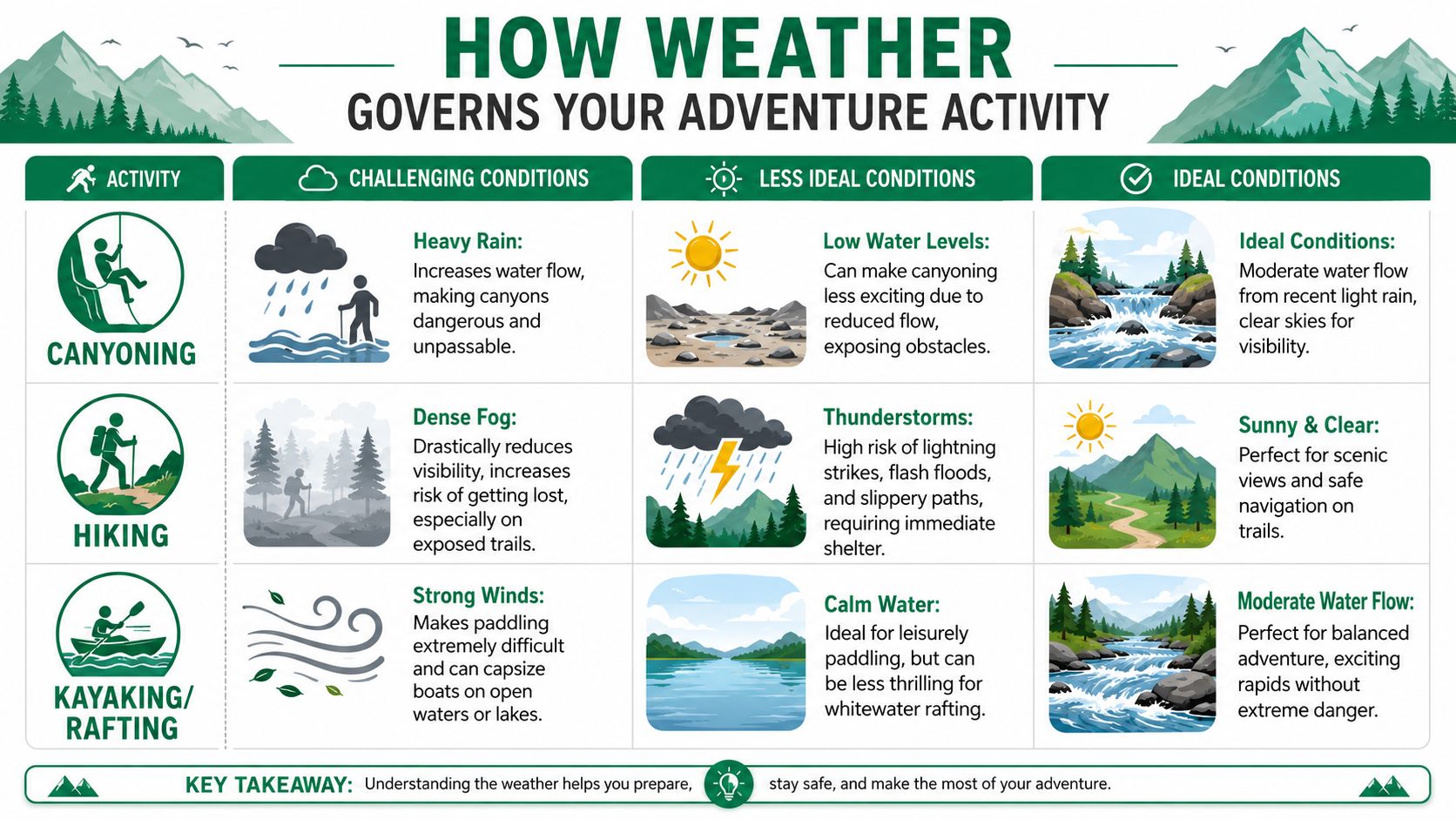
Weather doesn't just influence outdoor sports in Slovenia. It governs them. The same conditions that improve one activity can make another one less enjoyable or completely unsuitable.
Canyoning depends on more than sunshine
Canyoning is where visitors most often underestimate weather consequences. They see a warm day and think the canyon must be perfect. A guide reads the full chain. Recent rainfall, upstream collection, canyon shape, anchor exposure, water colour, and escape options all matter.
For June in Pivka, the climate signal is especially important. In June, Pivka sees an average of 142.59mm of rain, creating higher river levels that are often optimal for summer rafting and kayaking, but also require expert assessment for flash flood risks in canyons, according to World Weather Online's Pivka climate averages.
That's the trade-off. Water in the system can improve the experience. It can also remove your safety margin if rain arrives at the wrong time or if the route funnels water aggressively.
Another point beginners don't expect is that “easy” features still need respect. A long Austrian review of canyoning accidents found that jumping accounted for 23.4% of injuries, while rappelling accounted for 10.8% and sliding for 8.7%, based on the published canyoning accident study. The lesson is simple. Familiar-looking moves are not low-risk just because they look playful.
Rafting and kayaking follow flow, not mood
Rafting and kayaking depend on balance. Too little flow and the run can become technical in the wrong way, with exposed rocks and awkward lines. Too much flow and the margin for beginners gets narrower very quickly.
What works best is moderate, readable movement. Guides look for water that gives the trip energy without turning every decision into damage control. That's why recent rain can be welcome in some river settings and a reason to cancel in others.
If you're travelling through different parts of Slovenia, this article on Triglav National Park weather is a useful companion because alpine catchments and karst zones don't react in the same way.
A river doesn't care what the app icon says. It responds to what fell upstream, how steep the terrain is, and how quickly the system is moving.
Winter lessons depend on snow line and visibility
Winter instruction is more than booking a lesson on a snowy day. Snow altitude, road access, surface texture, and visibility all change what is productive for beginners. Good ski teaching happens when people can repeat movements without fighting weather stress at the same time.
There's also a deeper safety lesson from canyoning that applies across outdoor sports. A review of reported global canyon incidents found that even beginner-friendly canyons accounted for 22 fatal outcomes among 94 reported incidents, according to the Wilderness Medical Society article on canyon difficulty and injury. Difficulty labels alone don't protect people. Real assessment does.
Beyond Rain and Sun What Our Guides Really Watch
Most weather apps train people to look at two things first. Rain. Temperature. For outdoor travel in Pivka, that's often the least interesting part of the decision.
Air quality changes comfort fast
Air quality is the quiet factor that gets ignored until someone in the group starts coughing, rubbing their eyes, or tiring early. Basic forecast tools sometimes show a simple rating, but they rarely connect that rating to what it means for a family with allergies, a child, or anyone with respiratory sensitivity.
That gap matters. While many forecasts note basic air quality, they often miss seasonal pollen or wildfire smoke risks. A national survey found 41% of outdoor travelers in Slovenia lack real-time health-risk data, which is essential for those with respiratory sensitivities, as noted on the AccuWeather Pivka forecast page.
For a guide, that changes practical decisions. Maybe the route is technically safe, but a high-pollen morning makes a forest approach unpleasant for one family member. Maybe smoke haze doesn't stop the day, but it changes pacing, exertion, and whether a harder option still makes sense.
Small signals matter on the ground
Guides also watch what standard forecasts don't express clearly enough:
- Water feel, not just air temperature. A hot afternoon doesn't make immersion warm.
- Surface grip. Rock polish, mud, and moss can turn an easy step into a problem.
- Micro-wind. A sheltered car park can hide gusts in the open section ahead.
- Storm timing. A late-day risk may still be unacceptable if the route has no easy exit.
The equipment side matters too. The UIAA issued a safety alert noting that some canyoning harnesses showed a resistance drop to just 10% of standard value after 3 to 5 years of use, which is why guides check straps, wear, and corrosion closely according to the UIAA canyoning harness safety alert. Visitors often think weather is the only variable. In reality, weather and equipment condition are always part of the same safety system.
Good outdoor judgement is rarely dramatic. It's a series of small checks made early enough that the client never feels the problem.
Packing Smart and Staying Safe in Pivka's Climate
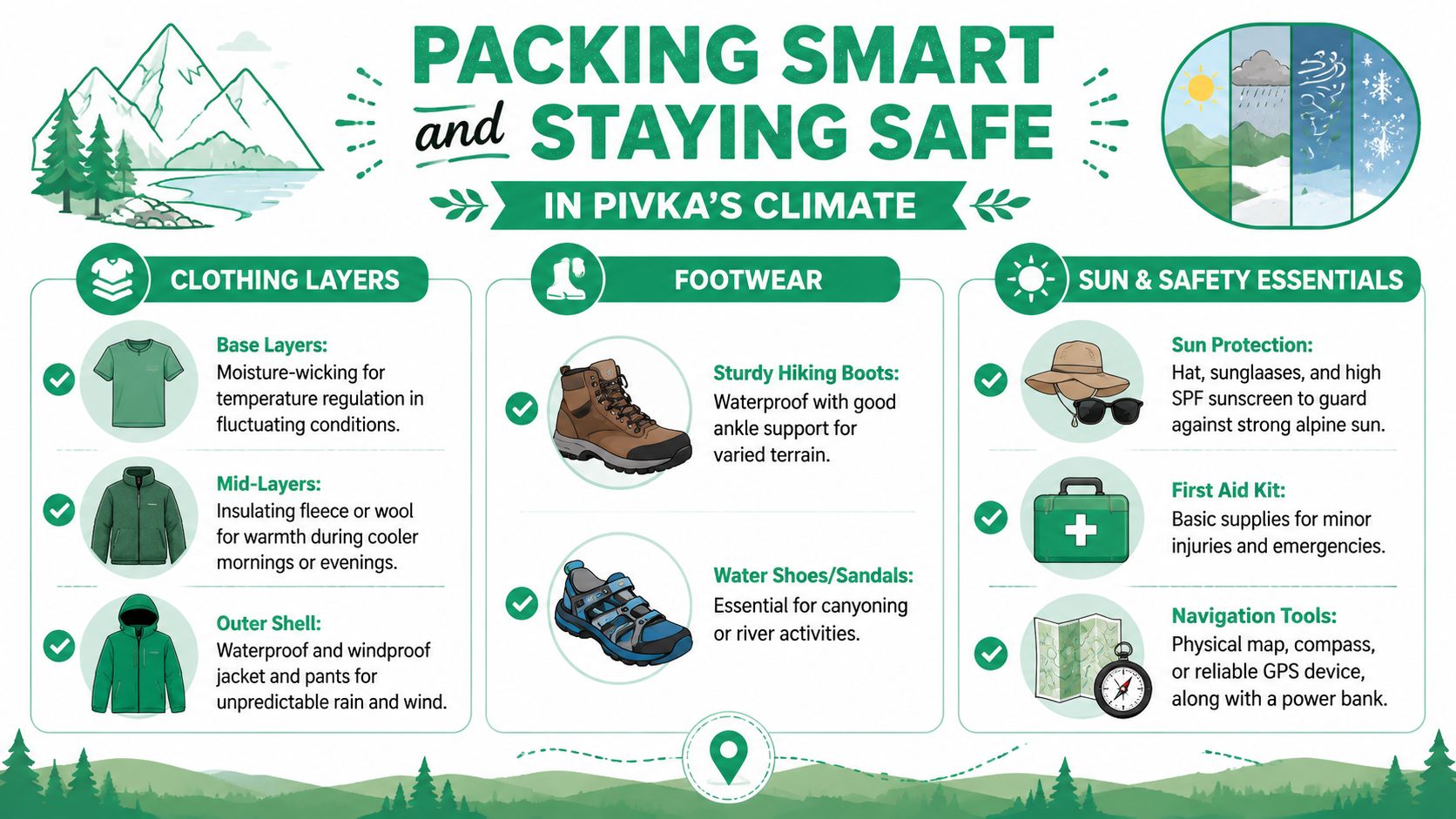
Most packing mistakes in Pivka come from treating the forecast as a dress code. It isn't. It's a risk and comfort signal. Pack for movement, shade, wet exposure, and changing temperatures.
Pack for the swing, not the forecast screenshot
The safest travellers in Slovenia are rarely the ones with the biggest bags. They're the ones who bring the right layers and accept that conditions can feel different hour by hour.
A practical packing setup looks like this:
- For upper body layers: Start with something light that dries well, then add an insulating top you can pull on quickly after a wet activity.
- For your feet: Use shoes that can handle slick ground if water is involved. Fashion trainers are the usual weak point.
- For sun exposure: Bring a cap, sunglasses, and protection for exposed skin. Clear skies in alpine and karst settings can feel stronger than visitors expect.
- For spare comfort: Dry clothes for the drive back make a big difference after canyoning or rafting.
If your route includes cave time or nearby underground stops, this guide on Postojna Cave temperature is worth checking because travellers often underpack for the colder, damper feel of subterranean environments.
For anyone bringing a phone, mirrorless camera, or action camera into wet terrain, OctoStream's camera protection advice is practical because it focuses on moisture, impact, and handling rather than just generic travel packing.
Safety improves when the system is organised
The biggest safety upgrade for a beginner isn't bravery. It's joining a guided setup where route choice, timing, equipment, and weather interpretation already work together.
One data point is especially reassuring for first-timers. Guided canyoning is statistically very safe, with an overall injury rate of just 4.2 per 1,000 hours and a mortality risk of only 0.02 per 1,000 hours, confirming professional oversight is key for beginners, according to Outdoor Tara's canyoning safety summary.
That doesn't mean clients should switch off their judgement. It means they should focus on the things they can control.
- Listen early: The safety briefing matters most before the first obstacle.
- Say something quickly: If you're cold, anxious, or breathing badly, tell the guide before the route commits.
- Respect gear checks: Helmets, harness fit, boots, and fastening points aren't admin. They're part of the experience working well.
- Keep one dry layer ready: The comfort gain is immediate after the activity ends.
The right gear doesn't make bad judgement safe. It gives good judgement room to work.
Frequently Asked Questions About Weather and Bookings
Do trips run if the app says rain?
Sometimes yes, sometimes no. Light rain on its own doesn't automatically cancel an activity. What matters is how that rain affects visibility, water behaviour, footing, and route safety. For water sports, recent rain upstream can matter more than what's falling at the meeting point.
What counts as bad weather?
Bad weather is any condition that removes a sensible safety margin. That can mean unstable storm timing, unsafe water flow, poor visibility, uncomfortable wind exposure for beginners, or health-related conditions that make the day unsuitable for the group.
Do I need to reconfirm if the forecast changes?
It's smart to stay alert, but don't try to make the final call from a phone screenshot. Local operators and guides normally monitor conditions and contact guests if a real schedule change is needed. If you're unsure, ask directly instead of guessing from a single app.
What should I do on the morning of the activity?
Eat lightly but properly, bring the clothing you were told to bring, and arrive with a small margin of time. If you have asthma, allergy issues, or you're recovering from illness, mention it before the activity starts.
What happens if weather forces a change?
Professional operators usually shift to a safer time slot, move to a different route, postpone, or cancel if that's the only responsible option. The best systems are flexible before they are rigid.
Here's the simplest decision view:
| Weather Condition | Canyoning | Rafting / Kayaking | Guideline |
|---|---|---|---|
| Clear and stable | Usually suitable | Usually suitable | Follow guide timing and heat management advice |
| Light rain with stable conditions | Sometimes suitable | Often suitable | Depends on route, recent rainfall, and water response |
| Heavy rain or storm risk | Often unsuitable | Sometimes unsuitable | Expect route changes, postponement, or cancellation |
| Strong wind or poor visibility | Route-dependent | Route-dependent | Extra caution for open or exposed sections |
If you want a well-organised day on the water, in a canyon, or on winter slopes, explore Outdoor Slovenia Activities. They run beginner-friendly adventures around Bled and across Slovenia with guides, equipment, transport, and the kind of weather judgement that makes the day both fun and sensible.