
You're probably reading this from a hotel in Bled, a lakeside café, or the boot of a rental car while deciding whether tomorrow is the day for a ridge walk, a ferrata, a canyon, or a simple trail that somehow turns serious once the weather shifts. That's a familiar moment around Lake Bled. The setting looks welcoming. It is welcoming. But it also asks for respect.
In Slovenia, samovarovanje is often translated as self-belaying or self-protection. In practice, it means something bigger. It means you don't step into mountain terrain hoping things will work out. You step in prepared, knowing what your gear does, how to use it, and where people usually make avoidable mistakes.
Around Bled and the Julian Alps, that mindset changes the whole day. It turns nervous movement into calm decisions. It makes steep terrain feel manageable. It lets you enjoy the exposure, the views, the river noise, and the alpine air because your safety system isn't improvised.
Table of Contents
- The Call of the Julian Alps and the Spirit of Self-Reliance
- What Is a Komplet za Samovarovanje
- Your Essential Bled Adventure Safety Checklist
- From Packed to Practiced How to Use Your Kit Correctly
- Tailoring Your Kit for Canyoning Rafting Hiking and Winter
- Maintaining Your Gear for Lasting Safety and Performance
- Your Adventure Begins with Confident Preparation
The Call of the Julian Alps and the Spirit of Self-Reliance
Stand on the shore of Lake Bled early enough and the whole place feels like an invitation. The church on the island appears first. Then the castle on the cliff. Then the light reaches the upper slopes of the Julian Alps and suddenly every path, ladder, ridge, and river seems possible.
That's the best part of Slovenia. Adventure is close. You don't need a major expedition to reach serious mountain ground. A short drive from Bled puts you in terrain where steel cables protect exposed traverses, where afternoon storms change the mood fast, and where the difference between a memorable day and a bad one often comes down to discipline.
Confidence comes from preparation
A Komplet za samovarovanje belongs to that discipline. It isn't there to make the mountains less wild. It lets you move through wild places with a margin of safety that matches the terrain.
People often assume preparation makes an adventure feel heavy or over-controlled. The opposite is usually true. The hiker who checks their kit, clips correctly, carries a headlamp, and knows where the weak points are will usually move more smoothly than the person relying on guesswork.
Practical rule: In exposed terrain, calm comes from systems, not from optimism.
Near Bled, that matters because the terrain changes quickly. A family walk can stay gentle all day. A mountain outing into Triglav National Park can shift from forest path to cable-protected rock in very little time. The same person may do rafting one day, a ferrata the next, and a high trail after that. Each setting asks for slightly different judgement, but the same principle holds. Respect the environment before it demands respect from you.
Self-reliance doesn't mean going alone
Self-reliance in the Slovenian mountain sense doesn't mean isolation. It means taking responsibility for your own readiness. If you join a guided activity, it means arriving with the right clothing, listening carefully, and understanding why the guide insists on a certain method. If you go independently, it means your kit and your habits must already be solid.
That attitude has deep roots in alpine culture. You earn freedom outdoors by preparing for it. When people get that right, Bled becomes more than a postcard base. It becomes the starting point for proper mountain days, the kind you remember for the views and the movement, not for preventable mistakes.
What Is a Komplet za Samovarovanje
You reach the first steep cable above Bled, clip in, and suddenly the question stops being academic. Is the gear on your harness an actual fall-protection system, or just metal and webbing that looks reassuring?
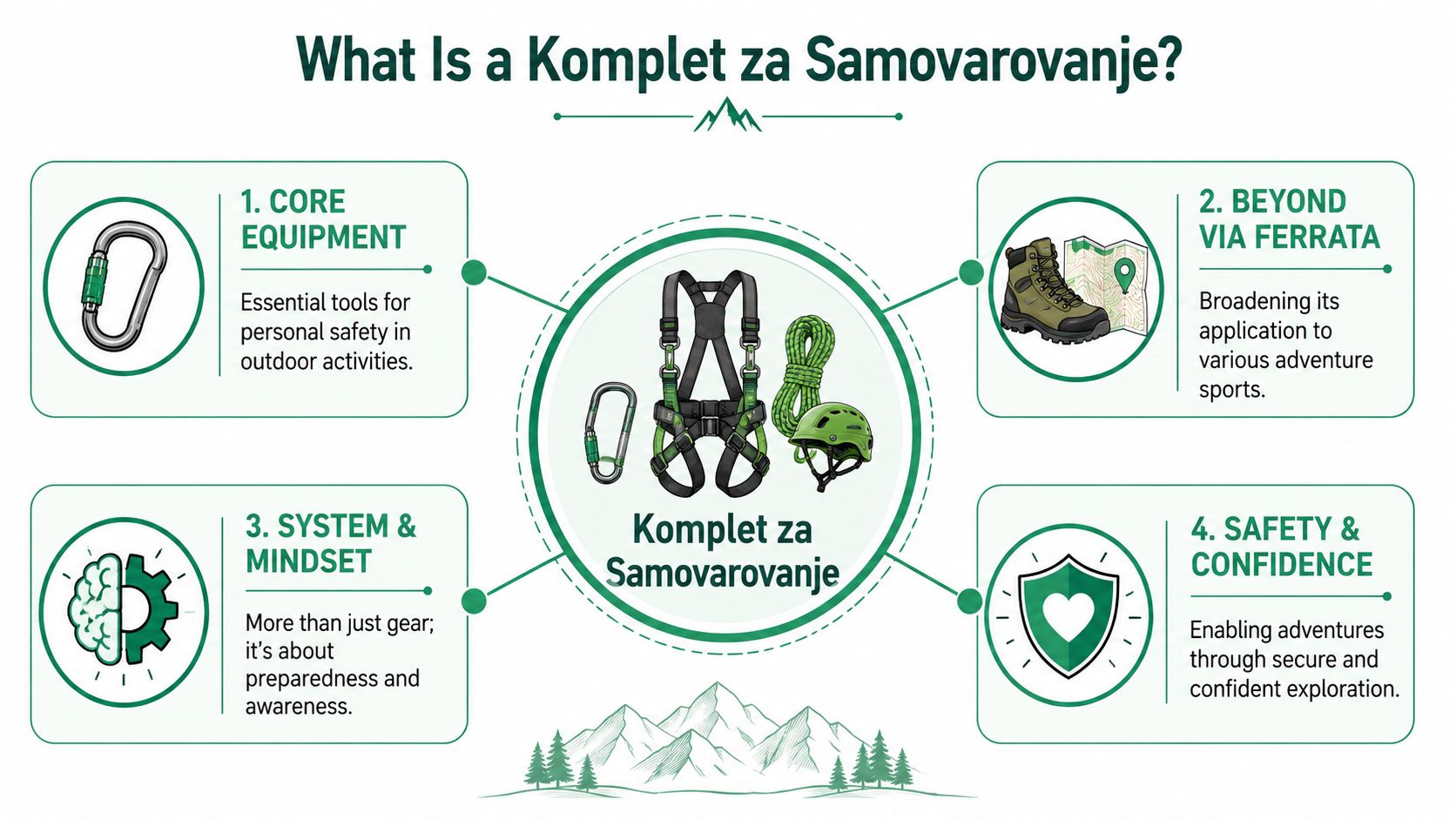
A komplet za samovarovanje is the via ferrata set built for that exact moment. It keeps you attached to the fixed steel cable and, just as importantly, manages fall forces in a way an improvised setup cannot. On protected routes above Lake Bled and deeper into the Julian Alps, that difference is what separates a controlled incident from a violent one.
The parts that do the real work
A proper ferrata set has three working parts, and each one solves a different problem on the route:
- Harness connection. This joins the set to your climbing harness using the method specified by the manufacturer. If this connection is wrong, the rest of the system cannot do its job properly.
- Energy absorber. This reduces the force of a fall. It is the part people overlook until they understand how hard a short ferrata fall can load the body.
- Two lanyards with ferrata carabiners. These allow continuous attachment as you pass cable anchors, one side at a time.
That is the core system. No single piece replaces the others.
The mistake I still see is treating the set like a pair of clips. It is a fall-arrest system. The absorber matters. The connection method matters. The carabiners matter. If one part is wrong, the setup may still look tidy on the harness and still fail at the only moment that counts.
Why improvised setups are dangerous
A sling and two ordinary carabiners can create attachment. They do not create the same protection.
On a ferrata, a slip often means a short fall above a fixed point, followed by a hard catch on a static system. Without an energy absorber designed for ferrata use, the force on the body can become severe very quickly. That is why experienced guides around Bled insist on a certified ferrata set rather than homemade combinations that only appear equivalent.
A simple rule works well here. If the route has a steel safety cable intended for ferrata progression, use ferrata equipment made for that purpose. Do not borrow logic from sport climbing, do not improvise with slings, and do not trust old gear of uncertain history.
What a ferrata set does, and what it does not do
| Part | What it does | What it does not do |
|---|---|---|
| Attachment point | Connects set to harness correctly | Fix a badly fitted harness |
| Energy absorber | Reduces force in a fall | Compensate for poor clipping habits |
| Twin lanyards and carabiners | Keep you attached while passing anchors | Make careless movement safe |
That distinction matters in the field. A certified set can reduce the consequences of a mistake. It cannot excuse clipping both carabiners badly, rushing at anchors, or overtaking people unsafely on exposed ground.
The same mindset carries into other local activities too. On guided rafting trips near Bled, people usually accept helmets and buoyancy aids without argument, because the hazard feels obvious. Ferrata demands the same respect, even when the route starts close to a car park and looks friendly from below.
If you're travelling from abroad, it also helps to understand Australian personal protective equipment requirements as an example of how different safety cultures frame equipment responsibility. The useful lesson is simple. Certified gear protects you only when it matches the activity, fits the user, and is used the way it was designed to be used.
A komplet za samovarovanje is not another item to tick off a packing list. Around Bled, it is a specific tool for specific terrain, and it deserves the same respect as the cable you trust it to clip into.
Your Essential Bled Adventure Safety Checklist
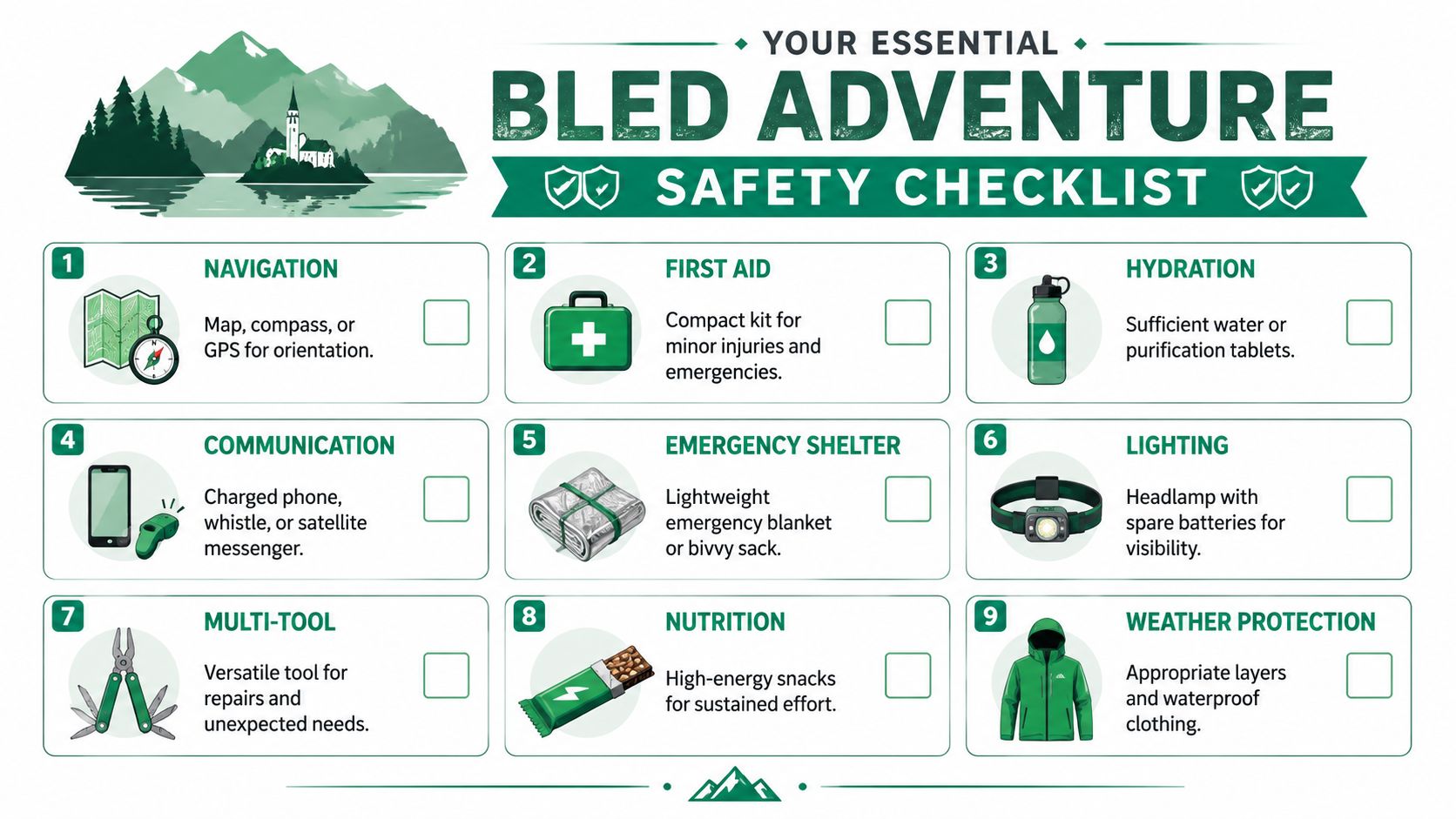
A good safety kit around Bled is never random. It reflects the actual day. Short approach, long summit, changing weather, wet rock, family pace, solo navigation, water activity, shoulder season cold. The checklist should answer those realities before you leave the car park.
The visual below gives the fast version. The details after it are where good decisions happen.
Technical safety
- Certified ferrata set and harness. If your route includes fixed cable protection, carry the proper system, not an improvised substitute. Fit the harness before you leave, not at the foot of the wall.
- Helmet. Rockfall doesn't need a dramatic alpine face. A loose stone above you or a slip into the cable line is enough reason.
- Gloves for cable work. Not essential for every person, but many people handle steel cable more confidently with lightweight ferrata gloves.
- Approach footwear with grip. Smooth trainers are where many “easy” days start going wrong.
First aid and personal care
A compact first-aid pouch is enough for most day outings if it's packed intelligently.
- Blister care. Feet end more mountain days than exposure does.
- Antiseptic wipes and plasters. Useful for cuts from rock, cable, or a rough scramble.
- Elastic wrap or simple support bandage. Helpful for minor twists until you can descend.
- Personal medication. This should never be an afterthought at the bottom of the bag.
Navigation and communication
Bled is visitor-friendly. Mountain terrain above it isn't always forgiving.
- Offline map on your phone. Don't assume signal will stay reliable.
- Power bank and charging cable. A long day of maps, photos, and weather checks drains batteries quickly.
- Whistle. It weighs almost nothing and carries farther than a shout.
- Written emergency plan. A small card with route, contact, and timing is surprisingly useful. Travellers who want a clearer framework can adapt a personalized travel safety template before heading into the mountains.
Pack for the problem you're most likely to face, but leave room for the problem you didn't predict.
If your week around Bled includes river time as well as mountain time, it's smart to separate kit by activity. Keep your mountain essentials ready in one pouch and your water-day items in another. That makes it easier to switch plans when weather or group energy changes. If river conditions tempt you toward a different kind of day, local options for rafting near Bled often make more sense than forcing a mountain plan in poor conditions.
Sustenance and shelter
Often, many day hikers under-pack because the outing looked short on the map.
- Water. Carry enough for the route and the heat. On longer days, purification backup can make sense.
- High-energy food. Bars, sandwiches, nuts, or simple carbohydrate-heavy snacks all work. Choose what you'll eat when tired.
- Emergency blanket or lightweight bivvy. It's one of the best weight-to-usefulness items in a pack.
- Headlamp. Day hike or not, delays happen. A wrong turn, cautious descent, or slow group pace can push you into fading light.
- Light waterproof and insulating layer. Around the Alps, weather can turn a comfortable morning into a cold descent quickly.
A practical Bled kit doesn't need to be huge. It needs to be deliberate. If every item has a reason to be there, you'll carry enough without carrying nonsense.
From Packed to Practiced How to Use Your Kit Correctly
You reach the first steep step above Bled. The lake is far below, your breathing is up, and the anchor arrives sooner than expected. This is the point where a new ferrata user learns whether the kit was merely packed or actually understood.
Owning a komplet za samovarovanje is not enough. Safe use depends on small habits done correctly while clipped in, slightly stressed, and sometimes tired. Around the Julian Alps, I see the same pattern every season. People buy decent equipment, then lose safety in the transitions, at the anchors, and in the way they move when terrain gets awkward.
Attachment to the harness is the first real check
Your ferrata set has to be connected to the harness exactly as the manufacturer designed it. No improvising. No guessing based on what looks centered.
Mistakes here are more common than many hikers expect. A twisted connection, the wrong loop on the harness, or a badly oriented absorber can compromise the whole system before the climb even starts. If you are joining a guided canyoning trip near Bled, your guide handles technical setup differently. On ferrata, your personal system is your responsibility unless a guide checks it directly.
Before leaving the ground, do this every time:
- Lay the full set out clearly so the absorber, attachment loop, and both lanyards are visible.
- Find the correct harness attachment point. Use the point intended for this system, not the loop that happens to be easiest to reach.
- Follow the manufacturer instructions for that exact model.
- Check the orientation. The absorber should sit cleanly, and the lanyards should not be trapped, twisted, or forced across the harness.
- Get a partner check. Even experienced climbers miss simple setup errors.
I strongly recommend practicing this at home before the trip. Not once. Several times, until you can recognize immediately when something looks wrong.
Movement on the cable has to stay disciplined
Good ferrata movement is quiet and deliberate. Carabiners are transferred by hand. Balance comes before speed. At each anchor, one carabiner moves, then the other. That rhythm prevents the sloppy clipping that causes many avoidable mistakes.
A few habits matter a lot on route:
- Approach each anchor in control. If your feet are poor, stabilize first.
- Transfer one carabiner at a time so you stay protected throughout the move.
- Watch carabiner orientation after every transfer, especially on traverses and awkward cable angles.
- Pause for one second after clipping. That brief check catches many errors.
Smooth clipping is safer than rushed clipping.
This matters even more on popular routes above Bled, where traffic can push people into hurrying. Haste is one of the worst influences on ferrata judgment.
Common mistakes that create real danger
The dangerous errors are usually ordinary ones. They happen on easy ground, in crowds, or when people assume the kit will compensate for poor habits.
| Common error | Why it's dangerous | Better practice |
|---|---|---|
| Clipping carelessly on a horizontal section | Carabiners can sit badly and load in poor positions | Recheck orientation whenever the cable direction changes |
| Two people between the same anchors | A fall can overload that section and increase consequences for both users | Keep one person in each protected section |
| Shoving carabiners along the cable | You lose control and encourage lazy transfers | Move them by hand, one at a time |
| Clipping both lanyards into the wrong short section during a pass | It creates false security and poor system behavior | Follow the anchor-passing sequence exactly |
Crowding deserves special attention. On busy summer routes, people stack up below ladders and steeper moves, then drift too close together between anchors. That is not just untidy technique. It changes the loads involved if someone slips.
Weight matters too, but the important question is not only body weight. Backpack, clothing, cold hands, fatigue, and poor footwork all affect how safely the system is being used. Treat the stated user range as a hard compatibility limit. Then thoroughly assess the full situation you are bringing onto the route.
Practice before exposure
The best place to learn anchor transfers is not halfway up a polished wall with a queue below you. Practice on the ground, on a low training cable, or under direct supervision. Repeat the sequence until your hands do it calmly and in the same order every time.
That is how good guides teach around Bled. We do not aim for confidence based on possession of gear. We aim for confidence based on correct repetition under simple conditions first, then real terrain later.
Packed gear sits in the bag. Practiced gear works when your heart rate rises and the consequences are real.
Tailoring Your Kit for Canyoning Rafting Hiking and Winter
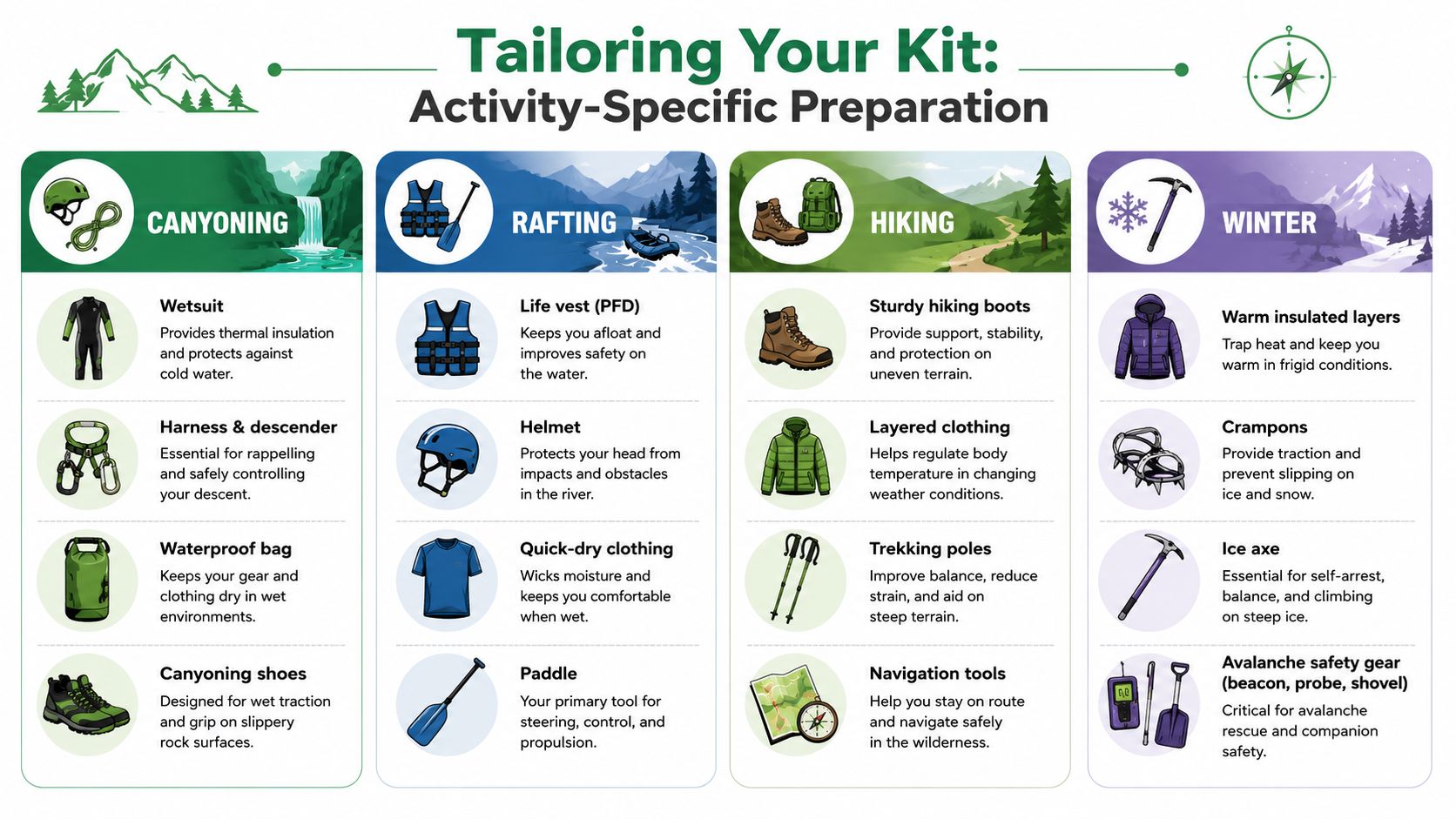
A single base kit works for many days around Bled, but it shouldn't stay identical across activities. The mountain, the river, the canyon, and the snow all punish different forms of laziness. Good preparation means adapting the system instead of pretending one setup covers everything.
Canyoning
Canyoning is where many first-timers expect the greatest risk, but guided canyoning is statistically very safe for beginners. A peer-reviewed study found an overall injury rate of 4.2 per 1000 hours of activity, with nearly half of injuries being minor soft tissue injuries, according to this canyoning safety overview. That lines up with what careful guiding, route choice, and proper equipment are meant to achieve.
For canyoning, your personal kit usually becomes smaller because the technical equipment is specialised.
- Guide-provided essentials usually include wetsuit, helmet, canyoning harness, ropes, and descent systems.
- Your useful additions are compact. A towel for after the trip, dry clothes, any personal medication protected from water, and perhaps a small dry bag depending on the format of the outing.
If canyoning around Bled is on your shortlist, it helps to know what a guided day looks like before you pack for it. A look at canyoning near Bled gives that context.
Rafting and kayaking
Water changes priorities fast. On a raft or sit-on-top kayak, flotation and communication matter more than ferrata hardware.
A simple comparison works well here:
| Item | Rafting and kayaking priority | Notes |
|---|---|---|
| PFD | Essential | Must fit properly and stay secured |
| Helmet | Essential | Especially in moving water and rocky channels |
| Whistle | Highly useful | Should be accessible, not buried |
| Quick-dry clothing | Better than cotton | Keeps comfort and reduces chilling |
For guides, there are additional tools and rescue responsibilities. For guests, the most important habit is to wear provided equipment properly and avoid “comfort adjustments” that reduce security.
Hiking
Hiking has the widest range. A lakeside walk and a full mountain day may both be called hiking by visitors, but they don't need the same kit.
For alpine hiking near Bled and in Triglav National Park, I'd prioritise:
- Navigation tools you can use
- Extra insulating layer even in fair weather
- A fuller first-aid pouch than you'd carry on a short tourist walk
- Food and water beyond the optimistic minimum
Hiking is where self-sufficiency shows most clearly. There may be no guide, no ropes, and no group equipment to smooth over a poor decision.
If the day depends on stable weather, easy footing, and a perfect pace, the kit is too light or the plan is too optimistic.
Winter terrain
Winter doesn't just add cold. It changes consequences. Wet gloves become a problem. A delayed descent becomes a heat-loss issue. Hard snow turns a slip into a much bigger event than the same stumble on summer dirt.
Your winter version of the kit may include:
- Warm layered clothing and spare dry gloves
- Traction tools such as crampons when terrain demands them
- Ice axe in appropriate mountain terrain
- Avalanche transceiver, shovel, and probe for backcountry travel
The main trade-off in winter is between speed and security. People often strip weight to move faster, then lose far more time dealing with cold, transitions, or uncertain footing. A winter kit should look slightly conservative. That's usually the right choice.
Maintaining Your Gear for Lasting Safety and Performance
You finish a wet day above Bled, throw the kit in the boot, and tell yourself you will sort it out tomorrow. That small decision causes a lot of avoidable gear problems. Grit sits in the carabiners, damp stays in the textile parts, labels fade, and the next inspection starts with guesswork instead of confidence.
Good maintenance is part of safe movement in the mountains. It is not admin. A komplet za samovarovanje only does its job if its condition is known, its history is clear, and its worn parts are caught before they become dangerous.
In Slovenia, PPE used for safety is subject to formal inspection requirements, and self-belay equipment should be checked at regular intervals by a competent person, with retirement based on manufacturer guidance, age, condition, and use history, as noted earlier in the article. In practice, that means two things for visitors around Bled. Keep the product information readable, and never rely on gear with an unknown past.
A simple inspection routine
Use the same order every time. Consistency helps you notice change.
- Check webbing and stitched sections first. Look for cuts, fraying, glazing, stiff patches, abrasion, or unusual fading.
- Inspect the energy absorber pouch. If it is damaged, distorted, opened, or shows any sign of deployment, stop using the set until it has been properly assessed.
- Test each carabiner on its own. The gate should close cleanly and completely. Auto-locking parts should move as they were designed to, without sticking or hesitation.
- Examine metal contact points closely. Sharp edges, corrosion, grooves, and deformation matter because they damage rope, webbing, and confidence.
- Read the markings and label. If the manufacture date, model, or instructions are no longer legible, that is a real limitation, not a cosmetic issue.
Before heading into the hills, I also pair that check with the latest Bled mountain weather forecast. Rain, heat, and repeated scraping on limestone all change what the kit will deal with during the day.
Cleaning, drying, and storage
Cleaning should be simple enough that you do it after every proper outing.
- Rinse off dirt with clean water after muddy, dusty, or wet use.
- Let the gear dry naturally in shade or in a well-ventilated room.
- Keep it away from radiators, direct sun, and hot car interiors.
- Store textiles so they are not crushed under hardware or sharp tools.
- Retire any item with doubtful history instead of keeping it as a backup.
Water-based adventures are especially hard on equipment. The UIAA canyoning harness safety alert highlights how water, heat, and abrasion speed up wear, and that lesson carries across to any textile safety gear used around rivers, canyons, or wet approaches near Bled.
Well-kept gear is usually unremarkable. The gates work cleanly. The webbing stays supple. The label is readable. Nothing feels uncertain in your hands, and that is exactly the standard to aim for.
Your Adventure Begins with Confident Preparation
By the time a komplet za samovarovanje reaches the mountain, the important choices should already be done. The set should be appropriate, correctly attached, compatible with the activity, and in good condition. That's what turns safety gear from luggage into a working system.
Adventure around Bled is at its best when you can give your attention to the experience itself. The line of a ridge. The temperature of canyon water. The strange silence of fresh snow. The colour of the lake when the clouds break. Preparation doesn't reduce any of that. It protects it.
For independent mountain days, that means carrying responsibility with you. For guided activities, it means choosing people who take equipment, instruction, and route management seriously. On canyoning and rafting trips, professionally maintained technical gear removes a huge amount of uncertainty for first-timers and families. That peace of mind is part of the experience.
Good preparation gives you freedom. It lets you say yes to the day for the right reasons, not because you underestimated it. That's the value of learning your kit properly. You move with more confidence, make better decisions, and leave the mountain with the kind of memories you came for.
If you'd like the adventure without the stress of sorting every technical detail yourself, explore Outdoor Slovenia Activities for guided canyoning, rafting, kayaking, hiking, and winter experiences based around Lake Bled and Slovenia's most beautiful mountain scenery.