
You're in Bled with the family. You've walked the lake, taken the photos, maybe rung the church bell, and now the children still have energy to burn. The parents want something memorable, not something forced. The children want movement, challenge, and a story to tell afterwards.
That's usually the moment families start looking beyond the standard sightseeing list. In this part of Slovenia, that makes sense. The terrain itself keeps inviting you to do more. Forest paths turn into viewpoints, limestone walls rise above valleys, and mountain trails seem built for curious young legs and hands.
That's where Plezanje za otroke makes sense. Not as an extreme sport, and not as a test of bravery, but as a family activity that mixes play, movement, problem-solving, and just enough adventure to feel special. For many children, climbing feels less like “sport” and more like a game with a clear reward. Reach the next hold. Trust your feet. Try again. Smile at the top.
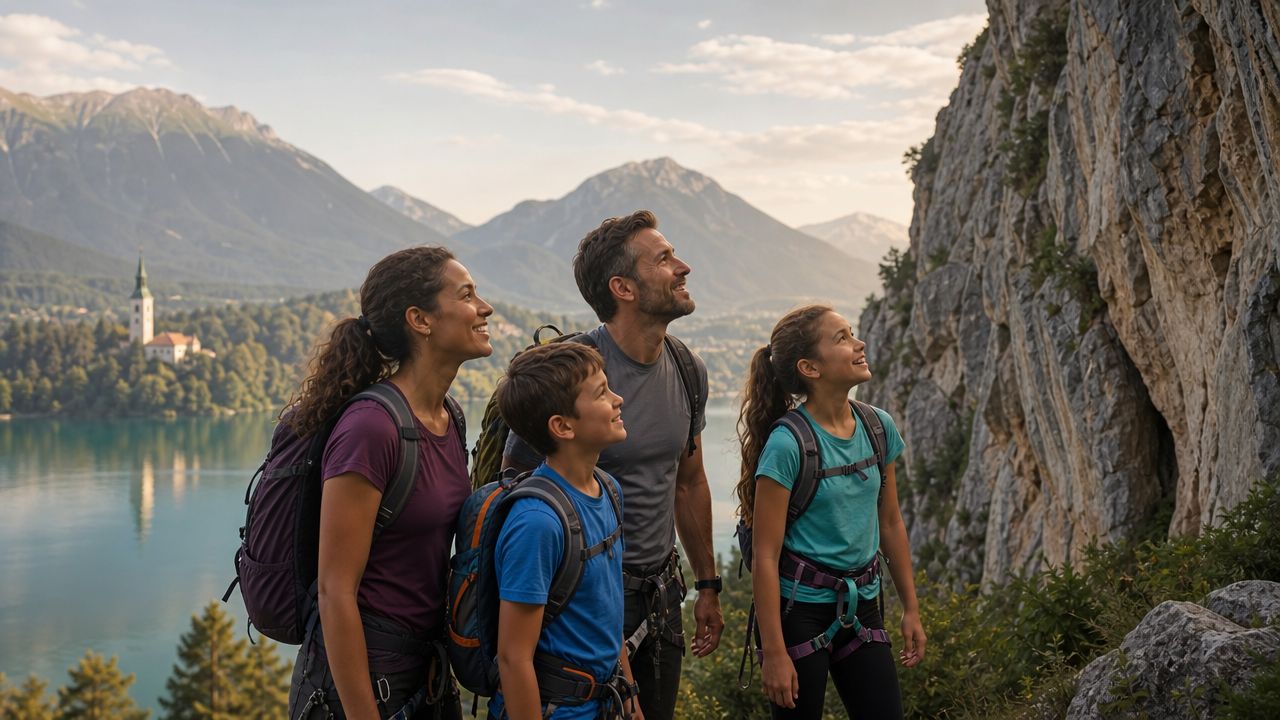
Families often arrive thinking climbing is only for fearless teenagers or highly trained adults. In practice, the best child-friendly sessions look very different. They're structured, patient, safety-focused, and adapted to the child in front of the guide. If you're already collecting ideas for active family days, this round-up of Hiccapop outdoor activity ideas is also a useful companion for planning a trip with younger children.
Table of Contents
- Your Family's Next Great Adventure in Slovenia
- Why Climbing Is a Superpower for Kids
- When Can Kids Start Climbing? An Age and Readiness Guide
- Choosing Your Family's Climbing Adventure
- What to Expect from a Guided Climbing Session
- Our Favourite Family Climbing Spots Near Bled and Triglav
- Your Family Climbing Checklist and FAQs
Your Family's Next Great Adventure in Slovenia
A good family adventure has to work on two levels. It needs to feel exciting to a child, and manageable to a parent. Climbing does that unusually well. Children get the thrill of going up, choosing holds, and using their whole body. Parents get structure, supervision, clear equipment, and a pace that can be adapted.
Around Lake Bled and the edge of Triglav National Park, climbing also has an advantage over many other activities. It fits different energy levels. Some families want a short introduction that leaves time for swimming, cake, and an afternoon stroll. Others want a half-day challenge that becomes the highlight of the trip.
It feels adventurous without needing to feel reckless
The word climbing can worry parents before they've seen how a proper family session runs. That's understandable. But family-friendly climbing isn't organised around pressure, speed, or showing off. It's organised around simple movement, trust in the system, and a guide who reads the group well.
Children don't need to be bold from the first minute. Many of the happiest young climbers start cautiously. They touch the wall, test one foothold, come down, laugh, and then go again with much more confidence.
Practical rule: The best first climbing day ends with a child saying, “Can I do one more route?” Not with a child who feels pushed.
Slovenia is built for this kind of family day
This is one of the reasons climbing fits so naturally here. Slovenia gives families both controlled spaces and dramatic natural settings. You can start indoors on a rainy day, move to real rock when the child is ready, or choose a route that combines hiking and protected movement for older children.
For families staying near Bled, that flexibility matters. Weather changes. Energy changes. Children surprise you. A good plan leaves room for all three.
Here's what tends to work best for visiting families:
- For younger children: Short sessions, playful tasks, lots of praise, and easy success early on.
- For school-age children: Clear progression, simple challenges, and enough independence to make choices.
- For teenagers: More height, more exposure, and activities that feel like a real mountain adventure.
- For mixed-age families: Routes and formats where one child can climb while another watches, rests, or joins in gradually.
The biggest shift for most parents is realising that climbing isn't one thing. It can be an indoor taster, a morning on easy rock, or a scenic family outing with helmets, cables, and views of the Julian Alps. That range is exactly why it works so well here.
Why Climbing Is a Superpower for Kids
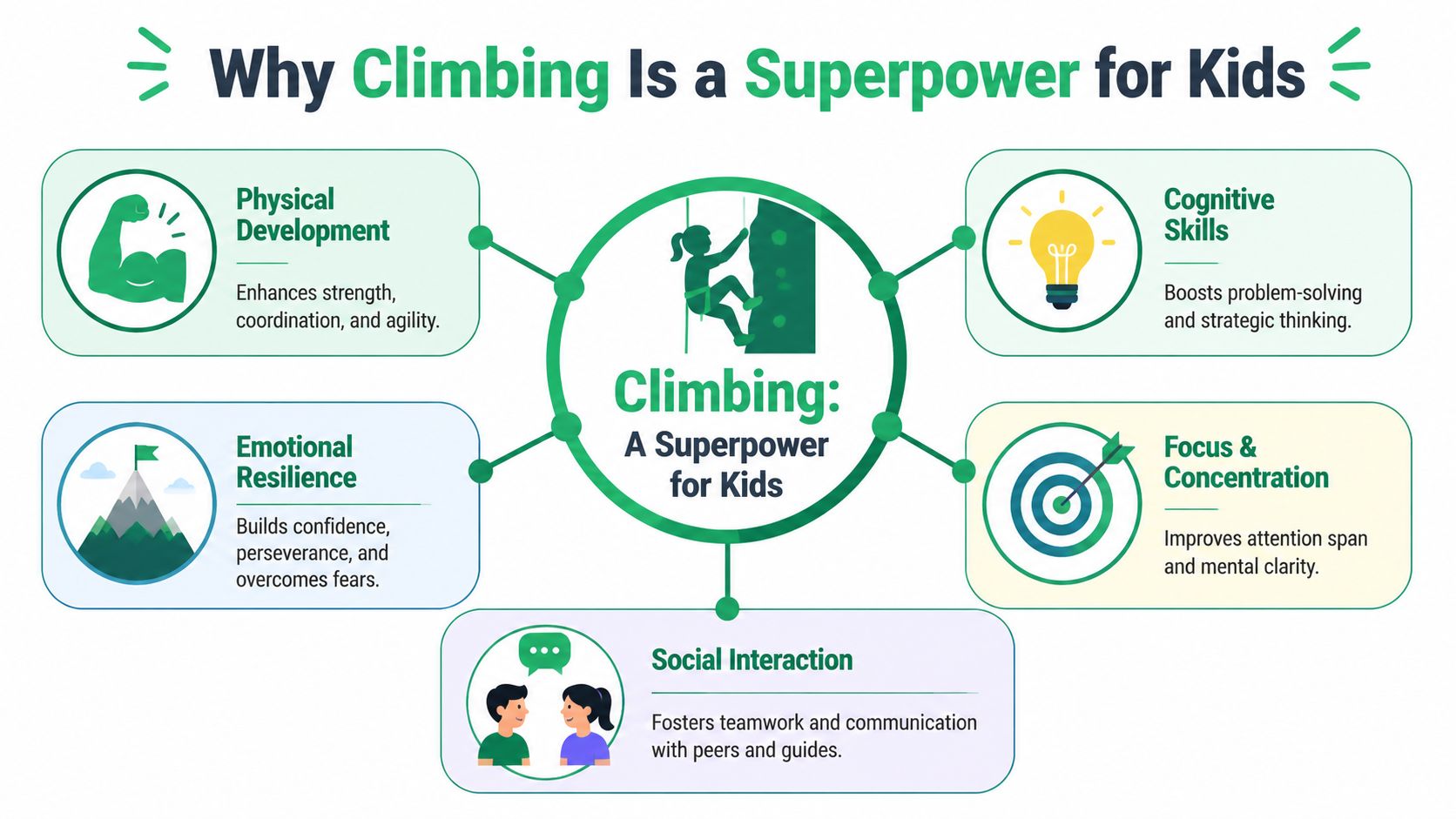
Climbing gives children a puzzle they solve with both body and mind. That's why it holds attention so well. A route asks a child to notice shape, balance, timing, and sequence. Which hand first? Where does the foot go? Can I stand higher before I pull?
Climbing works on the body and the brain
A Slovenian master's thesis on children's sport climbing reports measurable training effects on arm strength, shoulder-girdle strength, trunk strength, coordination, precision, and trunk mobility in child climbers, which is one reason youth climbing programmes are taken seriously in Slovenia's coaching environment (University of Ljubljana repository).
That list matters because it matches what guides and coaches see in practice. Good climbing asks children to push with the legs, stabilise through the core, stay coordinated under small changes in body position, and make precise hand and foot placements. It's not random scrambling. It's controlled movement.
A lot of parents expect climbing to be mainly about upper-body strength. For children, that's usually the wrong starting point. The children who move best are often the ones who learn to trust their feet, shift weight calmly, and stay balanced.
It also builds the kind of confidence parents notice at home
Climbing is honest. A route doesn't move closer because a child gets frustrated. They pause, think, test another option, and try again. That process is valuable well beyond the wall.
Children often get three non-physical benefits from climbing:
- Decision-making: They have to choose a sequence instead of following a fixed script.
- Focus: The wall gives immediate feedback, so attention tends to sharpen naturally.
- Emotional resilience: Coming down and trying again becomes normal, not a failure.
Children rarely describe this as “building resilience”. They describe it as “I nearly did it, then I got it on the next try.” That's exactly the point.
There's also a social side parents sometimes underestimate. Climbing encourages communication. Children listen to guides, watch other climbers, wait their turn, and celebrate each other's progress. That's one reason many families who want broader context on active childhood habits also like to explore youth sports development alongside specific activities.
What doesn't work is treating climbing like a performance test. If adults focus too much on height reached, speed, or who did better, children tighten up. What works is a calm atmosphere where progress counts, stopping is allowed, and curiosity stays at the centre.
When Can Kids Start Climbing? An Age and Readiness Guide
This is the question parents ask first, and the honest answer is that there isn't one magic birthday. Children don't all arrive at climbing readiness in the same way. Some are keen, coordinated, and happy to follow instructions very early. Others need more time, or a more playful entry point.
What local programmes tell us
In Slovenia, organised children's climbing clearly starts young. Plezalni center Ljubljana places children into age-based groups beginning at 3–4 years with Mini plezalne igre, followed by 4–6 years, 6–9 years, and later older youth pathways, with enrolment organised in quarterly cycles (Plezalni center Ljubljana programme guide).
That tells parents something important. In Slovenia, child climbing isn't treated as a niche activity for older, highly sporty kids. It's structured from preschool age onward, and the youngest groups are framed in a playful way rather than as serious training.
The useful lesson isn't “start as early as possible”. The useful lesson is that format matters. A games-based class for a preschooler is a different thing from a structured climbing session for an older child.
Readiness matters more than the birthday
When parents ask whether a child is ready, these signs are more useful than age alone:
- They can listen for short bursts: A child doesn't need perfect concentration, but they do need to stop when asked and take in simple safety instructions.
- They enjoy physical play: Climbing suits children who like jumping, balancing, scrambling, hanging, or exploring playground structures.
- They can cope with small frustrations: Every child gets stuck sometimes. Readiness shows up in how they respond.
- They show interest: If a child wants to touch the holds, ask questions, or watch others climb, that's a strong starting point.
- They're comfortable with equipment: A harness and helmet shouldn't feel overwhelming.
A shy child can still be ready. A bold child can still be not ready. Temperament and readiness aren't the same thing.
For very young children, the best first experience is usually short and playful. Think climbing games, easy movement, and plenty of time on the ground between attempts. For primary school children, a more structured introduction often works well because they can follow sequences and understand basic technique. Teenagers usually want a stronger sense of challenge and progress.
Parents often make one mistake at this stage. They choose based on what sounds exciting to them, not on what will help the child enjoy the first session. If a child's confidence is still developing, an easy wall with lots of early wins will often beat a dramatic outdoor setting. If the child already loves heights and movement, a bigger step can be a better fit.
The goal isn't to produce a tiny climber. It's to give the child a good first relationship with climbing.
Choosing Your Family's Climbing Adventure
Not every climbing experience feels the same. Some families need a gentle first taste. Others want the outdoors straight away. Some have teenagers who don't want a children's activity at all. In Slovenia, you can usually choose between three practical directions.
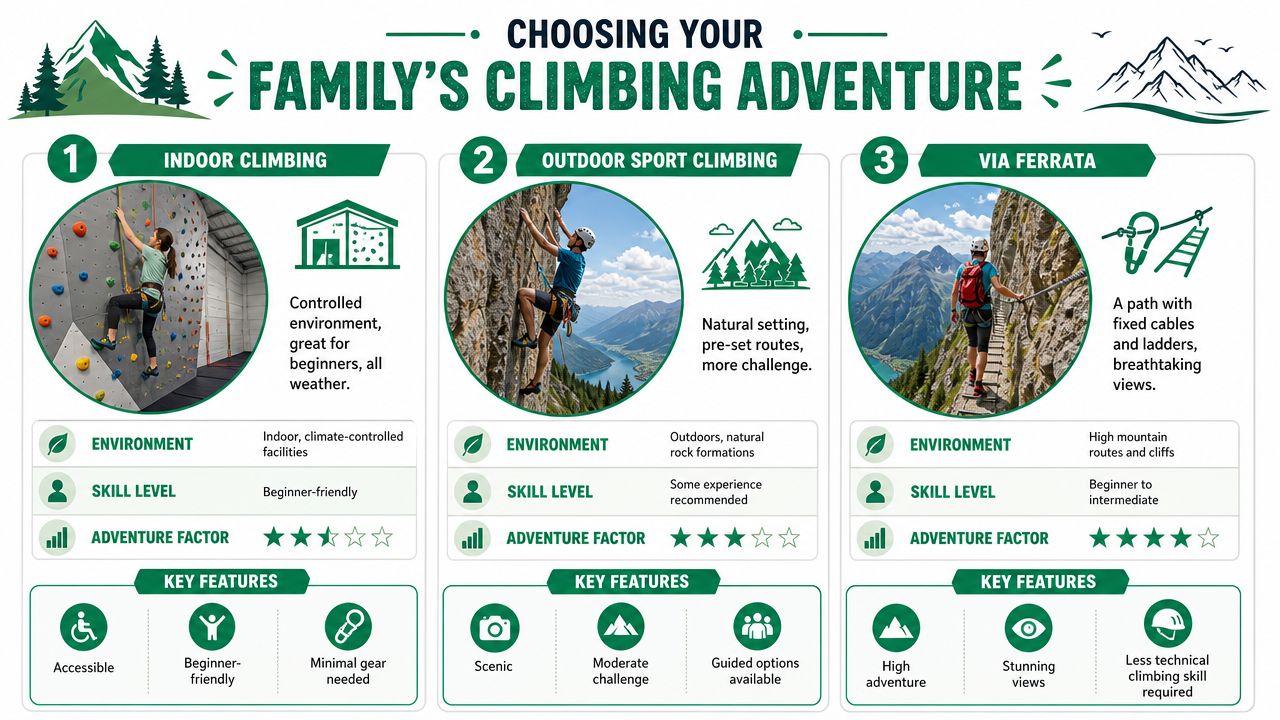
Indoor walls
Indoor climbing is the simplest place to begin. The environment is controlled, the holds are obvious, and weather doesn't interfere. For younger children or cautious first-timers, that predictability helps a lot.
Indoor sessions work especially well when you want to answer one question: does my child enjoy climbing enough to want more?
Best fit:
- New climbers: Low-pressure first contact with climbing movement.
- Rainy days: Easy logistics when the weather turns.
- Children who need routine: Fewer variables than outdoor rock.
Outdoor rock climbing
Outdoor climbing changes the atmosphere immediately. The rock has texture, the setting feels wild, and the child starts to experience movement as part of the natural surroundings rather than as a gym activity. For many families, this is the memorable version.
It also asks a bit more from everyone. Terrain underfoot may be uneven. Attention has to widen beyond the route itself. Good route choice matters. For families who enjoy nature and want a climbing day that feels distinctly Slovenian, this is often the sweet spot.
A simple comparison helps:
| Experience | Environment | Best for | Main trade-off |
|---|---|---|---|
| Indoor climbing | Predictable and controlled | First sessions, younger children | Less of the mountain atmosphere |
| Outdoor sport climbing | Natural rock and scenic setting | Families wanting a real outdoor adventure | More variables to manage |
| Via ferrata | Mountain route with fixed protection | Older children and teens | More exposure and bigger commitment |
Families who want a climbing-style challenge in a park setting may also enjoy the Bled adventure park experience, which can suit children who like height and movement but aren't ready for rock.
Via ferrata
Via ferrata sits somewhere between hiking and climbing. You move through mountain terrain using fixed cables, steps, and other protection. It feels big, scenic, and dramatic. It can be a brilliant family adventure for older children and teenagers who want altitude and mountain views more than climbing technique.
What doesn't work is choosing via ferrata solely because it sounds exciting. Exposure feels very different from a short climbing route. If a child freezes on ladders, dislikes steep drop-offs, or struggles with sustained focus, it may be better later.
The right choice isn't the most adventurous option on paper. It's the one your family will still be smiling about over dinner.
What to Expect from a Guided Climbing Session
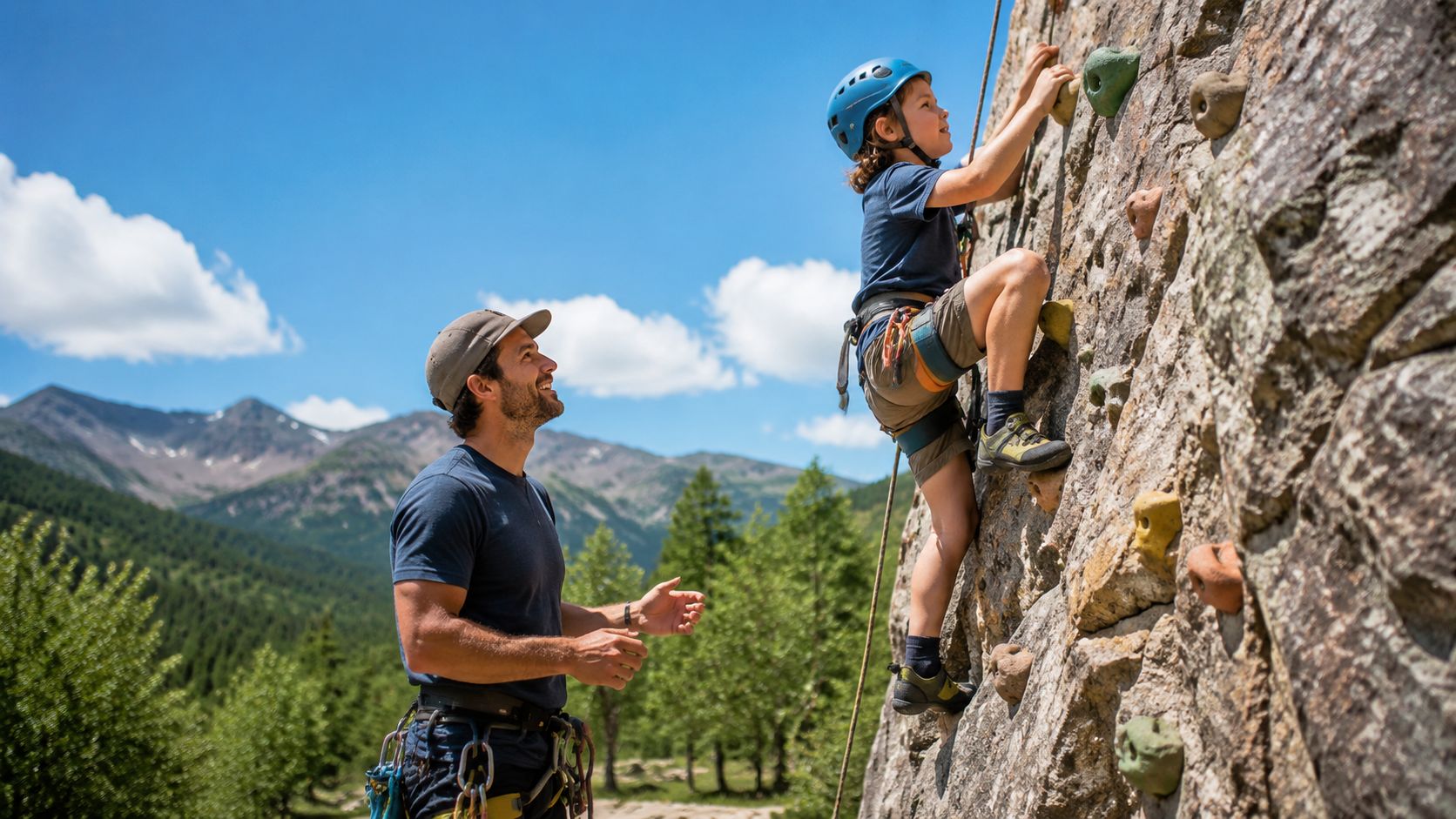
A guided family session should feel calm from the first few minutes. The best ones don't rush children into the wall. They slow the start down, create familiarity, and let the child understand what's happening before the first climb begins.
From meeting point to first climb
Most good sessions begin with a simple welcome, a quick check of everyone's mood and experience, and proper fitting of equipment. Harnesses need to sit correctly. Helmets need to be comfortable. Children usually relax once they've touched the gear and seen that everything is explained clearly.
Then comes the safety briefing. For adults, this is about systems and trust. For children, it needs to be short, concrete, and memorable. A guide might focus on a few key rules such as where to stand, when to listen, and how to move one step at a time.
The first route should never be the hardest. A smart guide gives a child an early success. That first climb might be short, easy, and almost playful, but it sets the tone for the whole session.
What good guides do differently
A family guide isn't only there to manage ropes. They manage energy. They notice when a child is excited, distracted, tired, or intimidated. They change the route, the pace, or the language before a small wobble becomes a big problem.
That usually looks like this:
- They give one instruction at a time: Children climb better with clear, short cues.
- They coach feet, not just hands: Most beginners pull too much and forget to stand up through the legs.
- They normalise coming down: Stopping is part of learning, not a failure.
- They involve the family: Parents often help most by staying encouraging and letting the guide lead.
A strong session usually has a rhythm. Climb, rest, watch, laugh, try again. For younger children, games and small challenges keep the mood light. For older children, guides often add a little more technique, route choice, or independence.
Good family climbing feels organised, but not stiff. Children need structure, and they also need room to enjoy themselves.
By the end, the goal isn't exhaustion. It's that satisfying mix of effort, pride, and fresh air that makes the ride back to Bled pleasantly quiet.
Our Favourite Family Climbing Spots Near Bled and Triglav
The best family climbing locations aren't always the most famous ones. For children, the right place is usually the one with a short approach, a friendly atmosphere, and rock or terrain that rewards effort quickly. Around Bled and the wider Triglav area, that creates a few very different kinds of day.
A sunny first step above the valley
For first-timers, we prefer spots where the approach is easy and the setting feels open rather than intimidating. A child shouldn't spend all their energy on the walk in. They should arrive curious, not already tired.
The ideal beginner crag has room to sit, a clear base area, and routes that let children understand the movement. Parents often imagine that dramatic cliffs make the day memorable. For younger climbers, a sunny wall with easy starts does the job much better.
This kind of outing suits families who want:
- A half-day activity: Enough adventure without taking over the full holiday schedule.
- A first outdoor climbing memory: Real rock, but in a gentle format.
- A flexible pace: Time for breaks, photos, snacks, and repeat attempts.
A bigger mountain day for adventurous families
Some families don't want a taster. They want a proper day in the natural surroundings. In the Triglav National Park area, that can mean combining a scenic drive, a short mountain approach, and a climbing session in a setting that feels far from the busy lakeshore.
These are the days children remember for the whole package. The smell of pine forest. The cold stream nearby. The sense that the family has gone somewhere special, not just joined an activity slot.
What works best here is honesty about stamina. A child may love climbing but dislike long approaches, heat, or waiting around. If you choose a bigger day, choose one where the mountain setting adds joy rather than friction.
A ferrata day with serious scenery
For older children and teens, the Upper Sava Valley and nearby mountain areas offer a different flavour of adventure. A via ferrata day replaces repeated short climbs with continuous movement through a protected route. It often feels more like a mission than a lesson.
One standout option in the wider area is the Jerm'n via ferrata route, which gives a sense of the dramatic terrain families come to this region for. This kind of outing is usually best for confident older children, active teenagers, and parents who want a shared challenge rather than a child-only activity.
The trade-off is simple. Ferrata gives you scenery, exposure, and a strong mountain feeling. In return, it asks for steadier focus and a bit more commitment from the whole family.
A practical way to choose between local options is this:
| Family type | Best match near Bled and Triglav |
|---|---|
| Young child trying climbing for the first time | Easy crag or indoor wall |
| School-age child who enjoys movement and nature | Outdoor rock session with short approach |
| Teenager wanting a bigger challenge | Via ferrata or longer mountain-based outing |
Families are often happiest when they choose the day that matches their child now, not the activity they hope their child will grow into by the end of the holiday.
Your Family Climbing Checklist and FAQs
A little preparation makes family climbing much smoother. Most of the stress parents feel before a first session comes from not knowing what they need to bring, or what happens if the child gets nervous. In practice, the basics are simple.
What to pack
Bring clothing your child can move in easily. Think sporty layers rather than anything stiff or bulky. Closed shoes are the safe default unless specific climbing footwear is provided on site.
A practical packing list usually includes:
- Comfortable clothes: Leggings, joggers, shorts, or light outdoor trousers work well.
- Water and a snack: Children climb better when they're not tired or thirsty.
- Sun protection: Hat, sun cream, and sunglasses for the time before and after climbing.
- A light extra layer: Mountain areas can feel cooler than the lakeshore.
- Any personal essentials: Hair ties, plasters, or medication if needed.
If you like having a broader family packing reference for active days out, this guide to essential gear for family adventures is a handy extra checklist.
For technical protection, a proper via ferrata set or climbing gear should always be activity-specific and correctly fitted rather than improvised.
Questions parents ask most often
Is it safe for my child?
It's safe when the activity matches the child, the terrain matches the plan, and qualified guides use proper equipment and clear supervision. The biggest safety factor is good judgement, not bravado.
What if my child is afraid of heights?
That doesn't automatically rule climbing out. Many children are fine once they start low, move gradually, and feel supported. The key is not forcing the pace.
Do I have to climb too?
Not always. Some family days work well with children climbing and parents watching, encouraging, and taking photos. Other outings, especially ferrata-style ones, are more enjoyable when the family participates together.
The best first session is rarely the most dramatic one. It's the one that leaves your child wanting to come back.
If your family is ready for an active day in the Bled area, Outdoor Slovenia Activities offers guided adventures across some of the country's most beautiful natural settings, with a safety-first approach and beginner-friendly options for families who want to experience Slovenia beyond the usual sightseeing.