
The pilot clipped the final buckle, looked at the windsock, and said, “When I say run, just walk with purpose.” A few steps later the hillside dropped away, Lake Bled opened beneath us, and the strange thing wasn't fear. It was how calm the world suddenly felt.
That's the magic of a polet z jadralnim padalom around Bled. It feels wild from the ground and surprisingly natural once you're in the air.
Table of Contents
- The Closest You Will Get to Flying Like a Bird
- What Exactly Is a Tandem Paragliding Flight
- Why Lake Bled Is a World-Class Paragliding Destination
- Your Paragliding Adventure from Start to Finish
- Our Uncompromising Commitment to Your Safety
- Planning Your Flight with Outdoor Slovenia
- Frequently Asked Questions About Paragliding
The Closest You Will Get to Flying Like a Bird
The first surprise is the silence.
You expect rushing wind and a stomach-drop, something closer to a theme park ride. Instead, after take-off, the wing settles above you and the flight becomes smooth, suspended, almost peaceful. The island church on Lake Bled no longer looks like a landmark on a postcard. It looks tiny and perfect, floating in green-blue water, with the castle perched on its cliff like it was built for this exact view.
For a first-timer, that shift is unforgettable. One moment you're standing on a mountain slope checking your helmet strap. The next you're sitting comfortably in the harness, legs free, watching forested ridges fold into one another toward the Julian Alps. People often arrive tense, shoulders raised, asking if they'll need to jump. Then they laugh once they realise it's a gentle launch and not a leap into empty space.
The feeling people remember most
It's rarely the adrenaline.
It's the odd, beautiful calm of being carried. You notice details you'd miss from a road or hiking trail. The changing colour of the lake. The neat geometry of fields farther out. Tiny movement on paths below. Even the light feels different when you're gliding through it instead of looking up at it.
Local insight: The best tandem flights don't feel rushed. They feel unhurried, like the mountain has agreed to lend you a little time in the air.
That's why so many visitors who come to Bled for one iconic experience end up choosing the sky. Some compare it with a balloon ride, and if you're curious about that softer, drifting perspective, it's worth looking at hot air ballooning over Slovenia. Paragliding is different. It's more personal, more connected to the slope, the breeze, and the pilot's judgement in the moment.
More wonder, less intimidation
A good flight doesn't make you feel brave. It makes you feel looked after.
That matters, especially if this is your first real airborne adventure. The whole experience can be thrilling without feeling chaotic, dramatic without feeling reckless. Done well, a polet z jadralnim padalom above Bled becomes one of those travel memories that stays unusually sharp. You remember the take-off steps, the first wide turn, and the exact moment your nerves gave way to awe.
What Exactly Is a Tandem Paragliding Flight
A tandem paragliding flight is not a jump.
That's the biggest misunderstanding beginners bring with them. You don't stand on an edge and throw yourself into space. You and the pilot start on a suitable slope, the wing inflates overhead, and then you move forward until the glider lifts you cleanly from the ground. It feels much closer to being carried upward by a giant, steerable kite than to doing anything extreme.
How it works in simple terms
The paraglider wing is a fabric canopy designed to catch and use air efficiently. The passenger sits in a secure harness attached to the pilot, who sits behind and handles the controls, the route, and the landing.
From the passenger's side, the job is refreshingly simple:
- Listen to the briefing: The pilot explains take-off posture, where to place your hands, and when to start moving.
- Run or walk as instructed: Usually it's a few committed steps, not a dramatic sprint.
- Sit back when told: Once airborne, you settle into the harness and enjoy the flight.
- Follow landing instructions: At the end, the pilot tells you exactly when to lift your legs or take a step.
What the pilot does and what you do
People often worry they'll need special skills. You won't.
The pilot reads the air, keeps the wing pressurised, steers, chooses the line, and manages the landing approach. Your role is to cooperate during take-off and landing, then take in the scenery in between. If conditions are suitable and the pilot offers it, you may even get a brief feel for the controls, but the flight remains under the pilot's command.
A tandem flight should feel clear from the first minute. If the instructions are simple on the ground, the whole experience becomes easier in the air.
Who usually enjoys it most
It isn't only for adrenaline travellers. Some of the happiest passengers are people who never saw themselves doing “air sports” at all.
A couple celebrating an anniversary. A parent travelling with older children. A hiker who has already seen Bled from trails and wants one completely different angle. What they tend to share is curiosity, not bravado. That's why tandem paragliding works so well as a first flying experience. It strips away the technical burden and keeps the best part: the sensation of free, quiet movement above one of Slovenia's most memorable views.
Why Lake Bled Is a World-Class Paragliding Destination
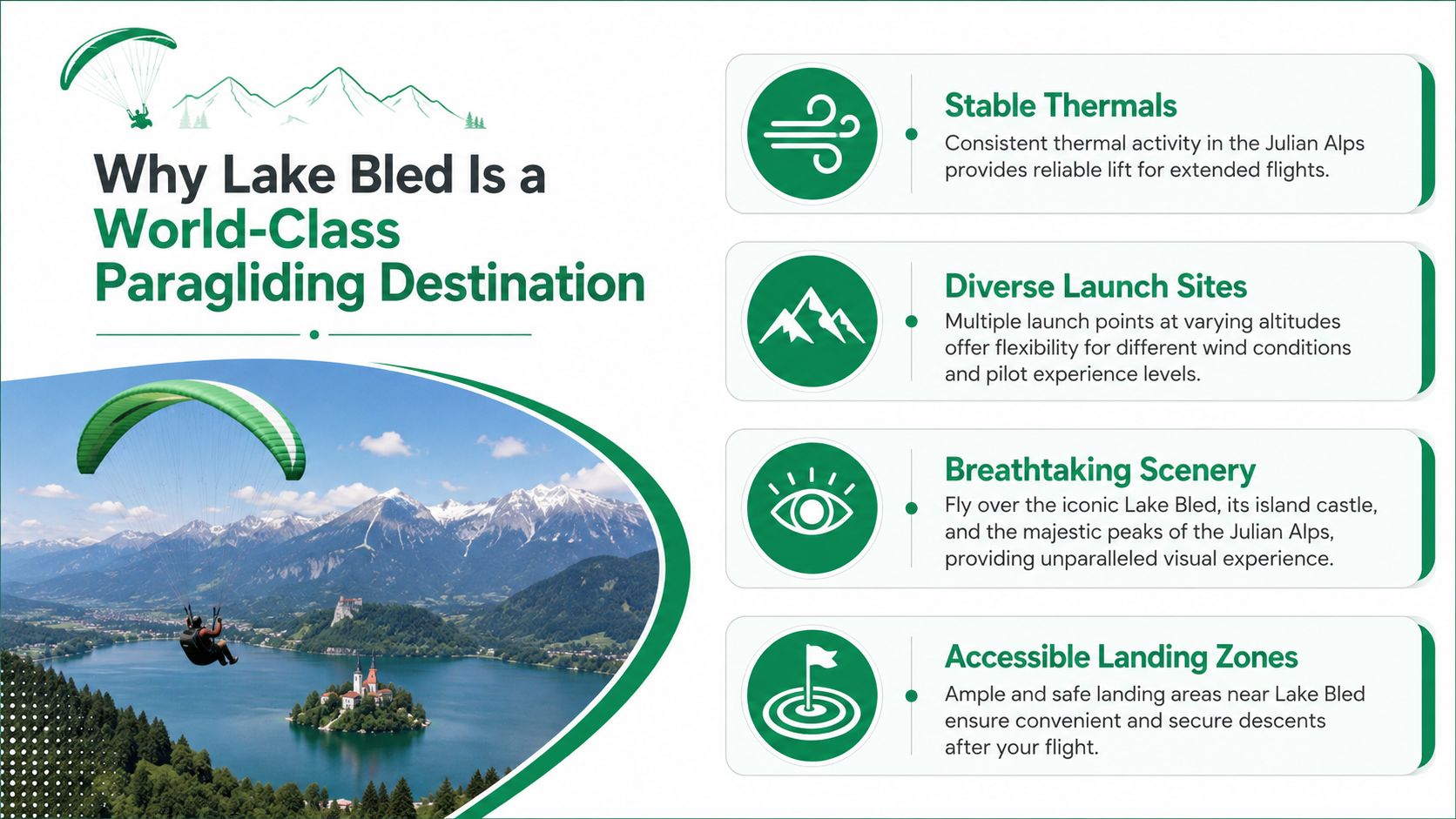
Bled has a rare advantage. It looks spectacular from the ground, and it becomes even more dramatic from the air.
From above, the lake's shape sharpens, the island becomes the centre of the scene, and the surrounding mountains stop being a backdrop and start feeling like the architecture of the whole experience. You're not just looking at a pretty lake. You're flying through a compact alpine setting where water, cliffs, forest, and distant peaks all sit close enough together to create a view with real depth.
Beauty is only part of the story
What makes a place memorable for tandem flying isn't scenery alone. It's the combination of mountain relief, launch possibilities, and the kind of visual drama that stays with you after the flight.
Around Bled, the terrain delivers that in layers. Near the lake, you get iconic landmarks that first-time visitors instantly recognise. Farther out, the ridges and valleys of the alpine world give the flight a sense of scale. That mix makes the experience feel cinematic without becoming remote or inaccessible.
A few qualities stand out:
- Recognisable landmarks: The island, church, and castle give the flight an immediate sense of place.
- Mountain character: The surrounding alpine terrain adds grandeur and variation to the route.
- Strong visual contrast: Water, woodland, cliffs, and open sky make the panorama unusually rich.
- A clear sense of journey: Even a short flight feels like movement through a complete vista rather than a simple up-and-down ride.
Slovenia's flying heritage runs deep
Bled also benefits from being part of a country with a serious free-flight tradition. Slovenia's paragliding story reaches back to 1984, when Dare Svetina made the country's first recorded paragliding flight from Dobrča, and Slovenian accounts mark 1986 as the point when the sport became properly established locally. The same academic source notes that early gliders had a glide ratio of about 3:1, meaning roughly 3 metres forward for every 1 metre of descent, which shows how quickly the sport developed from controlled mountain descent into something much more refined in Slovenia's alpine terrain, as described in this Slovenian paragliding history source.
That history matters because it tells you something about the culture around flying here. Slovenia didn't stumble into paragliding as a passing tourist trend. It adopted it early, shaped it in mountain conditions, and built knowledge around it.
Why that matters for your flight
When you fly above Bled, you're not only buying a view. You're stepping into a place where mountains and free flight have belonged together for a long time.
That gives the experience weight. The terrain feels right for it. The local enthusiasm feels earned. And the memory tends to be stronger because everything lines up at once: the setting, the flying culture, and the strange joy of seeing one of Europe's most photogenic places from the only angle that makes it look even better.
Your Paragliding Adventure from Start to Finish
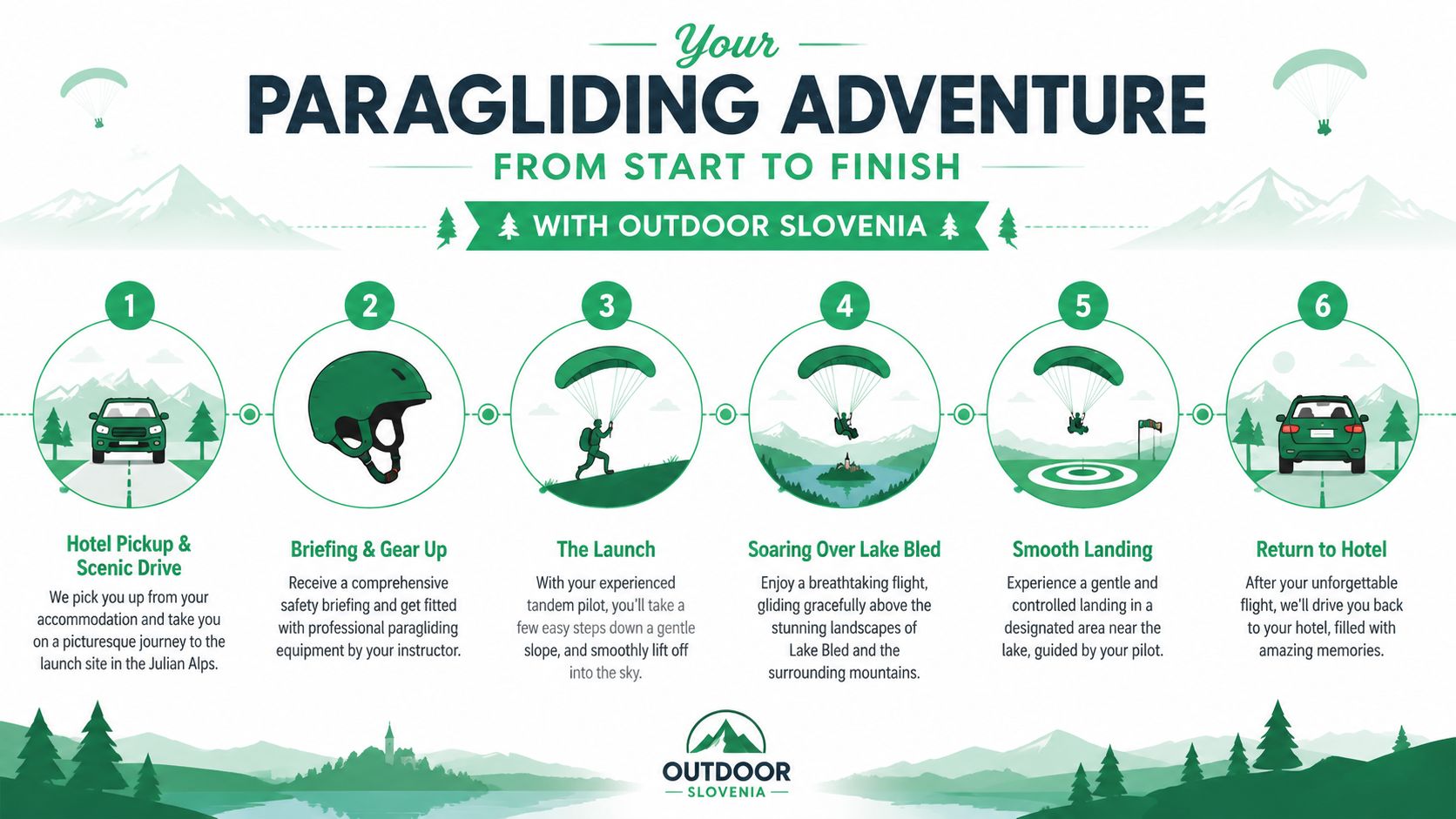
The take-off is often remembered. I think the day starts earlier, in the car, when the lake disappears behind trees and the road begins to climb.
The mood changes on that drive. Bled's cafés and promenades give way to farmhouses, forest edges, and open mountain views. By the time you reach the launch area, the experience already feels less like a tourist activity and more like a proper alpine outing.
Before take-off
At launch, there's usually a short pause while the pilot studies the conditions. That moment often reassures nervous passengers more than any speech could. You see that nothing is rushed. Wind direction matters. The wing layout matters. Timing matters.
Then the practical part begins. Helmet on. Harness checked. Carabiners secured. The pilot explains what will happen in plain language, often with a dry joke to keep things relaxed. Good briefings never sound theatrical. They sound calm and specific.
A first-time flyer's experience often follows this rhythm:
| Stage | What it feels like |
|---|---|
| Arrival at launch | Excited, slightly unsure, taking in the view |
| Gear and briefing | Reassuring, organised, easier than expected |
| Wing inflation | A sudden sense that this is really happening |
| Take-off steps | Focused, simple, surprisingly natural |
| First moments airborne | Silence, relief, then amazement |
The flight itself
Once you're off the slope, the body catches up with reality a second later. That's when people usually smile. Not politely. Fully.
You sit back into the harness and the view widens. The lake shifts below depending on your angle, sometimes shining brightly, sometimes turning deep green. Villages become neat patterns. Roads lose their noise. The pilot may point out landmarks or let the quiet do the work.
Some passengers talk the whole way. Others go completely silent. Both reactions are normal. The air has a way of reorganising your attention.
If conditions allow, the flight can include wider circling turns or a more direct glide depending on the day's character. That variety is part of what makes paragliding memorable. It never feels mass-produced. It feels shaped by the mountain and the pilot's decisions in real time.
The landing and the afterglow
Landing is gentler than most beginners expect. The approach smooths out, the ground rises toward you, and the pilot gives one or two clear instructions. Stand when told. Take a few steps if needed. Then it's over, except it isn't really over at all.
The strongest part often comes after. Your legs are back on the ground, but your mind is still up there replaying the route, the view, and the odd weightless comfort of the harness. Friends and family see your face before you say anything and know exactly how it went.
A good tandem day ends with simple pleasures:
- Photos and videos: Many people love having the flight captured, especially when the view over Bled opens wide.
- A slow return to town: The ordinary world feels pleasantly unreal for a while.
- A story worth retelling: Not because it was scary, but because it was beautiful in such a direct way.
That's the whole charm of a polet z jadralnim padalom. It fits into a single day, yet it changes the way you remember the place.
Our Uncompromising Commitment to Your Safety
One of the clearest signs of a good tandem day often comes before anyone leaves the ground. A pilot clips in, pauses, runs a hand along each line, looks at the wind, then looks again. Nothing is rushed. Guests sometimes read that calm as routine. From our side, it is attention.
What professional safety looks like
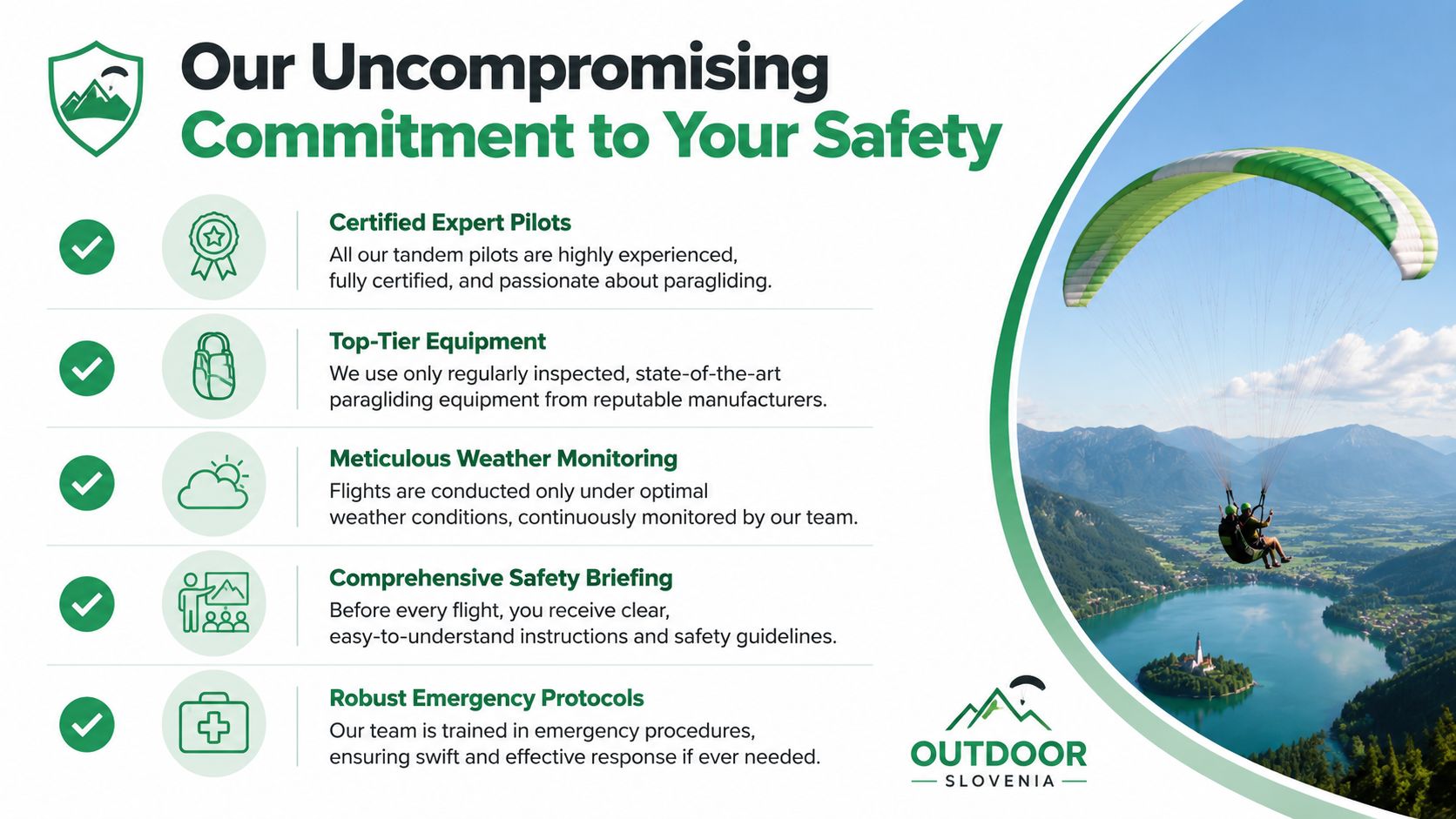
A serious tandem operation is easy to recognise once you know what to watch for. The briefing is short but precise. The equipment is handled with care, not tossed around like beach gear. Questions get direct answers.
That usually means a few things happening in the background every time:
- Qualified tandem pilots: Your pilot should hold the certifications required for passenger flights and know how mountain conditions behave across different launch sites.
- Well-maintained gear: Wings, harnesses, helmets, carabiners, and reserve parachutes need regular inspection and disciplined handling.
- Clear instructions: You should know what your job is at take-off, in the air, and during landing.
- Sound judgement: Good operators cancel flights when conditions are wrong. That decision protects the whole experience.
The best safety culture feels almost quiet. No dramatic speeches. No pressure. Just a team that checks, explains, and chooses carefully.
Weather makes the final call
This matters more in the mountains than many first-time visitors expect. Lake level can feel warm and still while the launch is getting side wind, stronger cycles, or air that is not right for a passenger flight.
That is why local knowledge matters so much. A trusted operator is not only choosing whether you can fly. They are choosing where, when, and whether waiting an hour will improve the day or end it. Sometimes the answer is a different launch site. Sometimes it is an honest cancellation, followed by a rebooking plan that saves the rest of your holiday from turning into guesswork.
Practical rule: The pilot you want is the one who explains the decision clearly, even when the decision is no.
If you want a better feel for how quickly local conditions can shift, this guide to weather patterns in Bled helps explain why flexible timing is often part of a safe flying day.
Safety starts with the passenger too
Your role is simple, but it matters. Wear proper shoes. Dress for cooler air than you expect. Mention any health concerns early, not at the launch. Then listen closely when the pilot explains take-off and landing.
Solo travellers often ask an extra question. How do I judge whether an activity feels professionally run in a place I do not know yet? The Travel Talk Today safety guide gives useful general advice for staying organised and alert while travelling, and that mindset carries over well to outdoor adventures.
Real confidence in paragliding does not come from pretending there is no risk. It comes from seeing how carefully the day is managed, from the first weather check to the final landing field. That is what lets the flight feel light, beautiful, and fully under control.
Planning Your Flight with Outdoor Slovenia
At 8:30 in the morning, Bled can look perfect from the lakeside. The island is still, the castle sits in clean light, and a first-time flyer often assumes that means an easy take-off is guaranteed. An hour later, up on the mountain, the decision may be different. A good flying day starts there. With honest planning, clear timing, and a local team that knows which launch suits the conditions and which one does not.
Who can usually fly
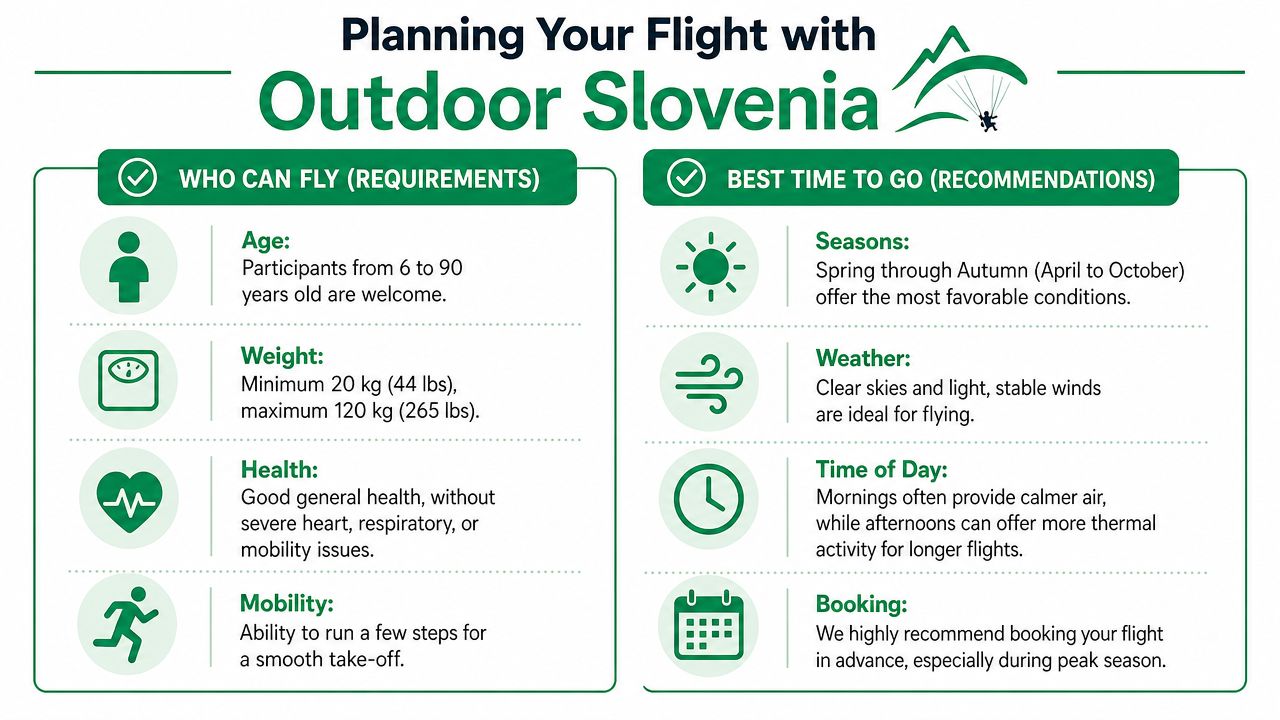
A tandem flight surprises many visitors because it asks for less athletic ability than they expected. You do not need experience, technical knowledge, or a climber's fitness. You need to feel steady on your feet, listen well, and manage a short, purposeful take-off run.
The easiest way to judge whether a flight is right for you is to picture the two active moments of the day. You walk a little at launch. You take a few steps again at landing. Everything in between is the reward.
A few simple checks help:
- General health: You should feel well enough for a light outdoor activity and free of medical issues that could make launch or landing unsafe.
- Mobility: You need to move confidently on uneven ground and on a slope.
- Clothing readiness: Closed shoes and sensible layers matter more than sports performance.
- Comfort level: You do not need to love heights. You do need to trust the pilot's instructions.
If you are unsure, ask before you book. The best operators answer plainly and would rather clarify early than sort out problems at the launch field.
Timing matters more than people expect
Visitors often plan paragliding like a museum ticket. Pick an hour, arrive, fly. Mountain flying rarely works like that.
One family might book a late-morning slot and end up flying in the afternoon because the air settles later than expected. Another couple might be driven to a different take-off than they had pictured because it offers a better window that day. Those changes are not signs of chaos. They are signs that someone is paying attention.
That local judgement matters in Slovenia's alpine terrain. Around Bled, conditions can vary between valley and mountain much faster than first-time visitors expect. The best launch for you depends on the weather, your comfort level, and what kind of flight you want from the day. Some passengers want the calmest possible first experience. Others are happy with a longer mountain outing if the conditions support it.
If your holiday schedule is tight, give yourself a date range rather than a single fixed hour. That one choice makes the whole experience easier.
What to wear and bring
Dress for a mountain morning, even if the lake feels warm when you leave town. Air can feel cooler higher up, and comfortable clothing helps you focus on the view instead of fiddling with sleeves or shoes.
A practical kit is simple:
- Sturdy shoes: Trainers or light hiking shoes with grip work well.
- Layers: A sweatshirt, fleece, or light outer layer is often enough.
- Sunglasses: Helpful in bright open sky.
- A light jacket: A smart extra on cooler days.
Bring less than you think. Pockets full of loose items and bulky bags only make the prep fussier.
Booking with the right mindset
The happiest passengers are usually the ones who plan for a real mountain activity, not a fixed photo appointment. They ask a few smart questions. What happens if the weather changes? Will the meeting time stay exact or be confirmed closer to the flight? Which launch is likely to suit a first-timer best on that day?
Those details matter as much as the dream itself. They turn excitement into confidence.
If Bled is one stop on a wider Slovenia itinerary, sort out your travel timing before you choose a flight window. This guide on getting from Ljubljana to Bled helps you map out the day without rushing.
A sensible booking approach looks like this:
- Choose a date window rather than one rigid hour.
- Confirm any health or mobility questions early.
- Check what clothing the operator recommends for the season.
- Ask how weather delays, launch changes, or rebooking are handled.
- Keep your phone close on the day in case the timing shifts.
That is how a polet z jadralnim padalom stays exciting for the right reasons. You arrive knowing what the day may ask of you, and you leave room for the mountain to choose the best moment to fly.
Frequently Asked Questions About Paragliding
Will I feel sick like on a roller coaster
Usually, no. A tandem paraglider doesn't behave like a drop ride. Most passengers find it much smoother than they expected. If you're prone to motion sickness, mention it before the flight so the pilot can keep the style of flying gentle and direct where possible.
How long is the actual flight
Flight duration depends on the day's conditions, the launch used, and the route the pilot chooses. It's better to think in terms of a complete experience rather than fixating on one number. The mountain and the air decide part of the timetable.
What happens if the weather changes
Pilots monitor conditions closely and make conservative decisions. If the weather isn't suitable, the flight may be delayed, moved to a different launch area, or cancelled. That can be disappointing in the moment, but it's also a sign you're dealing with professionals who respect alpine conditions.
Can my family watch from the ground
Often, yes, depending on the launch and landing setup for the day. Bled is a good place for that because the terrain offers plenty of viewpoints. It's worth confirming the meeting and landing logistics in advance so your group knows where to go.
Is take-off the scariest part
For many first-timers, yes, but only because it's the most unfamiliar moment. It's brief and focused. Once you're airborne and seated comfortably in the harness, most of the nervous energy disappears fast.
Do I need to be very fit
No. You don't need to be an athlete. You just need enough mobility to follow instructions and move properly during take-off and landing.
If a polet z jadralnim padalom above Bled sounds like your kind of memory, you can explore more mountain, river, and canyon experiences with Outdoor Slovenia Activities. Their adventures around Bled and wider Slovenia are built for first-timers, active travellers, families, and anyone who wants the outdoors to feel exciting, organised, and approachable.