
Classes I to II are the beginner-friendly end of rafting, Class III is the usual threshold for the first real whitewater run on the Sava Dolinka, and Classes V to VI are for expert paddlers only. If you're standing at a Bled meeting point wondering whether a trip is suitable for your group, the class number is the clearest signal of what the river will feel like, how much you'll need to work, and how much judgment the guide will need to bring.
That's why river guides don't treat rafting difficulty levels as a vague label. On Slovenia's alpine rivers, the class tells you whether you're looking at a mellow family outing, a lively guided descent, or a serious technical challenge where the boat and crew have to move exactly when the river demands it. For a first-timer, that difference can be the line between a day you laugh through and a day you spend gripping the tube and hoping the trip ends soon.
Table of Contents
- Why Rafting Difficulty Levels Matter Before You Book
- The Six International Classes from I to VI
- What Makes a Rapids Hard Wave Size Drops and Obstacles
- Matching Class to Skill from Beginners to Experts
- Rafting on the Sava Dolinka What the Classes Look Like
- How Guides Pick the Right Stretch for Your Group
- Safety Risks and What the Numbers Actually Show
- Common Myths and How to Pick Your First Trip
Why Rafting Difficulty Levels Matter Before You Book
You're at the riverbank in Bled, looking at a tidy itinerary, and the question is simple. Will this feel like a relaxed ride with a bit of splash, or a run that asks everyone in the boat to react quickly and paddle hard?
The international Class I to VI system exists to answer that question in a common language. It is not a marketing label, it is a safety and planning tool that reflects obstacle density and maneuvering difficulty as much as the water itself, which is why guides use it to match a river to the people in the boat. The scale also makes sense of why a run that looks inviting from the shore can still be unsuitable for an inexperienced group, especially on alpine water where features change fast.
For first-time guests, the value of the class system is practical. It tells you whether the trip is likely to stay in the realm of Class I to lower-end Class III, where beginner-friendly rafting usually lives in Slovenia, or whether it moves into the more technical territory above that. On a lake-and-river holiday around Bled, that distinction matters because families and first-timers need a clear explanation of why one section is right for them and another is better left to seasoned paddlers. See one local example at rafting in Bohinj.
Practical rule: if the operator can't clearly name the class and the stretch of river, you're not getting enough information to judge the trip properly.
A good guide will also talk in plain language about what the class means in practice. That can be the difference between a calm confidence-builder and a run that feels rushed before you've even put the helmet on. When the booking decision is handled well, the class number becomes a promise about fit, not a guess.
The Six International Classes from I to VI
Class I and Class II
Class I is moving water with few obstacles. It feels like a flowing river where the boat drifts, you steer lightly, and the main job is enjoying the scenery.
Class II adds easy rapids and small drops. It feels splashier, a bit livelier, and much closer to the kind of rafting many families expect on an easy Slovenian day out. On a calm stretch near the Sava Dolinka, this is the point where beginners start reading the water instead of just floating over it.
Class III and Class IV
Class III is the best-known threshold for commercial rafting, and the jump from Class II to Class III matters because moderate waves and more active teamwork start to show up. It feels like the boat wakes up, the guide's commands matter more, and everyone begins paddling with purpose.
Class IV is another step entirely. It brings 4-foot waves and drops that require quick, precise manoeuvring, which means the boat can't just drift through the line. It feels sharper, more technical, and less forgiving if the crew is distracted.
The higher the class, the more the river asks for timing, not just enthusiasm.
Class V and Class VI
Class V is long, powerful whitewater with hazards that are hard to avoid. In practice, it feels intense and committed, with no room for casual mistakes. The rapids are described with 5- to 8-foot drops, which is why this level belongs to very experienced paddlers only.
Class VI is the edge of the scale. It is considered so dangerous that safe passage is doubtful and serious injury or death is considered almost certain, so it sits outside the world of normal recreational rafting.
Operators rarely describe a river as one pure number. They usually name the dominant class and then point out the hardest feature, because a stretch can contain calmer water, then a stronger move, then another break.
What Makes a Rapids Hard Wave Size Drops and Obstacles
Waves and drops change the physical feel
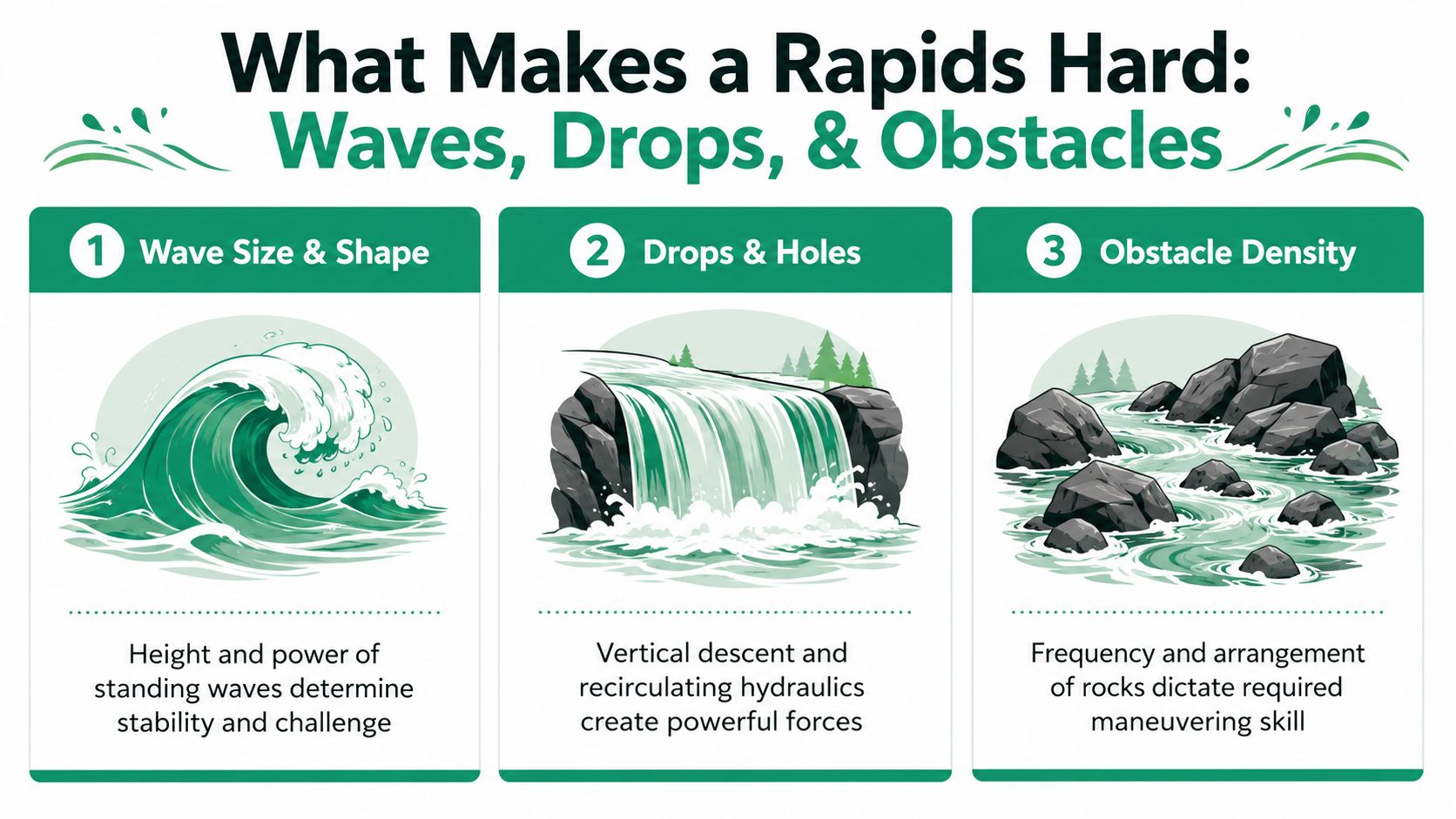
A rapid becomes harder when the water surface stops behaving like a smooth lane and starts pushing the raft around. Bigger standing waves lift one side of the boat, then the other, which is why Class III feels lively while Class IV begins to feel demanding.
Drops add another layer. A small ledge can be fun at lower classes, but as the descent gets steeper and the water starts to fold back on itself, the boat needs cleaner timing and better balance. That is the reason a river with similar-looking colour from the shore can feel completely different once you're on it.
Obstacles matter as much as raw power
Rocks, tight channels, and awkward river geometry are what force the crew to steer and survive the ride. The international scale is tied to obstacle density for a reason, because a fast river with a clean line can be easier than a slower river cluttered with hazards.
On alpine water, that distinction matters. Slovenia's rafting stretches often reward guides who know exactly where the river narrows, where the current leans, and where a boat has to move early rather than late. That's why the class system is really a map of decision-making, not just water speed.
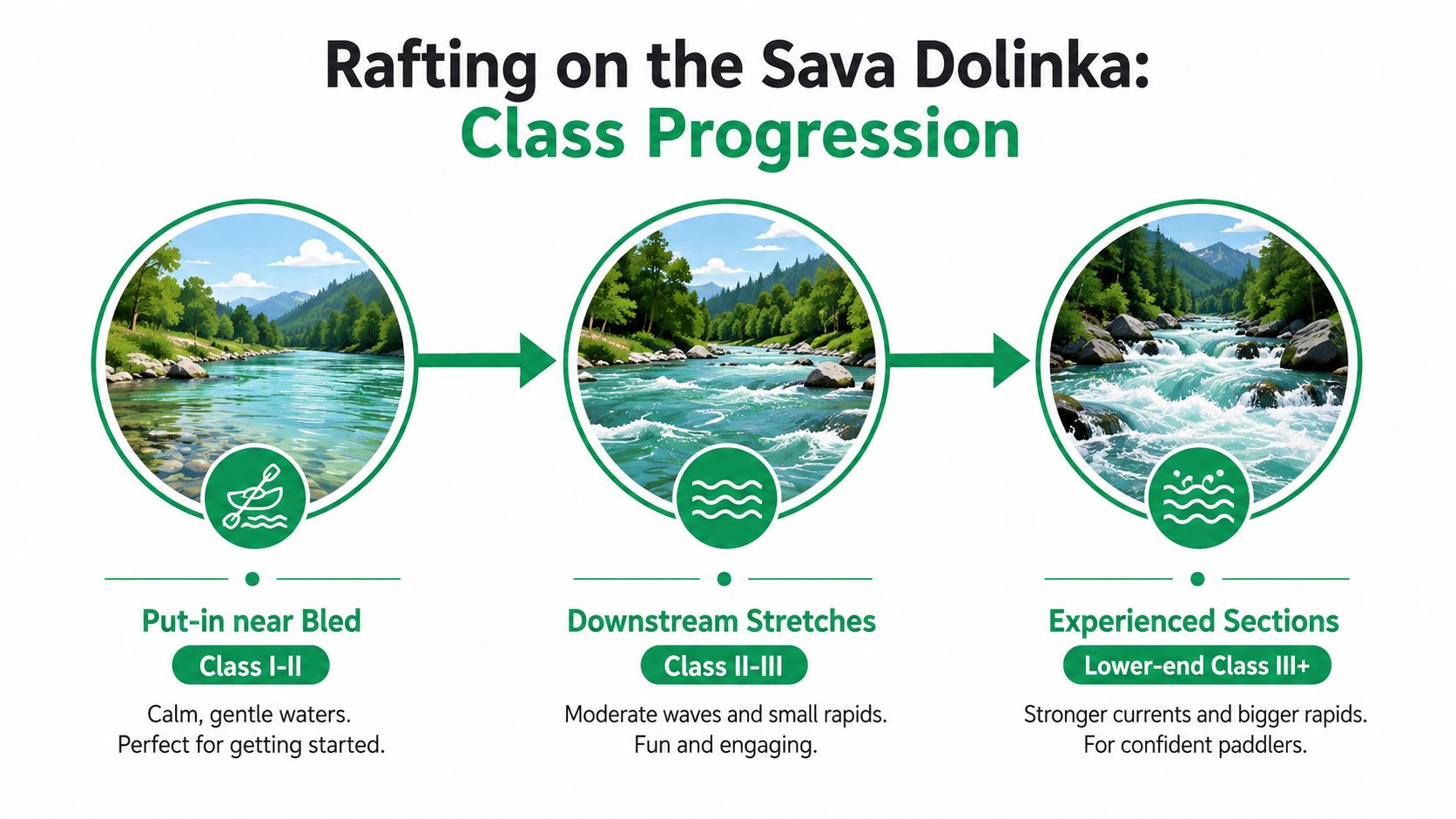
The Sava Dolinka progression shows this clearly. Near the put-in by Bled, a gentle section may feel like easy Class I to II water. Farther downstream, the river can shift into a more reactive mood, and the lower end of Class III becomes a better description of what guests experience.
That is why reading rapids is a skill in itself. A first-timer does not need to memorise every technical term, but they do need to understand that waves, drops, and obstacles work together. One feature alone does not define the run, the combination does.
Matching Class to Skill from Beginners to Experts
| Class | Typical Experience | Suitable Group | What the Run Looks Like |
|---|---|---|---|
| I | Gentle moving water | Nervous first-timers, very relaxed outings | Calm flow, light steering, minimal challenge |
| II | Small rapids and easy manoeuvres | Families, beginners, mixed-ability groups | Splashy but controlled, with clear channels |
| III | Moderate waves and active paddling | Confident beginners with a guide, active leisure groups | Lively, teamwork-based, the classic first whitewater feel |
| IV | Technical water with bigger drops | Experienced paddlers or very capable groups | Fast decisions, precise boat handling, more commitment |
| V | Powerful, expert-only whitewater | Highly experienced paddlers | Serious, complex, and demanding |
| VI | Unrunnable in practice | Not suitable for recreational rafting | Beyond normal commercial trips |
How to read the table without overthinking it
Beginners and families should look first at Class I and II. That is where the river gives you movement without asking for technical skill, and it is why a lot of Slovenia's introductory rafting takes place on lower-end water.
Class III is the upper edge of introductory trips when the guide is running the boat well and the group can follow commands. It suits people who want more splash and a stronger sense of action without jumping straight into expert territory.
Rule of thumb: if you want your first trip to feel exciting but not overwhelming, Class II or lower-end Class III is the sweet spot.
Experienced paddlers start to want more from the river. They usually feel comfortable with the pace and the need to read features on Class III, then begin exploring easy Class IV when they want stronger technical work. Class V and VI are not casual holiday options, they are specialist water.
One practical detail matters here. A trip is only as suitable as the people in the raft, so group composition matters as much as the class number. A mixed family group and a boat full of confident outdoor regulars should not be treated the same way.
Rafting on the Sava Dolinka What the Classes Look Like
Near Bled, the Sava Dolinka gives first-timers a very readable version of rafting. The river often starts with calmer stretches that let everyone settle in, then introduces clear spots where you have to react, paddle together, and listen to the guide. That is why lower-volume Class II and lower-end Class III water fit so naturally into family-friendly trips in this part of Slovenia.
The feeling is different from an expert river. On the Sava Dolinka, the run is usually built around confidence, not intimidation, so guests can enjoy the motion without being thrown straight into high-consequence water. That makes it a strong choice for visitors who want a real rafting day but don't want to gamble on a stretch that might feel too intense once they're already on the bank.
What guests usually notice on the water
The first part often feels like rhythm. You settle into the boat, the guide gives simple commands, and the river teaches you the shape of the line.
Then the rapids add small bursts of energy. The raft may dip, slide, and splash, but the run still feels readable, which is exactly what a first whitewater experience should do.
Farther from Bled, other Slovenian and Alpine rivers can feel busier, more technical, or more powerful. That is where higher-volume Class III and IV water starts to change the mood of the trip, because the boat has less margin for hesitation and the guide has to work harder to keep the line clean.
The Sava Dolinka stands out because it gives people a specific entry point. You can look at the river and say, it is the place where first-timers learn what whitewater feels like without being pushed too far too soon.
How Guides Pick the Right Stretch for Your Group
A good guide starts before the raft touches the water. They check the river gauge, look at recent rainfall or snowmelt, and match the plan to the people standing in front of them, because the same river can feel noticeably different from one day to the next.
What changes the decision
Water level matters because it changes how quickly the river moves and how hard the features hit. A section that feels like Class II on a quiet summer morning can shift toward Class III after rain or snowmelt, and that is normal on alpine rivers.
Group age and experience matter too. A boat with young children, cautious adults, or people who have never paddled before needs a different stretch from a group of fit, confident travellers who have done whitewater elsewhere. Time of season also affects the plan, because guides want the run to match both the river and the comfort level of the guests.
Ask three things before you book, which section are we running, what have river conditions been like recently, and how many guests will share one guide.
That simple conversation tells you more than a generic promise of a “fun rafting day”. It also explains why no reputable Slovenian operator should guarantee the exact same class on the exact same date every week.
For visitors who want a locally run option, Outdoor Slovenia Activities offers guided rafting on the Sava Dolinka with professional guides, full technical equipment, and hotel pick-up and drop-off. That combination only works well when the stretch is chosen for the group in front of the guide, not copied from a fixed script.
Safety Risks and What the Numbers Actually Show
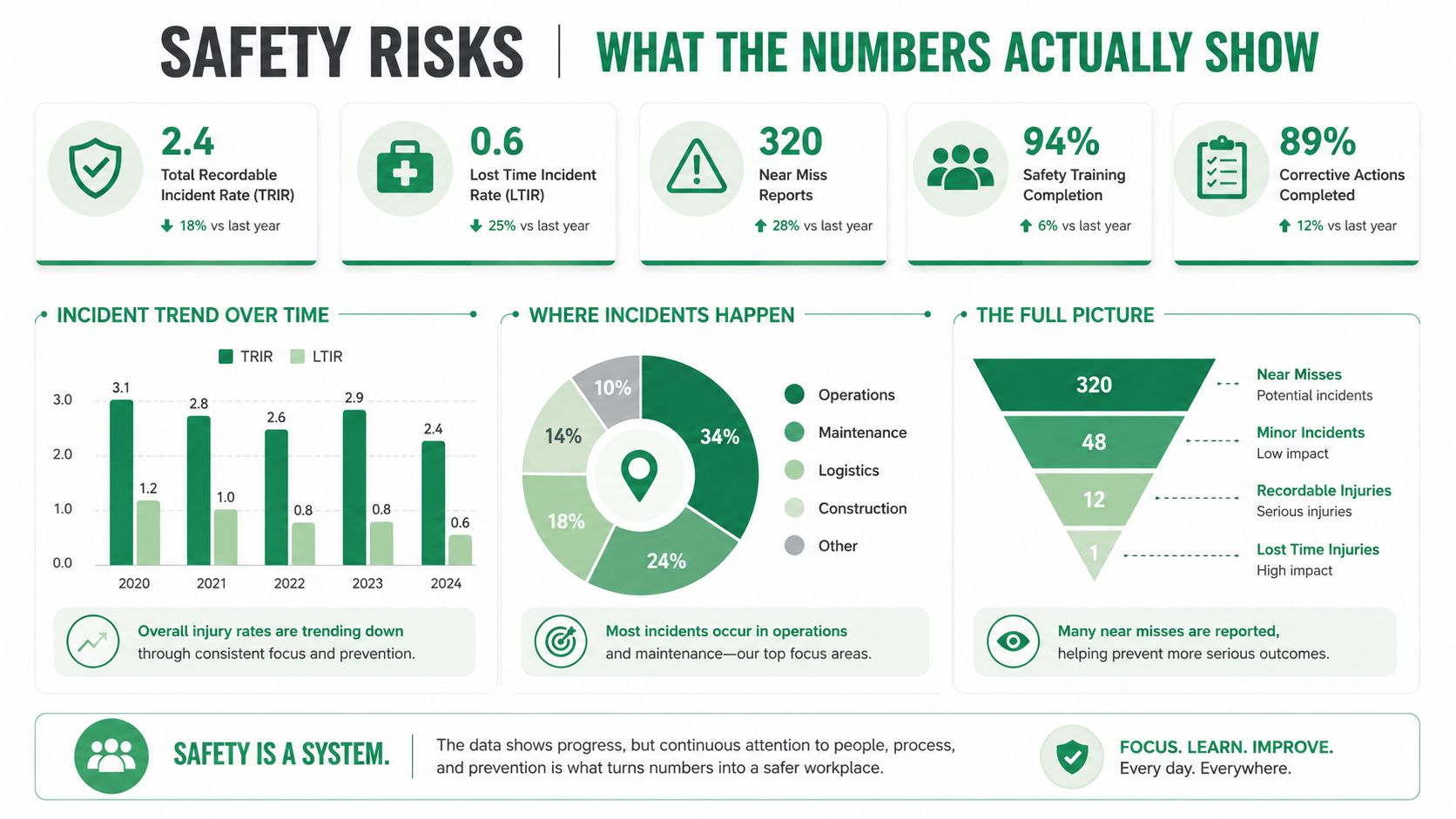
The number most people worry about is risk, and rafting has one useful thing going for it, it can be discussed openly. Fatality rates have been estimated at 0.55 to 0.86 per 100,000 user days in rafting research, which shows that commercial rafting is statistically low-risk when compared with many adventure activities, but not risk-free, according to Safety Space risk rating.
Where risk rises
Risk rises sharply at the top of the scale because the river stops forgiving mistakes. Class V water can bring 5- to 8-foot drops and hazards that are difficult to avoid, while Class VI is considered so dangerous that safe passage is doubtful and serious injury or death is considered almost certain. That is why the class number matters more than bravado.
The standard gear on Slovenian rivers is there to reduce consequences, not to turn hard water into easy water. You should expect a helmet, PFD, wetsuit, throw bag, and a guide who knows the section well and has the training to use the equipment properly.
What to trust on a real trip
Class choice comes before gear choice. A solid helmet helps, but it does not make the wrong river suitable for your group.
If you want to see how a high-quality guided river product is organised in practice, rafting on the Soča River shows how difficulty classes are used to define the route and the guest experience. The model is simple, the operator chooses a stretch that fits the water, then builds the safety plan around that stretch.
In other words, the safest way to enjoy a difficult-feeling river is to book with a certified local operator who matches the run to the group in front of them. That's the calm, professional standard worth looking for.
Common Myths and How to Pick Your First Trip
A lot of first-time guests still assume that a higher class automatically means a better day. It doesn't. A well-run Class II or lower-end Class III trip can deliver plenty of action, especially on the Sava Dolinka, without forcing new paddlers into water that outpaces their confidence.
Another common mistake is calling Class II boring. For active adults, that usually means they're looking at the wrong thing. On a good day, Class II still gives you steering, timing, teamwork, and enough splash to feel like a proper river adventure.
The phrase “family-friendly” also needs a closer look. It can describe a sensible beginner trip, but it can also be used loosely, which is why you should ask about the exact section, recent water level, and guide setup before you commit.
Quick booking checklist
- Confirm the class: Make sure the operator names the actual river class, not just “easy” or “moderate”.
- Ask about recent water conditions: River level can change the feel of the same section.
- Check minimum age and group suitability: Family trips should be matched to the youngest or least experienced guest.
- Verify guide qualifications: The guide should know the section and handle the safety briefing clearly.
- Check the equipment list: Full technical gear should be provided, not improvised.
- Ask about transfers: If you need hotel pick-up, confirm it before booking.
- Read the trip flow: If the operator explains logistics clearly, it usually reflects good organisation, the same kind of clarity you'd expect from how the travel app works in a trip-planning context.
A well-run rafting day should feel clear from the first question you ask. If the answers point toward a Class II or lower-end Class III run on a Slovenian river, you're looking at one of the most approachable introductions to whitewater in Europe.
If you want help choosing the right river stretch for your group, explore Outdoor Slovenia Activities and compare the guided options around Bled and the Sava Dolinka. We'll help you match the class to your comfort level, so your first rafting day feels exciting, safe, and easy to book.