
You've got rental boots on, the skis feel longer than your confidence, and the first thing in front of you is a gentle slope that somehow still looks serious. That's the normal adult-beginner start. The people around you might look calm, but plenty of them arrived with the same knot in the stomach, the same questions about fitness, and the same quiet hope that one lesson will be enough to make skiing feel possible.
For ski lessons adults, the question isn't whether you're “too late” or whether you should already know more. It's how to choose a lesson that fits your actual ability, your nerves, and the number of days you've got in Slovenia. The right format can turn a tense first hour into a usable first day, and that matters more than most brochures admit.
Table of Contents
- Starting From the Bottom of the Slope
- Why Adult Beginners Are More Common Than You Think
- Private Versus Group Lessons for Adults
- Why One Tightly Structured Lesson Often Beats a Multi-Day Course
- Realistic Skill Progression on the Slopes
- Handling Fear and Fitness Before and During Your Lesson
- Booking Tips for Adult-Only Classes at Slovenian Resorts
- Leaving Slovenia With a Clear Next Step
Starting From the Bottom of the Slope
The first five minutes in ski boots can feel ridiculous. You're upright, stiff, and a little clumsy, trying to remember whether the poles go in this hand or that one while the magic carpet hums in the background. That's usually the moment adults decide they either belong on the hill or should have booked something easier.
They do belong there. A good instructor sees that first-runs hesitation every week and treats it as the starting point, not a problem to fix. If you've rented gear and are wondering whether it's worth continuing, it's worth checking your setup first, especially if you need a proper fit for boots and skis through ski rental near me.
What the first hour usually feels like
The first lesson is rarely about graceful skiing. It's about learning where your weight goes, how the edges grip, and how to stop without panicking. Adults often want too much too soon, then get frustrated when their body is still reacting like it's on ice for the first time.
That's why a serious adult lesson starts simple. An instructor will usually keep you close to the learner area, reduce the number of moving parts, and build confidence before speed. The point is not to impress anyone standing near the lift queue.
What this guide helps you decide
The practical questions matter more than the fantasy version of the day. Should you book private or group? Is one lesson enough? Should you join an adult-only class or squeeze into a mixed family group? The answer depends on your comfort level, your trip length, and how quickly you want feedback.
If you're still deciding between resorts, lesson styles, or whether a beginner area is beginner-friendly, a look at best ski resorts for beginners can help you match the hill to your confidence. The goal is simple, find the lesson format that makes your first day feel manageable instead of theatrical.
Why Adult Beginners Are More Common Than You Think
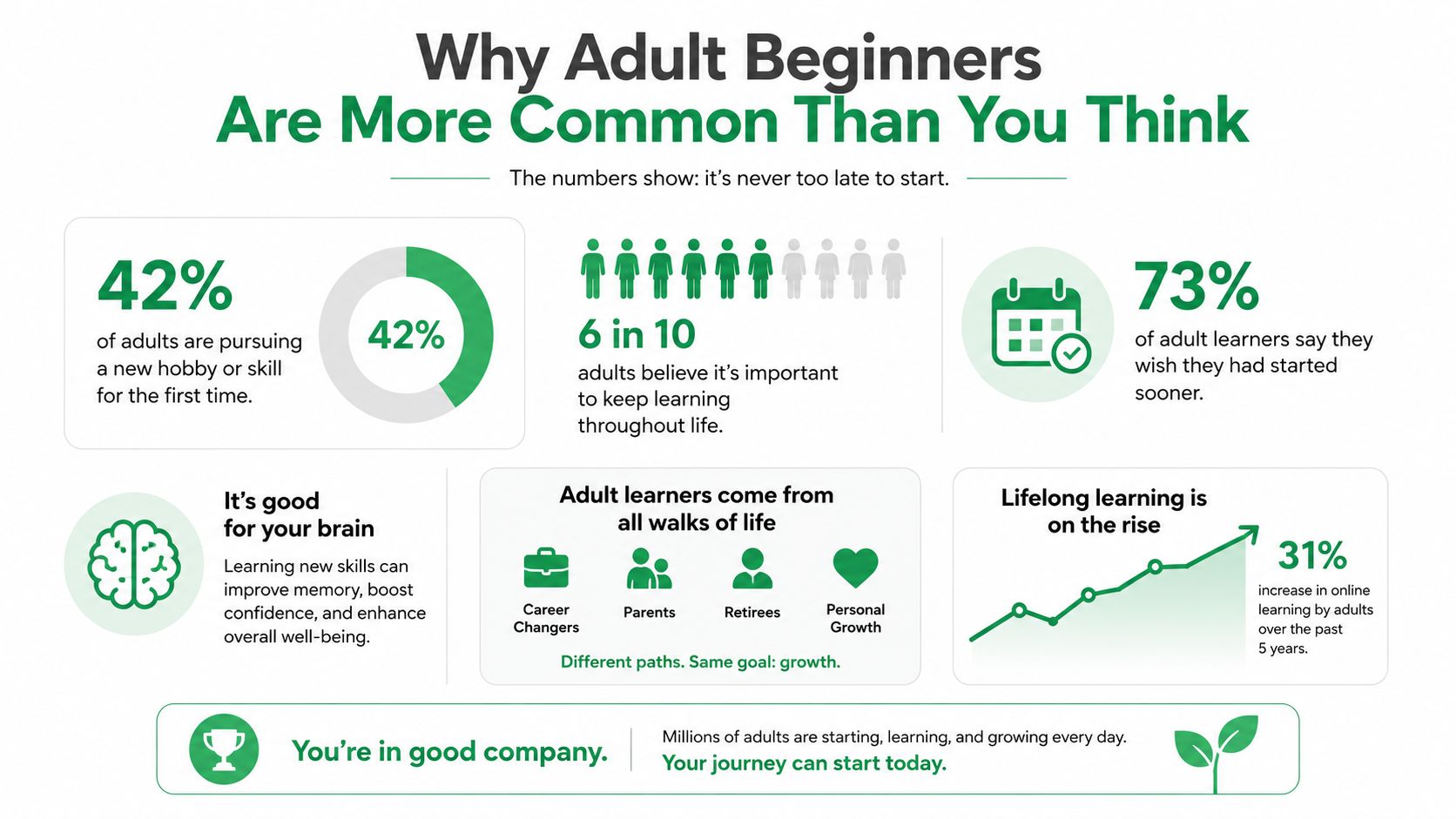
Adult beginners are a normal part of ski school life. One market report estimates that adults aged 19-50 account for 32.8% of ski school participants, and that adult programs make up 11.2% of total ski school market value. The same report says 60% of surveyed skiers started after age 20, with 34% learning between 20 and 29 and 13% between 30 and 39 source.
That matters on the hill. Instructors are used to nervous adults, late starters, and people who need the movement explained twice. They are not dealing with a strange exception. They are working with a large and familiar group.
Adult motivation shapes how lessons are sold
The same market data says adult learners are usually driven by fitness, precision technique, and skill advancement. That is a different mindset from a child who just wants to slide downhill. Adults often care about doing the movement correctly, and they usually respond well to clear feedback and visible progress.
It also helps explain why adult lessons are often more structured. The market has room for that approach. Private lessons hold 32.5% of service share, which fits the way many adults prefer focused correction and immediate answers source.
The historical pattern is reassuring, not unusual
Snowsports News, citing survey research, reported that 60% of respondents started skiing after age 20, with almost 34% learning between 20 and 29 and 13% between 30 and 39 source. The same report noted that the average first-time skier age has shifted over time, from 5-9 in the 1950s to 30-39 in the 2010s, and more recently to about 26-34.
Practical rule: if you're starting as an adult, you're in good company, and the lesson product should feel built for you, not adjusted awkwardly around you.
The takeaway is simple. Adult beginner demand is common enough that ski schools already know how to teach it. That is why lesson design, pacing, and feedback style matter so much on the first day. If you are comparing resorts, a look at best ski resorts for beginners can help you match the hill to your confidence.
Private Versus Group Lessons for Adults
| Factor | Private Lesson | Small Group Lesson |
|---|---|---|
| Feedback | Constant, immediate correction | Shared attention, less individual correction |
| Pacing | Built around your timing and nerves | Moves at the group's middle pace |
| Social comfort | Good for anxious or self-conscious adults | Good for sociable adults who relax with others |
| Best use | Short trips, specific goals, fast confidence | Better value for longer stays and patient learners |
| Cost | Usually higher | Usually lower per person |
An adult beginner often arrives at the slope with a mix of nerves, decent determination, and a body that is not used to sliding downhill on purpose. In that situation, private lessons usually give the cleanest start. The instructor can watch your stance, slow the drill when you freeze up, and keep the session focused on the small set of movements that matter first, stopping, turning, and getting onto a lift without panicking. That kind of attention works well for short trips, because you are not paying to spend the day waiting for everyone else to catch up.
Group lessons have a different strength. You see other adults making the same awkward first attempts, and that shared embarrassment often lowers the pressure. A small adult group can also be a better fit if you learn well by watching, and if you do not mind some time between corrections while the instructor moves around the class. The format is usually less intense, which helps some learners relax and keep going after the first wobbly run.
How to choose without overthinking it
If you only have one ski day, private usually makes more sense. You get direct correction, a pace that changes with your confidence, and fewer wasted minutes on skills you will not use yet. That matters when the hill is busy and your legs are already working hard just to stay balanced.
If you have several days and you enjoy learning with other adults, a small group can be a good fit. Keep an eye on class size and age mix, though, because a group that is too large or too mixed can split the instructor's attention in ways adults notice quickly. For a concrete booking point, take a look at Kranjska Gora ski school, then compare the class format with your trip length, fitness, and how much confidence you already have on snow.
My rule on the hill: anxious adults usually progress faster in private, sociable adults often enjoy group, and neither format works if the level match is wrong.
The question is not which format looks better on paper. It is which one gives you the steadiest first day on snow, with the least wasted effort and the least stress.
Why One Tightly Structured Lesson Often Beats a Multi-Day Course
A short ski break in Slovenia usually rewards clarity over volume. Adults who arrive anxious, stiff, or out of practice often learn more from one tightly organised first lesson than from a long course that keeps stretching the same early mistakes across several days. Skiing improves when the body has time to absorb a few clear movements, then repeat them with less noise in the head.
A regional adult course example shows why some skiers still prefer the slower build. Scuola Sci Tonale Presena offers 10 total lesson hours over 5 consecutive days, 2 hours per day source. That setup gives the instructor room to revisit the same patterns, and it works well for adults who are staying longer and want steady repetition instead of a rushed first encounter.
What a strong first lesson should cover
A well-run adult beginner lesson should leave you with the basics of stance, edging, stopping, turn shape, and getting around the beginner area without feeling lost. If the instructor is good, you'll also get a first look at lift use and probably finish on a short easy-piste run, not just in the flat practice zone. That is enough to make the rest of the day feel less mysterious.
For many short-trip visitors, that is the actual need. In Slovenian resorts, many adult learners arrive with limited time, sore legs, and a fair amount of hesitation, so first-day confidence matters more than a long technical programme. A single well-structured lesson can fit that reality better than a course you will not fully use.
When multi-day lessons make more sense
If you have three or more ski days, a short course can make sense. Repetition helps, and the instructor can return to the same movement errors after your body has had time to settle. That is especially useful once you already know how to stop and turn, and you want cleaner skiing rather than just getting down the hill.
If you are only in Slovenia for a weekend, do not buy the fantasy of rapid mastery. Choose the lesson that gets you moving comfortably, then let the rest of the trip reinforce it. That usually gives a better return than filling your schedule with hours your body and mind cannot fully take in.
Realistic Skill Progression on the Slopes
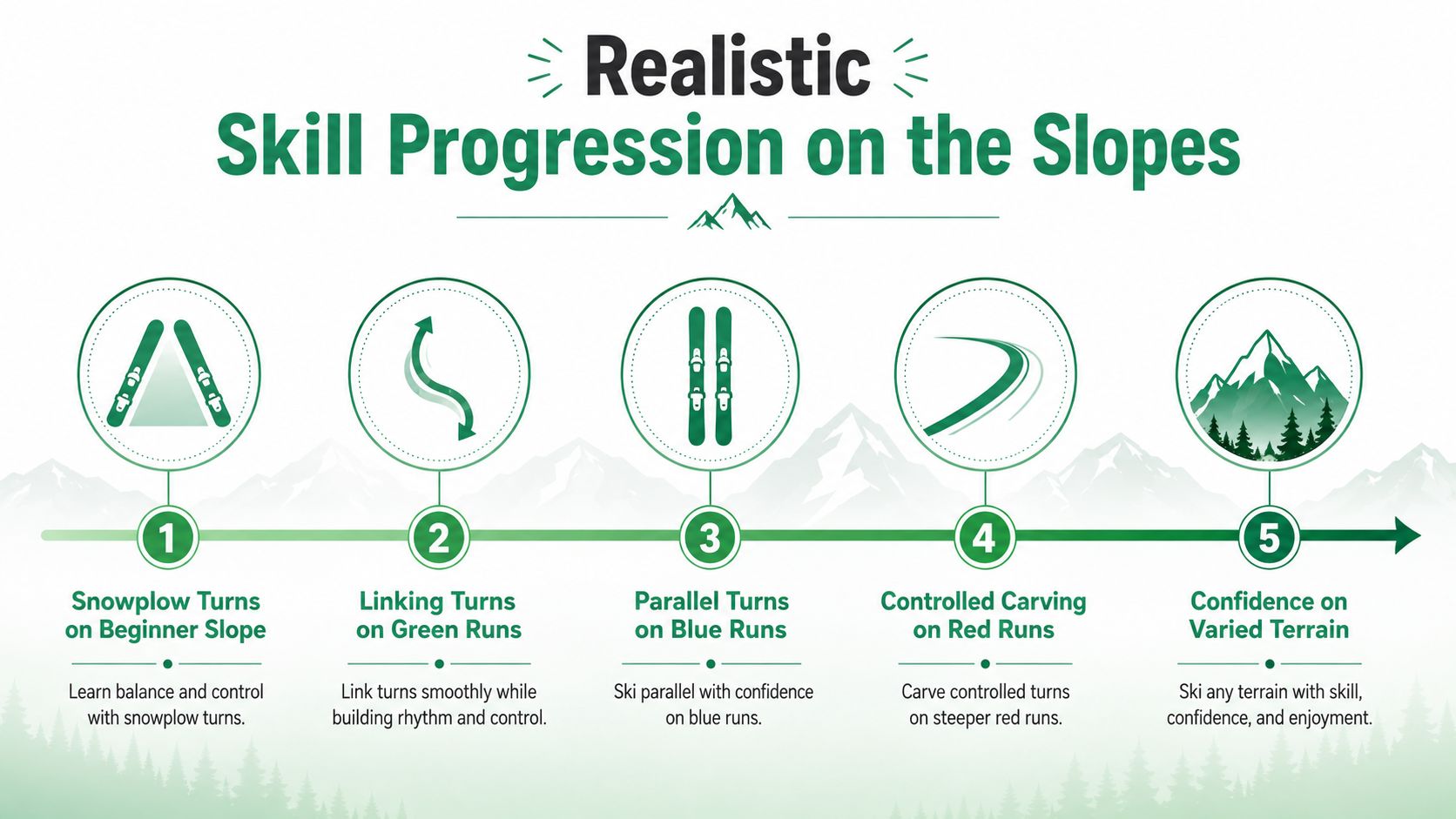
Good instructors use terrain benchmarks as a map, not a promise. A standard progression moves from linked turns on green terrain to basic parallel turns on blue terrain, then to control on variable black terrain with pole plants, carving, and terrain adaptation source. That helps adults understand where they are, without pretending that every body learns at the same pace.
What usually changes first
In the beginning, adults often learn control before style. You can look awkward and still be making real progress if you can stop reliably, steer into the fall line, and link a few calm turns on gentle ground. That's why beginner success often looks smaller than people expect.
The wedge-to-parallel transition is where many adults stall briefly. That's not failure, it's a normal phase where balance, edge control, and confidence have to catch up with each other. The strongest skiers are not the ones who rush through it, they're the ones who let it settle.
What to expect in Slovenia
If you've booked a single day at Vogel or Kranjska Gora, a realistic goal is groomed-piste confidence, a few linked turns, and a cleaner understanding of speed control. Black-run readiness is a different category, and it usually belongs to a longer progression, not one holiday. Treat the first trip as a foundation, not a final exam.
Good progress feels boring before it feels stylish. Adults often mistake steady repetition for slow learning, when it's really the stage where ski movements become dependable.
That's why ability-level matching matters so much. If you place yourself too high, the mountain feels chaotic. If you place yourself accurately, the hill starts teaching you in a way your body can use.
Handling Fear and Fitness Before and During Your Lesson
Fear stops more adult learners than technique does. Instructors see it all the time, on the carpet, at the lift, and again when someone has to point their skis downhill for the first time. The fastest way through it is not pretending you're fearless, it's telling the instructor what you're worried about and asking for the first steps to be smaller.
Chairlift nerves are especially common. A good instructor will start you on a magic carpet or button lift if the terrain allows it, so you can practise balance and turning without adding a moving chair to the equation. Keep your mental script short, tell the instructor you're nervous, ask for easier terrain, and focus on the next turn rather than the whole slope.
Fitness matters, but not in the way most adults fear
The first two days use muscles that many adults don't train directly. Legs, hips, and core all get involved, and the fatigue can feel surprising even if you're normally active. That said, you don't need athletic perfection to handle groomed beginner and blue terrain, you need enough conditioning to stay upright, recover between runs, and keep your focus.
The adult ski market also reflects this mindset. Adult learners are often motivated by fitness and skill advancement source, which is exactly why a pre-trip warm-up makes sense. If you're looking for a useful companion idea, the principle behind progressive overload for beginners applies well here, build steadily instead of expecting your body to adapt overnight.
What to do before you travel
- Do some cardio: walking, cycling, or stair work makes the first ski day feel less shocking.
- Add simple leg strength: squats, step-ups, and supported lunges are enough to wake up the right muscles.
- Practise balance: standing on one leg while brushing your teeth is more useful than it sounds.
- Pack in layers: overheating or shivering makes concentration worse.
- Hydrate early: dry mountain air and exertion add up faster than people expect.
Industry research shows why the emotional side matters. Only one-third to one-half of first-timers at many resorts take lessons, and the adult lesson-taker conversion rate has only moved from 15% to 17% over two decades, which suggests fear and uncertainty still keep many adults out of ski school source.
When adults understand that nerves and tired legs are normal, the lesson gets easier almost immediately. They stop trying to perform and start learning.
Booking Tips for Adult-Only Classes at Slovenian Resorts
A good booking starts with an honest check of your current level. Adults often remember a smooth holiday run from years ago and assume they should be at that stage now, or they downplay their ability because they feel they are “behind”. Both mistakes lead to the wrong class. Book for what you can do today, not for what you wish you could still do.
Adult-only groups usually fit nervous beginners better than mixed family classes. Adults tend to ask more specific questions, need less cheering from the side, and prefer a calmer pace without constant stop-start interruptions. If you can find a small adult group, that often gives you the best mix of attention and value.
What to confirm before you pay
- Group size: four to six people is usually a comfortable balance between attention and value.
- Language: ask what language the instructor speaks, not what the webpage implies.
- Meeting point: confirm whether you meet at the base area, rental shop, or a specific lift.
- Lift tickets: make sure you know whether the lesson includes one or whether you need to buy it separately.
- Private upgrade option: ask if you can switch if the group level is mismatched.
The time of day matters more than many first-timers expect. Morning lessons are often quieter and colder, which can help if you want less chaos around you. Afternoon lessons are usually busier, but they can feel easier on stiff legs once your body has warmed up. If fear is the bigger issue, a morning slot often gives you a calmer start.
Short stays in Slovenian mountain resorts make early confidence more important. If you only have a few days on snow, you need a lesson that gets you moving quickly and uses the time on the hill well. A tightly structured first class works better than a loose schedule that spends too long sorting out basics on paper instead of on snow. Adults usually learn more from one clear, focused session than from a slow build that assumes they will be back tomorrow.
For travellers who want instruction built into a wider winter trip, Outdoor Slovenia Activities offers adult ski lessons as part of its winter service set. That only helps if the class format, language, and timing fit your trip, so ask the same direct questions you would ask any ski school.
Leaving Slovenia With a Clear Next Step
The best outcome for an adult beginner is not black-run mastery in one holiday. It's leaving Slovenia able to ride a lift, link turns on a blue, and know exactly what to book next time. That's a real win, because it turns skiing from a one-off experiment into a sport you can return to with a plan.
The opening fear usually fades faster than people expect. By the time you've done a few turns, the slope feels less like a judgement and more like a puzzle with rules you can learn. Adults who get that first lesson often realise the second trip is where the sport starts to make sense.
You don't need to arrive as a skier. You just need to leave with one clean next step.
Outdoor Slovenia's adult ski school exists for exactly that kind of first contact with snow, clear instruction, safer progression, and a supportive start for visitors who don't want to guess their way through a resort. If you're ready to book a lesson that matches real beginner needs, visit Outdoor Slovenia Activities and choose the winter option that fits your trip.