
You're probably reading this the evening before your first lesson, wondering whether snowboarding will feel exciting, awkward, freezing, or all three. That's normal. Most first-timers don't struggle because they're unfit or uncoordinated. They struggle because nobody explains what the first day feels like, what matters most, and which instincts will get them into trouble.
Snowboarding for beginners works better when it's stripped back to the essentials. You don't need fancy jargon or aggressive terrain. You need the right clothing, a sensible board setup, a patient progression, and a beginner slope that gives you space to breathe. In the Julian Alps, that combination is easier to find than many visitors expect.
Table of Contents
- Gearing Up for Your First Day on the Snow
- Your First Hour Getting Comfortable with the Board
- Learning to Balance and Control Your Speed
- How to Make Your First Snowboard Turns
- Common Beginner Mistakes and How to Fix Them
- Your Beginner Snowboarding Adventure in Slovenia
- Your Snowboarding Questions Answered
Gearing Up for Your First Day on the Snow
The easiest way to make your first snowboard day miserable is to dress like you're going for a winter walk. Snow gets everywhere when you're learning. You'll sit in it, kneel in it, and occasionally fall into it. Staying warm matters, but staying dry matters more.
What to bring and what to rent
Bring the clothing that sits on your body all day. Rent the technical gear that should be matched to your size and riding level. For beginner equipment, guidance consistently points to a board sized to your height and weight, snug but not painful boots, and wrist guards, which Stio specifically recommends for beginners to reduce injury risk in the first few days of riding, as explained in Stio's beginner snowboard tips.
What you should wear:
- Base layer: A thermal top and bottom that keeps warmth close without making you sweat heavily.
- Mid layer: A fleece or light insulating layer if the day is cold.
- Outer layer: Waterproof jacket and waterproof ski or snowboard trousers.
- Hands and head: Warm gloves or mittens, plus something thin for under the helmet if conditions are cold.
- Feet: One pair of proper ski or snowboard socks. Not two. Two pairs usually create friction and pressure points.
What's usually better rented or provided:
- Snowboard: Correct length and flex matter more than graphics.
- Boots: These should feel secure around the heel and ankle without crushing your toes.
- Helmet: Non-negotiable for first-timers.
- Wrist guards: Strongly recommended for beginners.
Practical rule: If your boots hurt in the rental area, they won't improve after an hour on snow.
If you're planning your day in Kranjska Gora, it helps to sort the mountain logistics in advance, especially lift access and resort flow. The practical details on the Kranjska Gora ski pass page make that part easier to visualise before you arrive.
Beginner's Snowboarding Checklist
| Item | What to Look For | Provided by Us? |
|---|---|---|
| Base layer | Breathable, close-fitting, not cotton | No |
| Mid layer | Light insulation you can move in | No |
| Jacket | Waterproof, roomy enough for layers | No |
| Trousers | Waterproof, snow-resistant, easy to bend in | No |
| Socks | One pair, ski or snowboard specific | No |
| Gloves | Warm, waterproof, easy to grip with | No |
| Snowboard | Sized to rider height and weight | Yes |
| Boots | Snug fit, secure heel, no painful pressure | Yes |
| Helmet | Correct fit, stable on head | Yes |
| Wrist guards | Comfortable under gloves, protective | Yes or bring your own |
| Goggles or sunglasses | Useful for visibility and comfort | Bring your own if preferred |
Small details that save the day
New riders often focus on the board and forget the simple comfort mistakes. Don't wear jeans under waterproof trousers. Don't tuck bulky layers into your boots. Don't arrive dehydrated and call it nerves when your legs start cramping.
The best first-day setup feels boring in the changing room. That's good. If nothing pinches, bunches, slides, or flaps around, you've done it right.
Your First Hour Getting Comfortable with the Board
The first hour usually starts the same way in the Julian Alps. You clip one foot in, try to shuffle across flat snow near the beginner area, and the board feels wider, heavier, and less cooperative than expected. That feeling is normal.
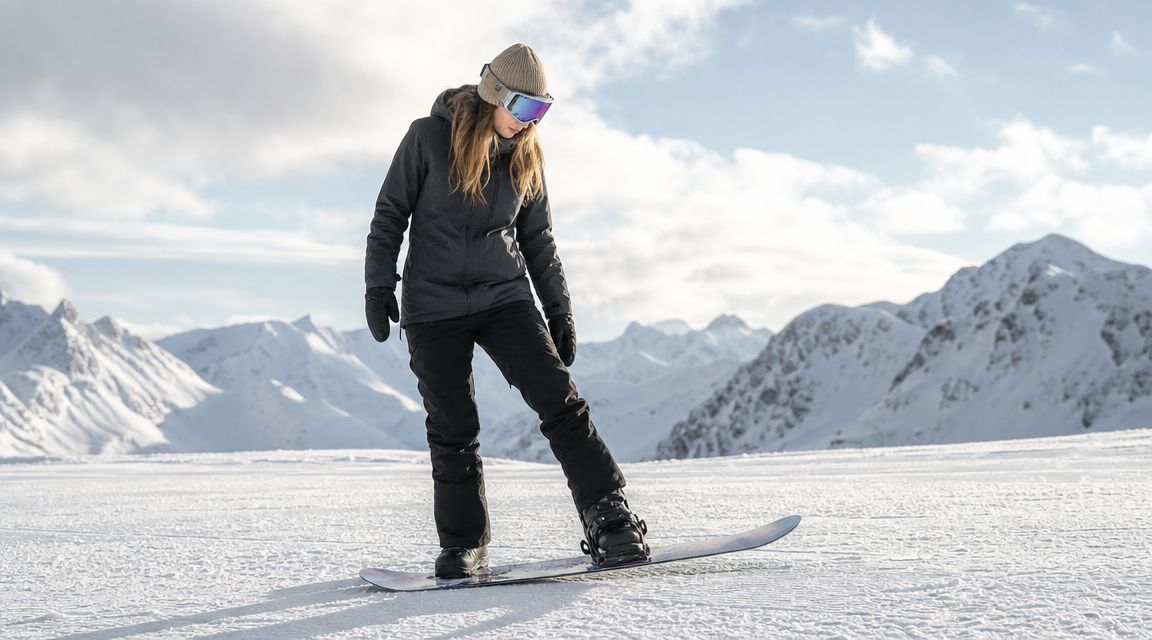
Good first lessons in places like Kranjska Gora do not rush to the slope. They start on flat ground because that is where beginners learn the small movements that make the rest of the day calmer. If a rider struggles with one-footed movement, lift queues, short traverses, and getting in and out of beginner zones become tiring fast.
Find your lead foot without making it complicated
You'll hear regular and goofy right away. Regular means left foot forward. Goofy means right foot forward. A simple test works well. If someone gave you a light nudge from behind, which foot would step out first to catch your balance? That is often your front foot.
Once you know your stance, strap in the front foot and stand still for a moment. Feel where the board sits on the snow. Keep the knees soft and the hips centred over the board. Beginners who lock their legs on flat ground usually struggle more than beginners who stay relaxed.
Start with the habits that save energy later
These first drills are not glamorous, but they matter on every run:
- Carry the board under control: Hold it close so the tail does not clip other people in crowded beginner areas.
- Practise strapping in and out: Learn to do it sitting and standing, because snow conditions are not always tidy or flat.
- Skate with short pushes: Use small, steady pushes from the free foot instead of long, hurried steps.
- Place the free foot against the stomp pad or next to the binding between pushes: That keeps the board running straighter.
- Try tiny glides on flat or very gentle snow: Learn how to stop the board before speed becomes a problem.
On Slovenian beginner slopes, especially in the morning when the snow is firmer, this part pays off more than people expect. Flat-ground control gives you confidence before you deal with a magic carpet, a button lift, or a crowded meeting point.
A proper beginner progression is simple. Get comfortable standing with one foot in. Then skate. Then glide a short distance. Then learn to stop cleanly. Riders who skip that order often waste half the lesson fighting the board instead of learning from it.
If you want coached practice on terrain that suits first-timers, a lesson through the Kranjska Gora ski school gives you space to work on movement and stopping before anyone pushes you onto steeper ground.
The board should start to feel like a long, slightly awkward shoe. Not like a wild animal attached to your front leg.
Repetition helps here. So does patience. If the first hour feels basic, you are probably doing the right work.
Learning to Balance and Control Your Speed
The first time a beginner points the board down even a mild slope above Lake Bled, the usual reaction is the same. The board feels quicker than expected, the shoulders tense, and the eyes drop straight to the nose of the snowboard. Good riding starts when that tension eases and the rider learns one simple truth. Speed is managed from the edges, not by hoping the board slows down on its own.
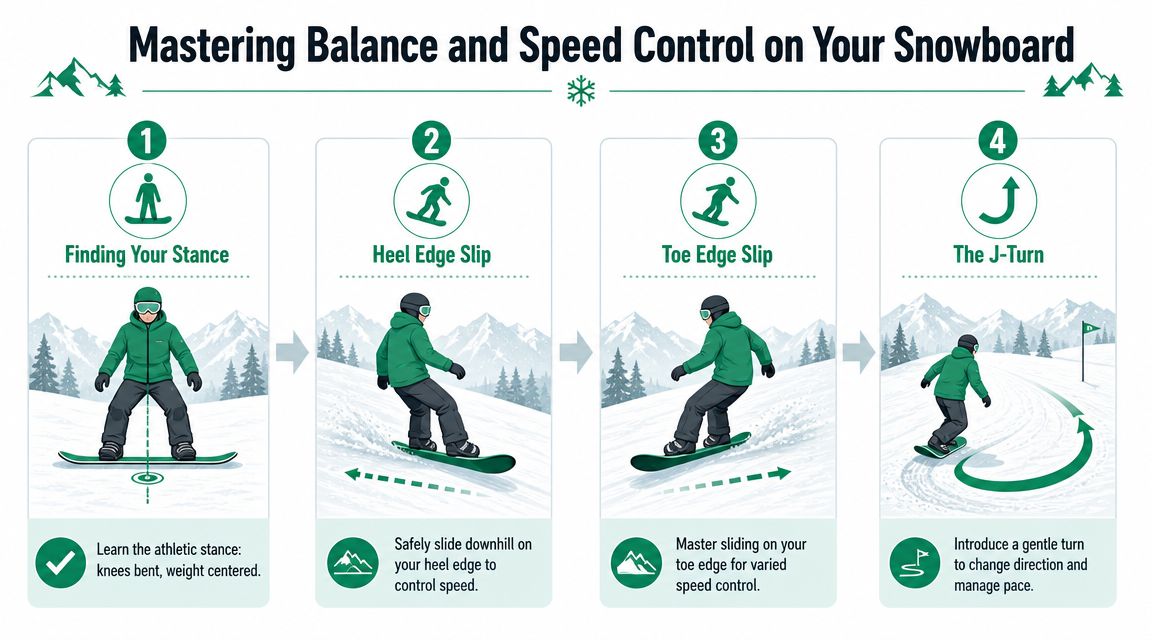
Your ready stance on a gentle slope
On an easy run, body position does more for you than courage. Keep the ankles and knees flexed, hips centered over the board, and hands relaxed where you can see them. The chest stays calm. Wild arm swings usually mean the lower body has stopped doing its job.
A lot of first-timers in Slovenia stand too tall, especially on firmer morning snow in Kranjska Gora or Vogel. Then every little ripple in the piste knocks them around. Others crouch so low that their legs cannot make small adjustments. The better middle ground is a stance that feels alert and springy.
One check works well. If someone gave your shoulders a gentle nudge, you should be able to stay balanced without straightening your legs or sitting back.
How Edge Control Slows You Down
Beginners do not need speed first. They need a reliable brake.
Your two brakes are the heel edge and the toe edge. Once those start to make sense, the board stops feeling random. Until then, even a short beginner pitch can feel slippery.
Start with a very short straight glide, only far enough to feel the board track under both feet. Then move quickly into edge drills on terrain that gives you room to stop well before the slope flattens into a crowded area.
Use this order:
- Heel-edge sideslip: Keep the board across the slope and let it slide gently with pressure through the heels.
- Toe-edge sideslip: Repeat on the toes, with the shins pressing lightly into the boots and the hips stacked over the board.
- Falling leaf: Stay on one edge and let the board drift a little left and right.
- J-turns: Begin in a small glide, then guide the board onto one edge until it finishes across the slope.
These drills look simple. They are doing serious work.
The board slows down when the active edge bites into the snow and creates friction. Too flat, and it accelerates. Too much edge, and it can catch or feel jerky. Good control sits in the middle. The pressure is clear, but never forced.
On Slovenian learner slopes, that skill matters even more after midday when softer snow starts to pile up into small mounds. A rider with decent edge awareness can stay calm through that chopped-up surface. A rider who stays flat-based gets bounced, speeds up, and often falls on the back side.
On a beginner slope, a clean heel-edge stop is worth more than a rushed turn with no control.
Fear causes a predictable mistake. Riders lean back, stiffen the legs, and point the board flatter because they want less edge. The result is usually more speed and fewer options. Keep the joints soft and stay over the board. The snowboard responds much better to that position.
What to practise before asking for more speed
Before you try a longer run or steeper pitch, make sure these movements feel calm and repeatable:
- Stand up without rushing
- Glide a short distance without twisting the shoulders
- Stop on the heel edge
- Stop on the toe edge
- Traverse a little across the slope
- Finish a basic J-turn on both sides
If one of these still feels uncertain, stay on the same terrain and repeat it. I have seen plenty of beginners improve faster on a short Slovenian training slope than on a bigger run they were not ready for. Solid basics feel slow while you are learning them. An hour later, they save energy, reduce falls, and make the first real turns much easier.
How to Make Your First Snowboard Turns
Your first real snowboard turn isn't a dramatic carve. It's a gentle change of direction that keeps you in control and finishes across the slope. That last part matters. If the board finishes across the hill, it slows down naturally.
From one edge to the other
Most beginners think turning starts with the shoulders. It doesn't. The board listens to what happens lower down first.
To start a turn, use this sequence:
- Look where you want to go. Your gaze should move down the intended path, not at your front binding.
- Soften the ankles and knees. A rigid lower body can't guide the board smoothly.
- Release the current edge slightly. Not fully flat for long, just enough to let the board change.
- Guide with the front knee and ankle. That begins the board's new direction.
- Let the hips follow. The upper body stays calm and aligned with the board.
A first heel-to-toe transition often feels awkward because beginners rush the middle. They drop from one edge and hope the next one catches them. A better turn feels connected. One edge softens, the board points a little more downhill, and the new edge engages before speed runs away.
What a first linked turn should feel like
Linked turns are just single controlled turns joined together. The shape should resemble a patient S, not a straight line with sudden panic corrections.
Keep these cues in mind:
- Finish each turn: Don't abandon it halfway. Let the board come across the slope.
- Stay centred: If you move too far onto the back foot, the board becomes harder to steer.
- Keep the chest quiet: Wild arm movements usually mean the lower body isn't doing enough.
- Breathe: A tense rider often holds the breath and stiffens everything.
If you're struggling, go back one step. Practise J-turns again. One strong turn on each edge teaches more than a dozen rushed linked turns with no control.
Smooth turns come from patience. Fast beginners often look busy. Good beginners look calm.
On easy Slovenian beginner terrain, that calm rhythm matters more than anything else. The riders who improve quickest aren't trying to impress anyone. They're stacking one clean movement on top of the next.
Common Beginner Mistakes and How to Fix Them
Most beginner problems aren't mysterious. They're predictable, and they usually come from natural instincts that don't work well on a snowboard.
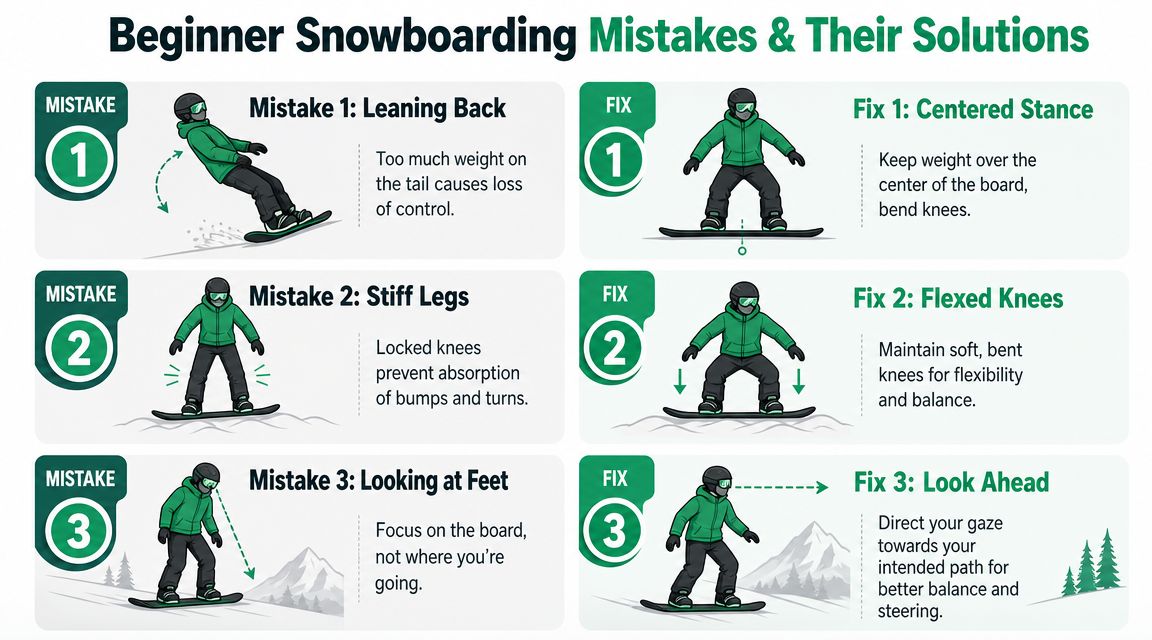
The mistakes I see most often on beginner slopes
Leaning back feels defensive, but it reduces control. The tail gets overloaded, the front of the board becomes less responsive, and the rider struggles to steer. The fix is simple and not always comfortable at first. Bring your weight back to the centre of the board, with a slight willingness to move forward rather than away from the slope.
Locked legs make every little bump feel bigger. Soft knees absorb movement. Straight legs bounce you out of balance.
Looking down pulls your posture apart. Your body tends to follow your head. If you stare at the board, your line gets messy and your reactions get late.
Trying to ride flat is the classic fear response. A key beginner challenge is staying calm without overcorrecting body position. Guidance highlighted alongside NIH safety principles stresses staying in control and being able to stop, and one of the biggest errors is trying to keep the board perfectly flat, which leads to edge catches. Early on, you should commit to either heel or toe edge rather than riding a flat base, as discussed in this beginner control and safety explanation.
Quick fixes that work on the hill:
- If you keep sliding too fast: Finish the turn more across the slope.
- If you catch an edge often: Check whether you're flattening the board between movements.
- If your thighs burn immediately: Relax the crouch. You don't need to sit into an invisible chair all the time.
- If the board feels hard to steer: Stop forcing the shoulders and use the front knee and ankle more deliberately.
The stance question beginners always ask
Beginners often want one perfect binding-angle answer. Real lessons are messier than that. One common recommendation is +15/+0, while other beginner instruction uses a more neutral duck setup such as 12°/-2° so riders feel less locked into one direction. That inconsistency is exactly why stance confuses first-timers, as described in this breakdown of beginner binding angles.
Here's the practical version. A mild duck stance can feel more natural for many beginners because it opens the hips and makes basic balance less awkward, especially when they're learning on both edges. But there isn't one magic setting. The right starting point depends on comfort, rental equipment, and how the instructor wants the rider to progress on that day's terrain.
The mistake isn't choosing the “wrong” angle by a few degrees. The mistake is assuming stance setup matters more than posture, edge commitment, and drill order. It doesn't.
Your Beginner Snowboarding Adventure in Slovenia
You step off the magic carpet, look up at a quiet beginner slope, and see sharp white peaks above dark spruce forest instead of a chaotic wall of skiers. That first impression matters. In Slovenia, many beginners start in places where the mountain feels real, but the terrain still gives you room to breathe.
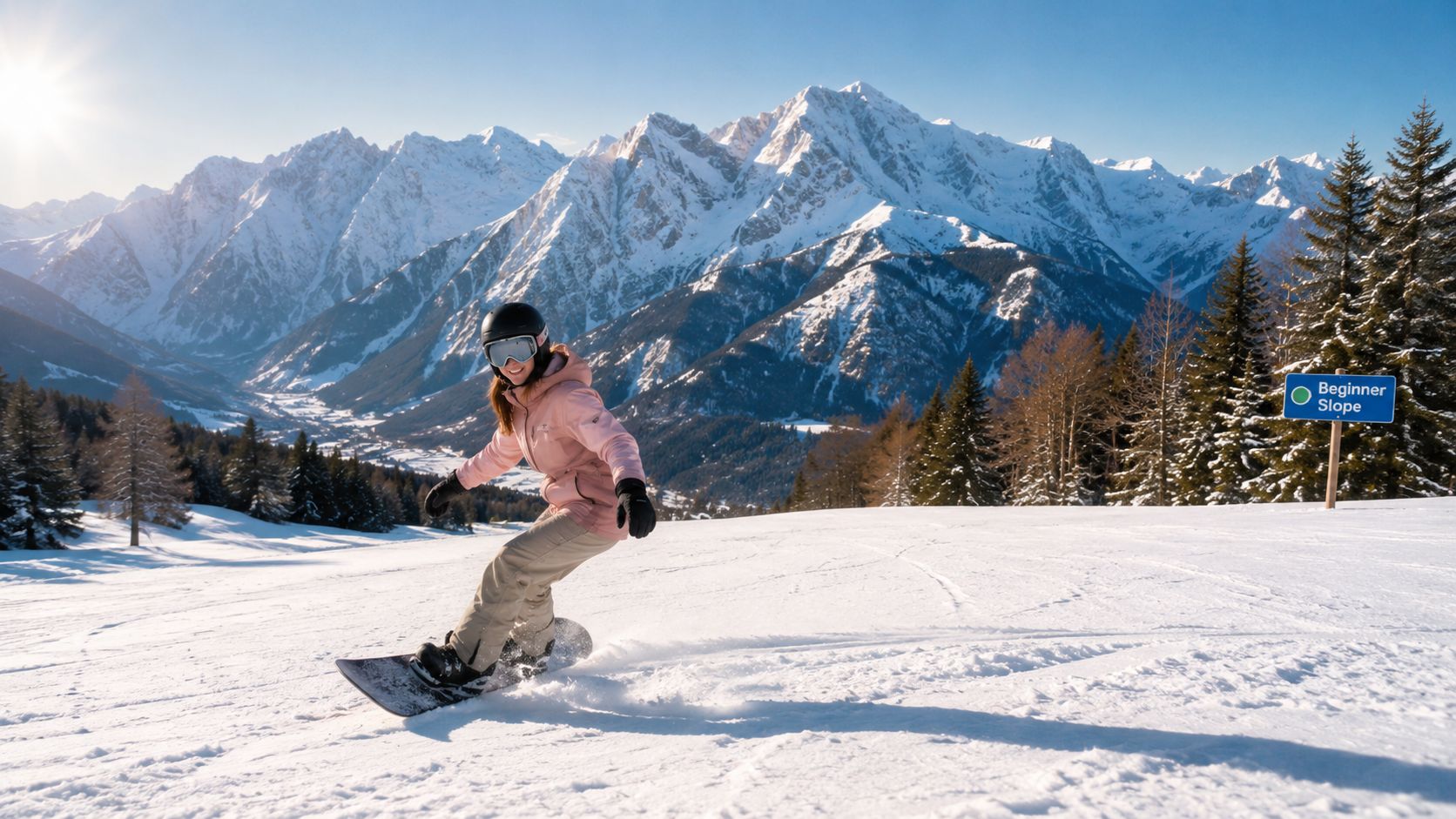
Why Slovenia suits first-time riders
I like teaching first-timers in Slovenia for a simple reason. The learning environment is often less intimidating than at many larger Alpine destinations. Around the Julian Alps, especially near Lake Bled, beginners can usually find gentle pistes, shorter transitions between lifts, and ski schools that are used to working with complete novices.
That does not mean every day is easy. Weather changes quickly in the mountains, and some resorts have flatter sections that can frustrate snowboarders more than skiers. But for a first lesson, the balance is good. You get proper alpine terrain, manageable slopes, and a pace that lets you focus on technique instead of crowd avoidance.
The local advantage is practical, not just scenic. If one area is windy, icy, or too busy for a relaxed first session, there are other nearby options without turning the whole day into a long transfer.
Where to learn near Lake Bled
Kranjska Gora is a smart choice for many beginners. The base area is easy to understand, the beginner zones are accessible, and the resort works well if you want a straightforward first day with minimal fuss. For nervous riders, that clarity helps more than people expect.
Vogel gives a different experience. It sits above Bohinj, so the mountain setting feels bigger and more dramatic, and on a clear day the views alone can settle first-day nerves into excitement. The trade-off is that conditions can feel more exposed, so I usually recommend Vogel for beginners who want a memorable mountain setting and are happy to follow an instructor's terrain choices carefully. If you want a better feel for the area, this guide to Vogel Ski Resort above Ukanc and Bohinjsko Jezero gives useful local context.
One factual option for lessons in this region is Outdoor Slovenia Activities, a Lake Bled based company that runs winter ski and snowboard instruction in Slovenian resorts for different ability levels.
For a first snowboard day in Slovenia, the best resort is usually the one that matches your confidence, snow conditions, and travel base, not the one with the biggest name.
That is why learning here often sticks with people. The first successful glide happens on a slope that feels calm, the break comes with views over the Julian Alps, and the whole day feels more like a mountain experience than a conveyor belt lesson.
Your Snowboarding Questions Answered
Do I need to be very fit
No. You don't need elite fitness to start snowboarding. A basic level of mobility, decent balance, and the willingness to get up after a few falls is enough for most beginners. Leg fatigue is normal on day one because the movements are unfamiliar, not because you're doing badly.
Is snowboarding suitable for children
Yes, if the setup is age-appropriate and the pace is patient. Children usually do well when lessons stay playful, the terrain is gentle, and the session length matches their attention span and energy. Good clothing and warm hands make a huge difference.
What if the weather is poor on lesson day
That depends on visibility, wind, snow conditions, and resort operations. Light snowfall often isn't a problem. Harsh wind, poor visibility, or lift disruption can change the plan. A professional school will adjust terrain, timing, or lesson format if conditions call for it.
How long does it take to learn
That varies a lot. Some people link basic turns quickly. Others need more time to feel relaxed on an edge. The better question is whether you can glide, stop, and move around without panic. Once those basics settle in, progress usually becomes much smoother.
Will I fall a lot
Probably, yes. But controlled, low-speed falls are part of learning. Good beginner terrain, a helmet, wrist guards, and sensible pacing make a big difference. The aim isn't avoiding every fall. It's learning in a way that keeps the falls small and the confidence growing.
If you're planning a winter trip around Bled and want help choosing the right first-day adventure, browse Outdoor Slovenia Activities for guided experiences across Slovenia, including beginner-friendly snow lessons and year-round outdoor trips.