
You’re standing by Lake Bled, looking at the water, the island church, and a row of waiting kayaks. The boat part feels simple enough. Then you pick up a paddle and hesitate. Why is one longer than another? Why are the blades slightly twisted? And does any of that really matter if you just want a relaxed hour on the lake?
It does. A veslo za kajak isn’t just something you hold while sitting in a kayak. It’s your engine, your steering wheel, and a big part of whether your time on the water feels smooth or awkward. The right paddle helps you glide smoothly past the shoreline. The wrong one can leave your shoulders doing all the work.
That’s especially true in Slovenia, where calm lake paddling and light river movement can sit very close together in the same holiday. Lake Bled invites an easy rhythm. The Sava Dolinka asks for a bit more control. If you understand a few basics before you launch, the whole experience gets easier.
Table of Contents
- Your Adventure Starts with the Right Paddle
- Understanding Your Paddle The Anatomy of a Veslo za Kajak
- Paddle Materials and Types What You Need to Know
- Finding Your Perfect Fit How to Size a Kayak Paddle
- Blade Shape and Paddling Performance
- Renting vs Buying Your Paddle in Lake Bled
- Safety and Care for Your Kayak Paddle
- Frequently Asked Questions About Kayak Paddles
- Is a kayak paddle different from a canoe paddle
- What does feather angle mean in simple terms
- How do I know if my paddle is too short
- How do I know if my paddle is too long
- Do children need different paddle sizes
- Is an expensive paddle necessary for casual holiday kayaking
- Should beginners choose low-angle or high-angle paddling
- Do guided kayaking activities provide the paddle
Your Adventure Starts with the Right Paddle
A lot of first-time visitors make the same assumption. The kayak is the important bit, and the paddle is just an accessory. On the water, it feels exactly the opposite.
Pick up the right veslo za kajak and the kayak responds cleanly. Your strokes feel even, the boat tracks more naturally, and you spend more time looking at Bled Castle and less time wondering why you keep drifting sideways. If the paddle is the wrong size or shape, the lake still looks beautiful, but your body notices the difference quickly.
Slovenia takes paddling seriously for a good reason. Veslanje, including kayaking, has been one of Slovenia’s most successful Olympic sports since independence in 1991, and Slovenian paddlers have won 15 Olympic medals in canoe slalom since 1992, including 7 golds, as noted in this Slovenian sports history source. That local paddling culture shows up in the way people here think about technique, safety, and gear.
A good paddle doesn’t make kayaking harder to learn. It makes the learning feel natural.
That matters if you’re renting for a morning on the lake, joining a family outing, or comparing options before travelling. If you want a broader look at design differences before you buy anything, Better Boat’s guide to best kayak paddles is a useful extra read. If you’re still deciding whether to paddle independently or combine your plans with a hire option, you can also browse local boat rentals in Bled.
Three simple questions usually solve most beginner uncertainty:
- How long should the paddle be? Your height and the kayak’s width both matter.
- What blade shape suits your trip? Calm lake paddling and moving water don’t ask for exactly the same stroke.
- Should you rent or buy? For most travellers, the easy answer is rent.
Understanding Your Paddle The Anatomy of a Veslo za Kajak
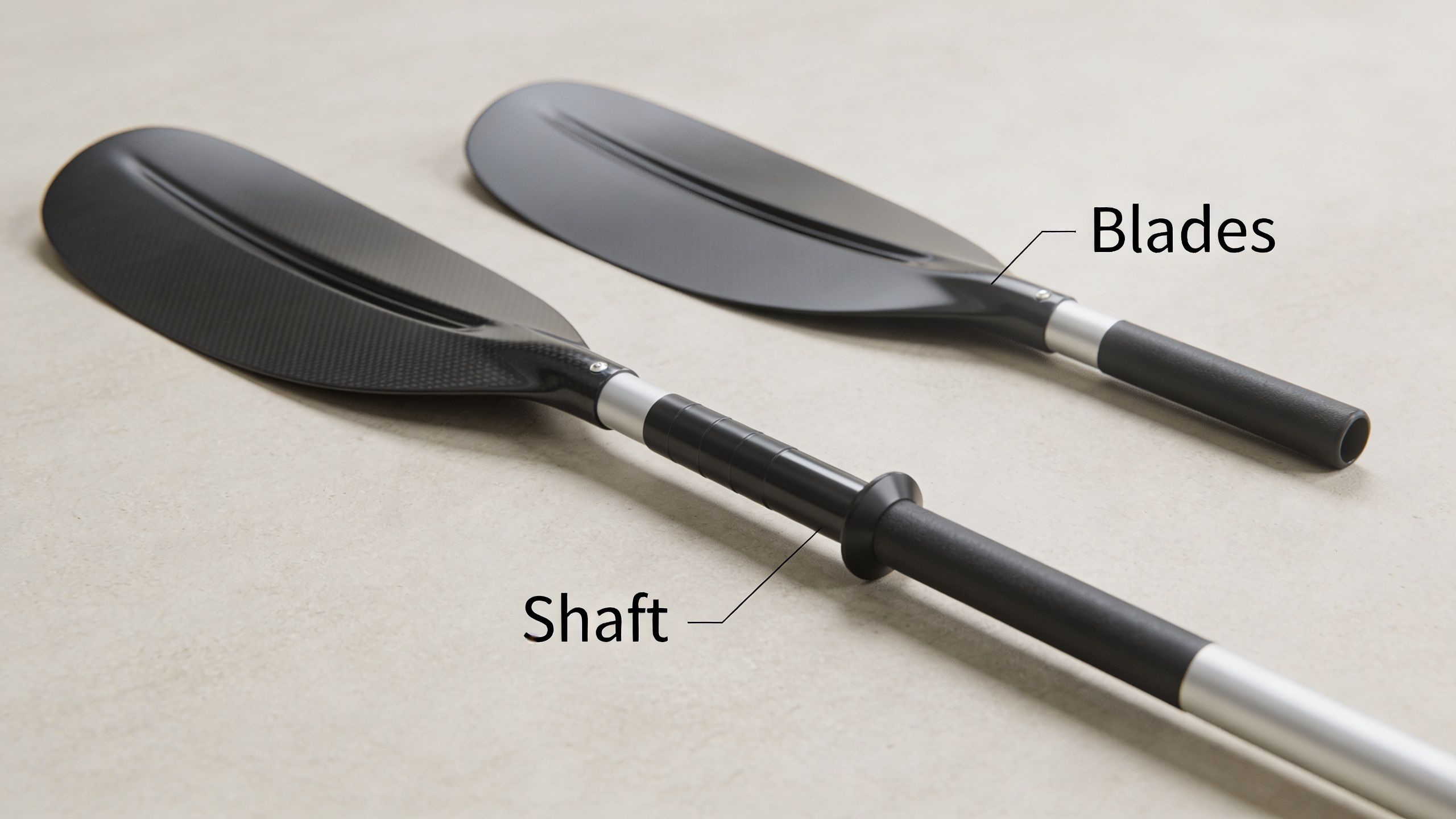
A kayak paddle looks simple at first glance. Long shaft. Blade on each end. Done. But the details are clever, and once you understand them, a lot of beginner confusion disappears.
The three parts you should know
Start with the shaft. That’s the part your hands hold. Think of it as the steering column of the whole system. A comfortable shaft lets you keep a relaxed grip instead of squeezing too hard, which is a common beginner habit.
Then come the blades. These are essential for propulsion. Each blade catches water and turns your body movement into forward travel. The easiest analogy is a spoon moving through soup. The blade shape helps it hold water cleanly instead of slipping uselessly through it.
The third part matters most on paddles that come apart. That’s the ferrule, the connector where a two-piece paddle joins in the middle. It lets the paddle separate for storage and transport, and on some models it also lets you adjust the blade angle.
Here’s the simplest way to think about the whole paddle:
- Shaft: where control comes from
- Blades: where power comes from
- Ferrule: where convenience and adjustment come from
Why paddle blades aren’t perfectly symmetrical
Many visitors notice that kayak blades don’t look like flat, identical rectangles. There’s a reason for that. The standard asymmetric dual-blade paddle often used around Lake Bled has approximately 45 × 15 cm blade dimensions and a 60-degree feather angle between blade surfaces, a design that helps create self-centring hydrodynamic stability, as shown in this Slovenian paddle specification.
That sounds technical, but the effect is easy to understand. The paddle wants to settle into the water in a more stable way. You don’t have to fight the blade as much during each stroke.
Two terms often trip people up:
- Asymmetrical blade: One side of the blade shape is slightly different from the other. That helps the blade track more smoothly in the water.
- Feathering: The blades aren’t aligned in the exact same plane. One is rotated relative to the other, which can help the paddle move more cleanly through air and water.
Practical rule: If a paddle feels like it twists in your hands every time you stroke, check the blade angle and how you’re holding the shaft before assuming you’re “bad at kayaking”.
For beginners on flat water, the paddle shouldn’t feel dramatic. It should feel quiet, balanced, and easy to repeat. That’s usually the sign that the anatomy is working with you, not against you.
Paddle Materials and Types What You Need to Know
The first paddle you use on holiday probably won’t be the last type you ever try. That’s good news. Beginners don’t need to overcomplicate this choice.
What matters most is understanding how a paddle’s material changes the feel in your hands, and how its construction changes transport and storage. You can think of this like walking shoes. A basic pair can still be the right pair for the day’s plan.
How the material changes the feel
Most visitors around Bled will first meet an aluminium shaft paddle with plastic blades. That’s the workhorse option. It’s durable, forgiving, and well suited to rental fleets because it handles regular use without fuss.
A lighter paddle usually feels nicer over a longer outing because every stroke asks a little less from your shoulders and wrists. In the Slovenian market, aluminium models are listed around 1,200 g, while carbon variants are listed around 670 g, with carbon designed to reduce paddler fatigue on multi-hour trips, according to the same earlier Slovenian product information already discussed. You don’t need racing gear for a scenic paddle, but you will feel the difference if you spend longer on the water.
Here’s how most travellers can think about the options:
- Aluminium with plastic blades: best for casual use, rentals, families, and first tries
- Fibreglass: often chosen by paddlers who want something lighter and a bit more refined
- Carbon fibre: light, responsive, and attractive for enthusiasts who paddle often
For a short Bled session, the sturdy rental paddle is usually exactly right. For repeated paddling over several days, a lighter option starts to make more sense.
One piece two piece and travel friendly options
Construction matters in a different way. It’s less about performance and more about practicality.
A one-piece paddle feels simple and solid, but it’s awkward to carry in a small car, on a flight, or through hotel storage. A two-piece paddle splits in the middle, which makes it much easier to transport and often easier to rinse and dry properly. Some paddles also come in four-piece designs, which are especially handy for travellers or operators who want compact storage.
A simple comparison helps:
| Paddle type | Best for | Main trade-off |
|---|---|---|
| One-piece | Regular local use | Harder to transport |
| Two-piece | Most travellers and rentals | Slightly more moving parts |
| Four-piece | Compact travel and mixed-use storage | Assembly takes a bit more attention |
There’s also a crossover question people ask after browsing paddle gear online. If you’re curious how paddle sizing logic compares across sports, Blitz Surf Shop has a helpful guide to find your ideal paddle board paddle. It’s a different discipline, but it helps show why length and intended use matter so much.
What you shouldn’t do is assume the most advanced material is always the best choice. A holiday paddle should match the trip, not your ambition in the shop.
Finding Your Perfect Fit How to Size a Kayak Paddle
If there’s one thing worth getting right before you push off from shore, it’s paddle length. A poorly sized paddle doesn’t just feel a bit odd. It changes your whole stroke.
The easiest comparison is a bicycle. You can ride one that’s too small or too large, but your body compensates the entire time. A kayak paddle works the same way. When the size is right, movement feels smooth. When it’s wrong, your shoulders lift, your hands work too hard, and the kayak never quite feels settled.
The two measurements that matter most
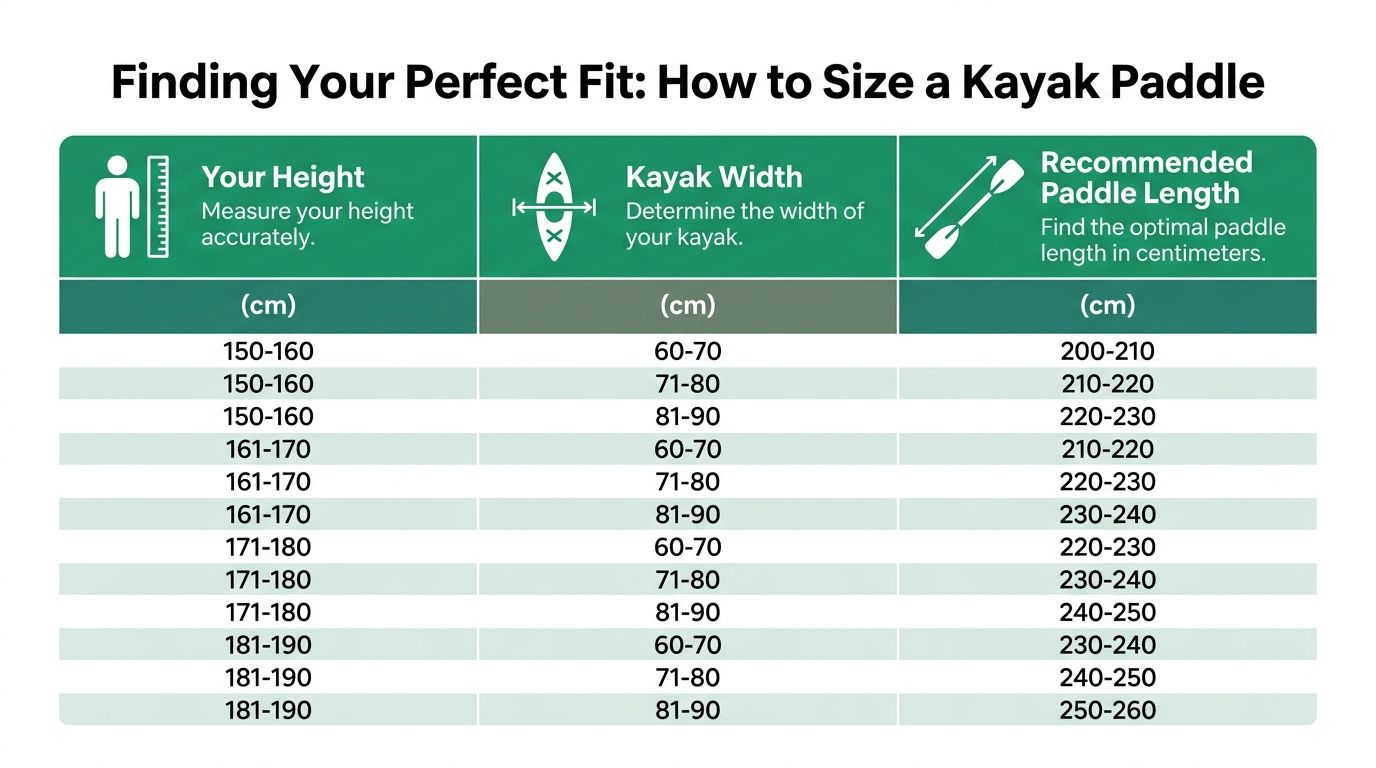
Beginners often focus only on their own height. That’s only half the answer. The other half is the width of the kayak.
A narrow kayak lets you reach the water more easily, so you can use a shorter paddle. A wider recreational kayak places the water farther from your body, so you need more length to plant the blade cleanly without awkward arm positions.
For Slovenian guidance, the relationship between paddler height and hull width is quite clear. For example, paddlers under 152 cm using kayaks up to 58 cm wide are guided toward a 200 cm paddle, while that same height range with kayaks over 81 cm wide is guided toward 230 cm, according to this Slovenian paddle sizing guide.
For the kayaks most visitors see on Lake Bled, there’s a very useful local benchmark. Recreational kayaks there are typically 70 to 80 cm wide, and average adult paddlers in the 170 to 180 cm height range usually fit best in the 220 to 230 cm paddle range. The same source notes that a paddle that is 10 cm too short can reduce stroke efficiency by approximately 15 to 20%.
If your top hand keeps rising too high and you feel cramped on every stroke, the paddle is often too short for you or too short for the boat.
A practical sizing chart for beginners
Use this chart as a quick field guide. It’s especially handy when you’re standing beside a rental rack and want a sensible starting point.
| Paddler Height | Kayak Width (< 60cm) | Kayak Width (61-75cm) | Kayak Width (> 76cm) |
|---|---|---|---|
| 150-160 cm | 200-210 cm | 210-220 cm | 220-230 cm |
| 161-170 cm | 210-220 cm | 220-230 cm | 230-240 cm |
| 171-180 cm | 220-230 cm | 230-240 cm | 240-250 cm |
| 181-190 cm | 230-240 cm | 240-250 cm | 250-260 cm |
You’ll notice something interesting here. The broad beginner boats common at tourist locations often push paddlers toward a slightly longer paddle than they expected. That’s normal.
A quick sizing method on shore works well:
- Check your height first. Don’t guess if you’re between sizes.
- Look at the kayak shape. Wide, stable recreational boats need more reach.
- Choose the calmer option for Lake Bled. A relaxed, low-angle stroke often pairs well with a slightly longer recreational paddle.
- Test a few dry strokes on land. Your shoulders should stay relaxed, not scrunched upward.
Families should be especially careful with “one paddle fits all” thinking. A parent can often manage with the wrong size for an hour. A child or smaller adult usually feels the mismatch immediately.
For holiday paddling, perfection isn’t the goal. Comfort is. If the paddle lets you dip the blade fully without knocking the boat or shrugging your shoulders on every stroke, you’re close to the right fit.
Blade Shape and Paddling Performance
Once the paddle length is sorted, blade shape starts to matter more. At this point, people often hear terms like low-angle and high-angle and assume they belong only to advanced paddlers. They don’t. They describe the style of stroke the paddle supports best.
A good way to picture it is this. Some paddles encourage a relaxed touring rhythm. Others encourage a more vertical, more powerful stroke. Neither is automatically better. The water decides.
Low angle paddling for relaxed lake trips
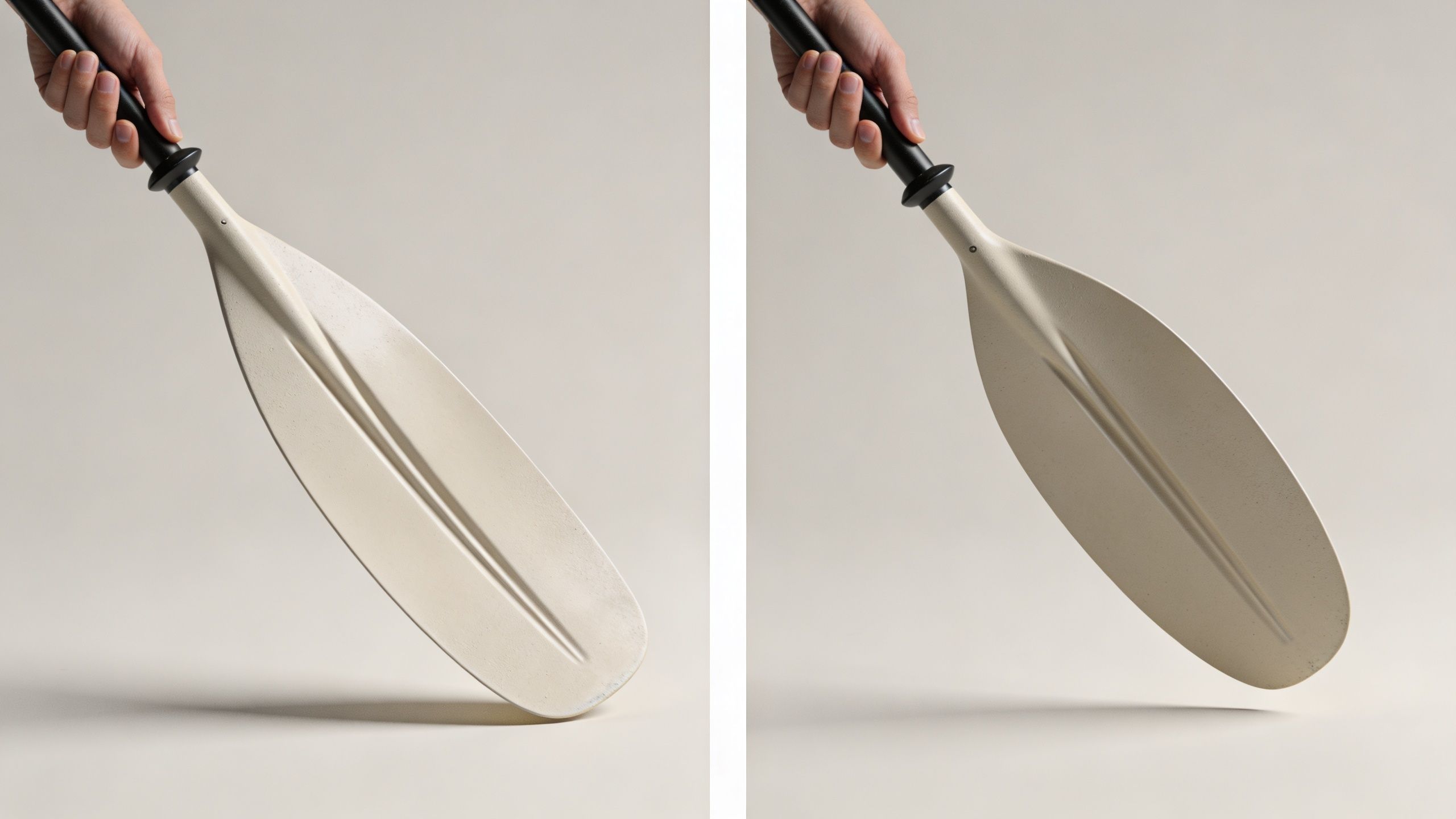
On Lake Bled, most beginners naturally use a low-angle stroke. Your hands stay lower, your movement feels easy, and the blade enters the water at a gentler angle. That suits sightseeing, photography stops, and family paddling where the goal is enjoyment, not speed.
Low-angle paddles are often longer and narrower in feel. They reward a smooth rhythm. On calm water, that rhythm is exactly what you want. You’re not trying to overpower the lake. You’re trying to glide through it.
This style also tends to feel friendlier for first-timers because it reduces the sense that you must “attack” every stroke. The kayak glides, you correct lightly, and the whole outing feels less tiring.
High angle paddling for stronger control
Rivers ask a different question. Even a gentle current can make the kayak respond faster, and tighter manoeuvres need cleaner power. That’s where a high-angle stroke comes in.
With this style, your top hand comes higher, the shaft is more vertical, and the stroke places power into the water more directly. Paddles intended for that use are often shorter and broader in blade feel. They help with control and quicker corrections.
A simple contrast helps:
- Lake Bled: lower hands, smoother cadence, easier cruising
- Sava Dolinka: more upright strokes, firmer catch, more precise direction changes
The best paddle shape is the one that matches the day you’re actually having, not the one that sounds most technical.
Beginners sometimes buy a paddle that looks sporty because they think it will perform better everywhere. On flat water, that can backfire. A more aggressive blade can feel like using hiking boots for a stroll through town. Strong, yes. Pleasant, not always.
If your holiday includes mostly lakes and easy recreational trips, choose comfort and rhythm. If you’ll spend more time on moving water with regular correction strokes, a more control-oriented blade starts to earn its place.
Renting vs Buying Your Paddle in Lake Bled
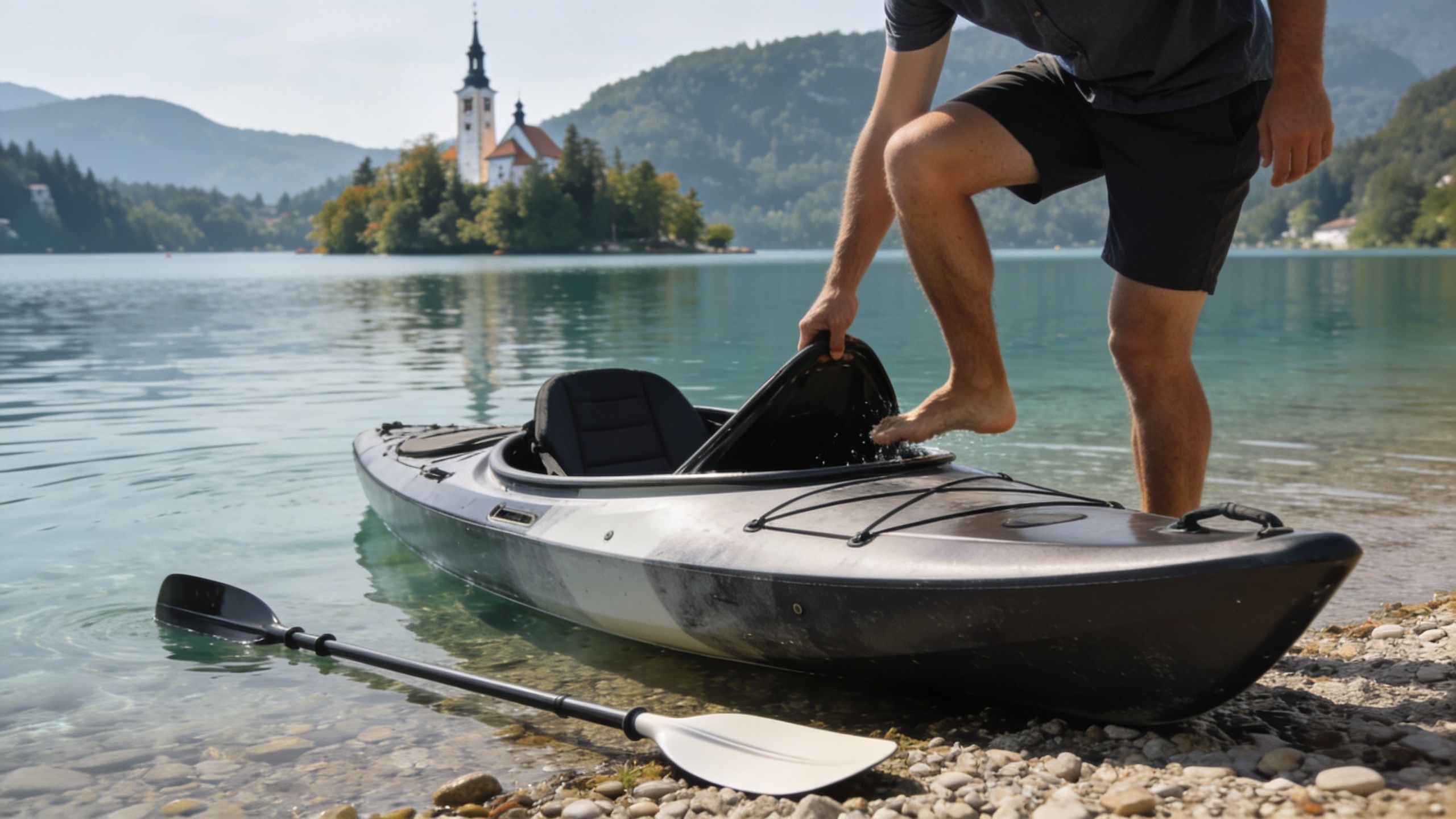
Most visitors to Bled do not need to buy a kayak paddle. They need a suitable one for the day, in the right size, in good condition, without the headache of travelling with it.
That’s why renting usually wins. It removes the hardest part for beginners, which is choosing before you’ve even felt the difference between paddle styles.
When renting makes the most sense
Renting is the smart choice if you’re in any of these groups:
- First-time paddlers: you don’t yet know what length and blade feel suits you
- Families on holiday: travelling light matters more than owning specialist gear
- Short-stay visitors: one morning on the lake doesn’t justify carrying a paddle across countries
- Casual explorers: you want the experience, not a gear research project
Lake Bled is exactly the sort of place where renting works well. You can turn up, get on the water, and spend your energy enjoying the view rather than worrying whether you chose the perfect model months ago. If you’re planning a self-guided outing, browsing kayak rental options in Bled helps you see what’s practical locally.
There’s another overlooked advantage. Renting lets you match the paddle to the specific boat you'll be using that day. That matters because, as covered earlier, width changes sizing.
When buying could be worth it
Buying starts to make sense in a narrower set of situations. Maybe you’re staying in Slovenia longer, paddling repeatedly, or you already know exactly what stroke style you prefer. In that case, owning your own paddle can give you consistency from session to session.
Ask yourself these questions before buying:
| Question | If your answer is yes | If your answer is no |
|---|---|---|
| Will you paddle often after this trip? | Buying may be sensible | Renting is simpler |
| Do you know your preferred length and stroke style? | Ownership becomes easier | Try more rentals first |
| Are you happy transporting gear? | Buying is realistic | Let the rental shop handle it |
For most holidaymakers, the answer is still clear. Rent first. Learn what feels good. Buy later if paddling becomes part of your life beyond one beautiful day on the lake.
Safety and Care for Your Kayak Paddle
A paddle isn’t only a performance tool. It’s part of your safety system. If it slips, loosens, or distracts you because it feels wrong, the whole outing becomes less comfortable.
Slovenian kayaking places real emphasis on doing the basics properly. That culture shows in formal training and equipment standards, and it supports a strong safety record in organised outings, as noted earlier in the article.
A quick check before you launch
Keep your pre-launch check short and consistent. You don’t need a mechanic’s eye. You need a paddler’s eye.
- Check the blade edges: Look for obvious cracks, splits, or severe chips.
- Inspect the shaft: Make sure it feels solid and not bent or rough where your hands will grip.
- Test the ferrule connection: If it’s a two-piece paddle, lock it together and give it a firm twist.
- Wear your PFD: The paddle helps you move. The buoyancy aid helps protect you if things go wrong.
If the water still looks inviting but the day feels chilly, understanding local conditions helps you prepare properly. A quick look at this guide to Lake Bled water temperature can help you dress more sensibly for the season.
A two-minute gear check on shore is easier than solving a problem halfway across the lake.
Simple care after paddling
Paddle care is very basic, but people often skip it when they’re tired and ready for lunch.
Do these simple things:
- Rinse the paddle with fresh water. Pay extra attention to the ferrule if it comes apart.
- Dry it before storing if you can. That helps prevent grit from settling in moving parts.
- Don’t drag blades across rough ground. It’s tempting on the shore, but it wears the edges quickly.
- Separate two-piece paddles gently. If they stick, don’t force them harshly.
Good care keeps the paddle feeling smooth in your hands. Good habits also make it easier for the next person who uses it.
Frequently Asked Questions About Kayak Paddles
Is a kayak paddle different from a canoe paddle
Yes. A kayak paddle usually has two blades, one at each end, while a canoe paddle usually has one blade. If you’re sitting in a recreational kayak on Lake Bled, you’ll almost certainly be using a double-bladed veslo za kajak.
What does feather angle mean in simple terms
It means one blade is rotated relative to the other. When you look down the shaft, the blades don’t sit in exactly the same flat line. That twist can help the paddle move more smoothly through each stroke cycle.
How do I know if my paddle is too short
The usual signs are easy to spot. You may keep lifting your upper shoulder, splashing more than expected, or hitting the side of the kayak because you can’t place the blade cleanly. On wide recreational boats, that’s a very common beginner problem.
How do I know if my paddle is too long
The stroke often feels slow and clumsy. You may notice extra strain from lifting more paddle than you need, or feel like the blades take too long to exit the water cleanly.
Do children need different paddle sizes
Yes. A family should not assume the adults’ paddle will suit everyone. Smaller paddlers usually do better with a shorter, easier-to-manage paddle that lets them keep a comfortable rhythm.
Is an expensive paddle necessary for casual holiday kayaking
Usually not. For short recreational trips, a durable rental paddle is often the sensible choice. The right size matters more than owning the most advanced material.
Should beginners choose low-angle or high-angle paddling
For calm lake outings, beginners usually feel more comfortable with a low-angle style. It’s smoother, gentler, and easier to sustain while sightseeing. Moving water can call for a more upright, stronger stroke.
Do guided kayaking activities provide the paddle
Yes. For organised guided kayaking activities, the paddle is typically included as part of the essential technical equipment, so you don’t need to bring your own unless you have a very specific preference.
If you’d like to spend less time overthinking gear and more time enjoying Slovenia’s lakes and rivers, Outdoor Slovenia Activities makes it easy to get on the water with beginner-friendly adventures, professional guidance, and the right equipment for the day.