
You're three runs into a January session near Bled, your legs are already talking back, and every turn starts to feel a little late. The board still moves, but the edges wash instead of bite, your shoulders drift downhill, and the easy green run suddenly feels busier than it did on the first lap. That's the point where how to improve snowboarding stops being a vague goal and becomes a set of small fixes you can feel under your boots.
The good news is that clean riding usually comes from repeating a few exact movements, not from hunting for a secret stance. Build the body to last, set up the stance so the board stays alive, time the edge change properly, and then practise those skills on the kind of groomed Slovenian terrain most riders learn on. If you keep that order, the hill starts giving you feedback instead of noise.
Table of Contents
- Where Most Riders Get Stuck on Slovenian Groomers
- Build a Body That Can Snowboard All Day
- Fix Your Stance Before You Fix Your Turns
- Master the Edge Change with a One-Two Rhythm
- Carve on Groomers Instead of Scrubbing Speed
- Read Snow Instead of Fighting It
- Manage Speed and Build Real Confidence on Steeper Terrain
Where Most Riders Get Stuck on Slovenian Groomers
Three laps in, the problem usually isn't courage. It's that the body is getting tired faster than the rider can adjust, so every turn starts to look the same, a little rushed and a little defensive. REI's training guidance is clear that tired legs and sore muscles make for sloppy riding on the hill, which matches what you see on resort groomers near Bled when the morning snow gets cut up and the rider starts hanging back instead of steering cleanly. REI snowboarding training guidance
The pattern is easy to spot. The shoulders point downhill before the board is ready, the front knee locks, and the rider tries to force a turn by twisting the upper body instead of letting the edges do the work. That's why improvement is usually not a single breakthrough, it's a sequence of fixes that build on each other.
The four things that matter most
- Leg stamina first, so the board can be repeated cleanly instead of survived.
- A centred stance, so pressure reaches both feet without fighting the board.
- A timed edge change, so the board rolls instead of skids.
- Terrain choice, so the drill matches the mistake and the slope stays honest.
Practical rule: if a turn falls apart on the third or fourth run, it's usually not a “style” issue, it's a fatigue issue or a timing issue.
That's why this kind of coaching works best on mellow Slovenian groomers before the run gets messy. The learner can feel the difference between a turn that is steered, a turn that is rolled, and a turn that is brushed sideways. When those differences are clear, progress speeds up because each repetition has a job.
For riders who know the Lake Bled area, that progression fits the kind of gentle resort terrain people book first. A good example is the Vogel area near Ukanc, where learners can build confidence on predictable slopes before asking the board to do anything fancy. Vogel Ski Resort near Ukanc
Build a Body That Can Snowboard All Day
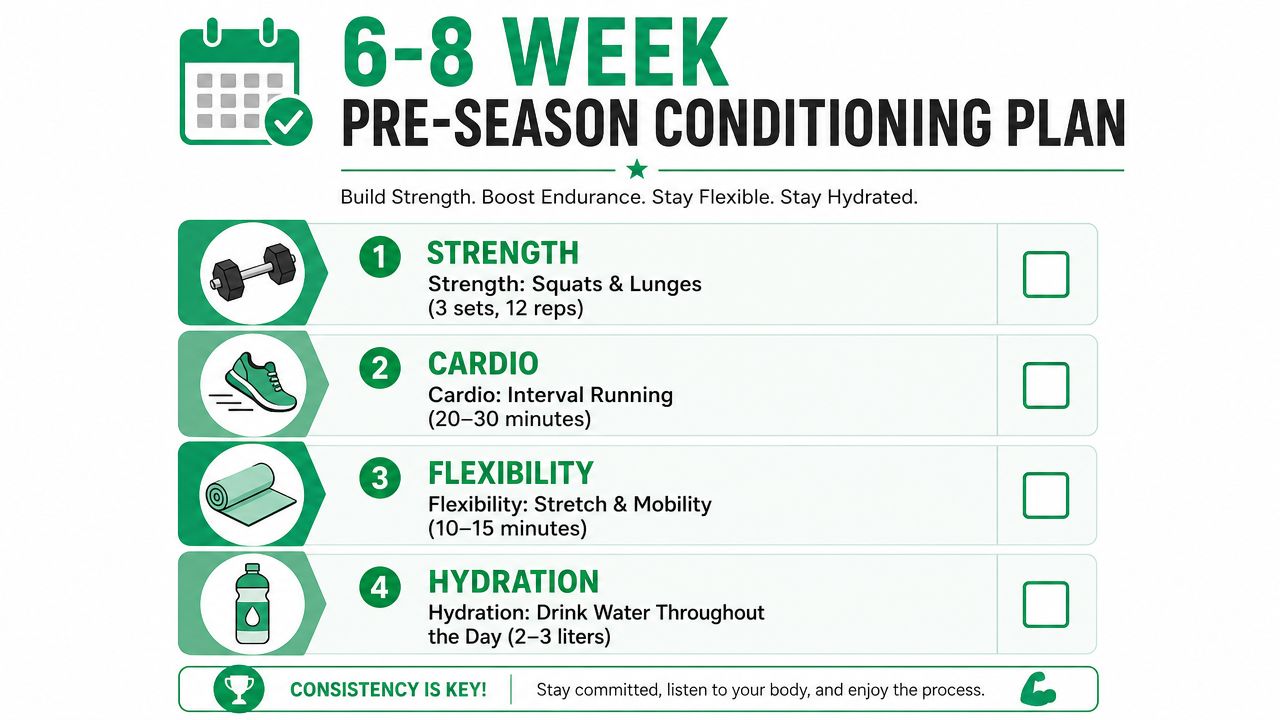
A rider can have decent technique and still fall apart halfway through the day if the body runs out of gas. That usually shows up on the same kind of mellow Slovenian groomers where learning starts, the turns get smaller, the legs start burning, and the board begins to get steered by survival instead of by shape. REI's snowboarding training guidance recommends starting prep before the season with regular conditioning sessions and cardio work, which makes sense because clean movement is easier to keep than to rebuild once fatigue has taken over.
A simple weekly rhythm
A good week does not need to feel like a training camp. Two days can focus on strength and balance, one or two can stay on the cardio side, and the rest can stay lighter with mobility, walking, or rest. The point is to arrive at the hill with legs that still listen after a few laps, not legs that feel fresh only for the first run.
The main muscle groups REI calls out are the glutes, quads, hamstrings, thighs, and calves. Those muscles hold the board stable when the run gets longer, the snow gets choppier, or the turn starts to flatten into a skid. REI snowboarding training guidance
What to do in practice
- Strength: squats, lunges, step-ups, and split squats help the legs keep pressure steady instead of collapsing when the slope asks for repeated turns.
- Cardio: brisk uphill walking, cycling, or steady running builds the kind of endurance that keeps decision-making clear on the second and third lap.
- Balance: single-leg stands, wobble board work, and controlled side-to-side shifts train the body to stay quiet when the board tips from edge to edge.
- Mobility: hip openers, ankle circles, and calf stretches keep the stance from feeling jammed up, which matters when the rider needs to absorb terrain instead of fighting it.
For riders who like to compare recovery and training support, a guide to top athletic performance supplements can be useful background reading, especially if the training habit is already in place and the next step is sorting through options carefully.
Bottom line: if the legs quit first, the turns get noisy, the stance gets narrow, and the board starts doing less of the work.
That is why fitness matters even on easy resort days. The rider who can stay composed through a full set of groomed laps learns faster, because each turn still feels deliberate near the end of the day. On cold days, comfort becomes part of the equation too, so it helps to sort out layers and gloves before the wind and snow start stealing warmth from your hands and thighs. A practical place to start is this guide to cold-weather gear.
Fix Your Stance Before You Fix Your Turns
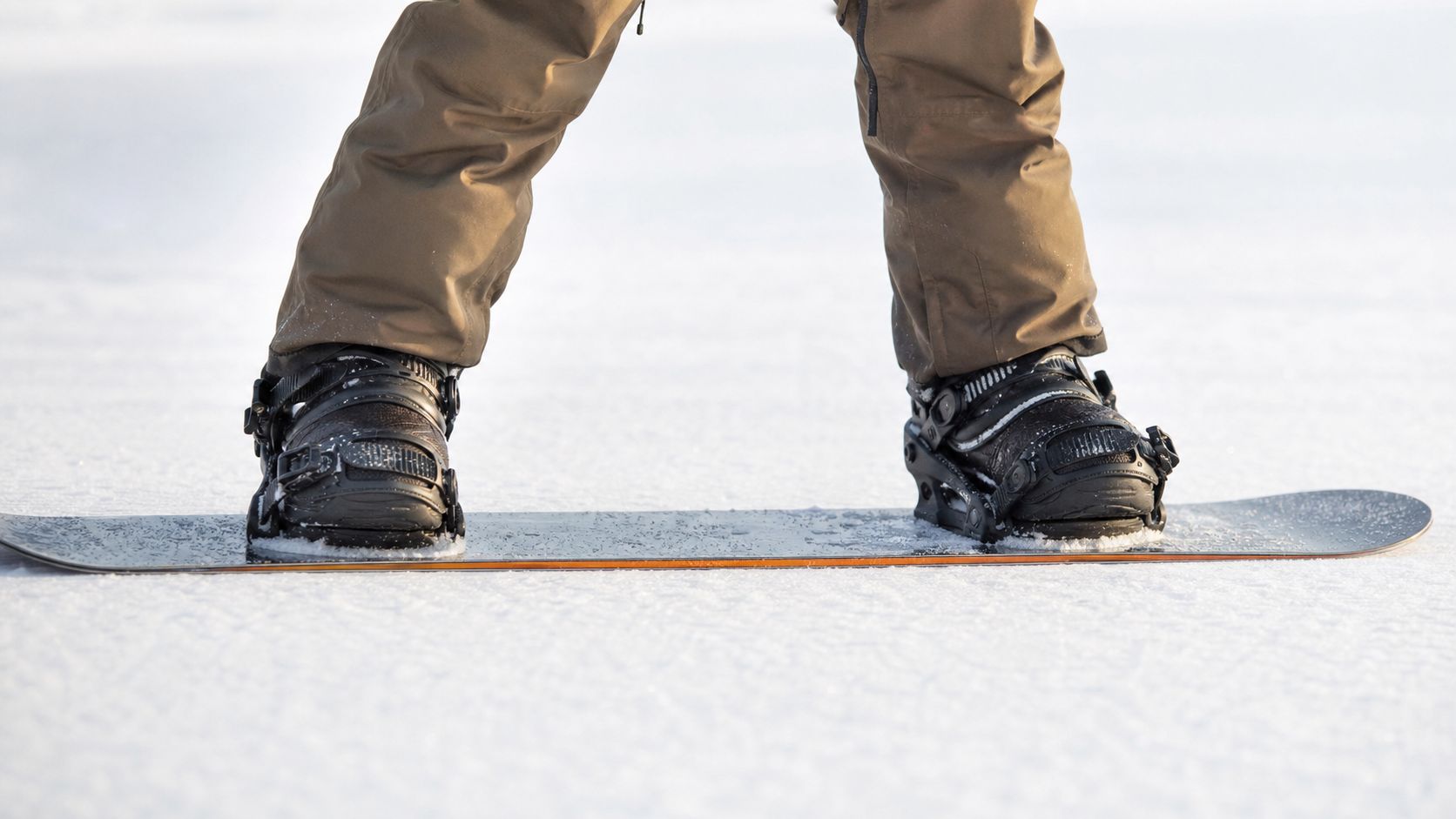
On the gentler groomers above Bled, the riders who struggle most usually are not missing a fancy trick. Their stance is already working against them. If the weight sits too far back, the front foot stops steering. If the knees stay locked, the board cannot roll from one edge to the other. If the shoulders twist away from the board, the whole turn starts to feel noisy and rushed. A better setup is centred, athletic, and flexible, with soft knees and ankles ready to absorb the slope instead of bracing against it.
The stance check that catches most mistakes
A lot of riders hear “stay low” and turn that into a crouch. That usually blocks the board instead of helping it. A more useful cue is to stand a little taller before the edge change, then let the body settle into the next edge with control. That matches the coaching advice in REI intermediate snowboarding techniques, where the focus stays on keeping the board organized across the fall line and letting the upper body work with the terrain instead of against it.
Use the chairlift ride as a quick reset. Check whether the front knee is soft, whether the hips stay over the board, and whether the chest points where the board needs to go rather than where nerves want to pull it. If any of those pieces drift, the turn usually starts with a correction at the top of the body, not with a harder push from the legs.
Common stance errors to notice early
- Leaning back on heelside turns, which makes the front of the board less useful and leaves you steering from the rear.
- Locking the front knee, which narrows your range and makes the edge change feel sudden.
- Dropping the shoulders downhill too early, which twists the board before it has finished the current turn.
- Sitting too low all the time, which takes away the small amount of extension you need when the board has to roll.
Stand tall enough to move, low enough to absorb, and centred enough to let the board speak.
That balance matters on early-season laps because the hill gives you repeated chances to feel the difference. On easy Slovenian groomers, a centred stance feels calm and predictable, while a backseat stance quickly makes the nose feel muted and the tail do too much of the work. Riders who clean up this setup often notice that their turns start improving before they can explain why.
For a beginner-friendly reference that fits the same kind of resort terrain, the guide on snowboarding for beginners is a useful companion to this stance work.
Master the Edge Change with a One-Two Rhythm
A clean edge change often looks simple from the side of a green run, but the timing behind it is where many riders slip. On the early-season groomers around Bled, the board usually gets noisy at the moment the rider tries to switch edges too quickly, or tries to move the whole body before the board has finished releasing. The one-two rhythm fixes that by splitting the change into two clear parts, first the front foot, then the back foot, then the hips come across so the new edge can hold without a snap. YouTube coaching example on one-two edge timing
Feel the board roll, not jump
Start the new turn by allowing the front foot to lead the release. Under your front binding, the board should begin to feel lighter on the old edge before the rear binding fully follows. If both feet switch at once, the board often pivots instead of rolling, and that is the feeling many riders mistake for a “bad carve.”
Let the back foot complete the change after the front foot has already started it. Then send the hips across the board so pressure settles onto the new edge in one clean line. The goal is a turn that feels like the board is being laid over in stages, not kicked over from the middle.
That matters because a lot of skidding starts with timing, not effort. Riders usually try to fix a messy edge change by forcing the legs harder, but the actual problem is often that the upper body and both feet arrive together. On a quiet Slovenian groomer, that mistake shows up fast, because the snow tells the truth the moment the board stops tracking and starts washing sideways.
Drills that show the mistake clearly
Use the hill to make the error obvious. A simple one-turn-to-a-stop on a green slope tells you whether the board can release cleanly without a rushed twist. If the turn feels abrupt, the front foot probably waited too long or the shoulders started the turn before the board had rolled.
A set of easy traverse-to-traverse changes helps too. Hold the line, let the front foot begin the new edge, then let the rear foot and hips follow in order. If the board feels like it grabs and releases in one sharp moment, the timing is still compressed.
Another useful check is to repeat gentle toe-to-heel transitions with no hurry to finish the turn. The point is not to make bigger turns, it is to hear and feel the sequence. When the order is right, the board stays calm under you, like a door swinging on a hinge instead of getting yanked open.
Coaching cue: front foot starts, back foot finishes, hips arrive last.
Once that rhythm clicks, the turn usually feels quieter and more controlled, not more dramatic. Riders often expect clean edge work to feel aggressive, but on a green run near Bled, the better timing usually feels almost patient. That is a good sign. It means the board is doing the work instead of the rider forcing the transition.
Carve on Groomers Instead of Scrubbing Speed
A clean carve is more than a prettier turn. It keeps the board engaged in the snow instead of skimming across it. On Slovenian groomers, especially the early-season runs that still hold a firm, readable surface, that difference shows up quickly. The board either follows the arc you asked for, or it leaves a thin sideways scrape that tells you the edge was never really set.
The best place to feel that difference is a quiet slope near Bled, where the hill is smooth enough to show what your feet are doing. If the board drifts when you try to turn, the problem is usually not a lack of effort. It is usually that the edge angle came on too fast, or the rider tried to force the shape of the turn before the board had time to engage.
Why more crouch is not always the answer
A lot of generic coaching says to bend more, but the cleaner question is whether your body is collapsed or organised. Coaching resources often describe a small rise or unweighting before the board rolls onto the next edge, which means many riders need a little more upright extension at the edge-change moment, not a deeper squat. Red Bull intermediate snowboarding tips points riders toward that same idea through edge control and body position.
That matters when toe-to-heel transitions keep scraping. A rider who stays folded up through the change often blocks the board from flowing into the new edge. The turn starts with too much pressure already loaded, so the board skips sideways instead of drawing a clean line.
Powder advice can also confuse the issue. A centred stance still matters in softer snow, but the weight shifts only slightly toward the rear so the nose stays light enough to steer. Sitting too far back makes the board harder to guide, not easier.
A simple carving ladder
Start with a traverse and let the board hold a clean edge. Feel the edge bite without trying to force a turn yet.
Then add a gentle turn initiation and keep the shoulders calm and matched to the board. The first movement should come from the feet and ankles, not from a twist in the upper body.
From there, build edge angle gradually through the middle of the turn. If you feel the board tighten its arc without spraying snow sideways, the pressure is coming on in the right order.
Finish with a little more edge, then let the board release smoothly into the next traverse. The point is to let pressure build through the turn, not dump it all at the start.
That pattern works well on the groomed runs around Bled, especially early in the day when the snow is still even and easy to read. It gives direct feedback. A round, quiet turn means the edge is doing its job. A scraped turn means the rider rushed the entry or leaned too hard before the board had time to set.
A clean carve usually feels quieter than a skid. The body settles, the edge holds, and the board finishes the turn with less drama than the rider expected. That is the sign of control on a groomer, the slope is being guided instead of fought.
Read Snow Instead of Fighting It
The surface changes the job before you even finish the first turn. Hardpack asks for tidy edge control and a board that stays organised. Powder wants a centred stance with a small shift toward the back foot so the nose stays light. Mixed snow asks for patience, because the board can sink, bounce, or deflect in the same run. The mistake is treating every patch like a groomer and then wondering why the board stops listening.
Read the surface before you commit
On hardpack, keep pressure even through the middle of the board and let the edge do the work. On softer snow, stay balanced, then ease a little more weight toward the rear without collapsing into the tail. That small adjustment keeps the nose from burying while the ankles stay loose enough to guide the board. If you sit too far back, steering gets harder, not easier.
A useful cue is to ask what the snow is asking for before each turn. If it is firm, build edge cleanly. If it is soft, keep the stance centred and let the front of the board stay light. If the run is chopped up, shorten the turn and stop trying to force the same clean carve you used five minutes earlier.
Match the turn to the terrain
- Clean groomer, stay centred, let the edge set gradually, and keep the turn round.
- Powder, stay centred with a slight rearward shift and keep the ankles soft.
- Mixed or chopped snow, shorten the turn and let the board move instead of fighting every bump.
That simple choice makes a rider easier to trust on the hill. The board starts feeling more predictable because the stance matches the snow under it, not the habit from the last run. On early-season groomers around Bled, where the snow often changes from smooth to broken in a few turns, that habit matters even more. A rider who reads the surface stays calmer. A rider who keeps trying to overpower it usually gets bounced around and loses timing.
Shorter turns on groomed runs are a good bridge into that awareness. Aspen Snowmass snowboard pro tips recommends that kind of progression because it helps riders close a turn cleanly before asking the board to handle rougher snow. Red Bull intermediate snowboarding tips also points riders toward a centred stance and softer ankles in deeper snow, which fits the same idea. Read the surface first, then choose the turn shape that matches it.
Manage Speed and Build Real Confidence on Steeper Terrain
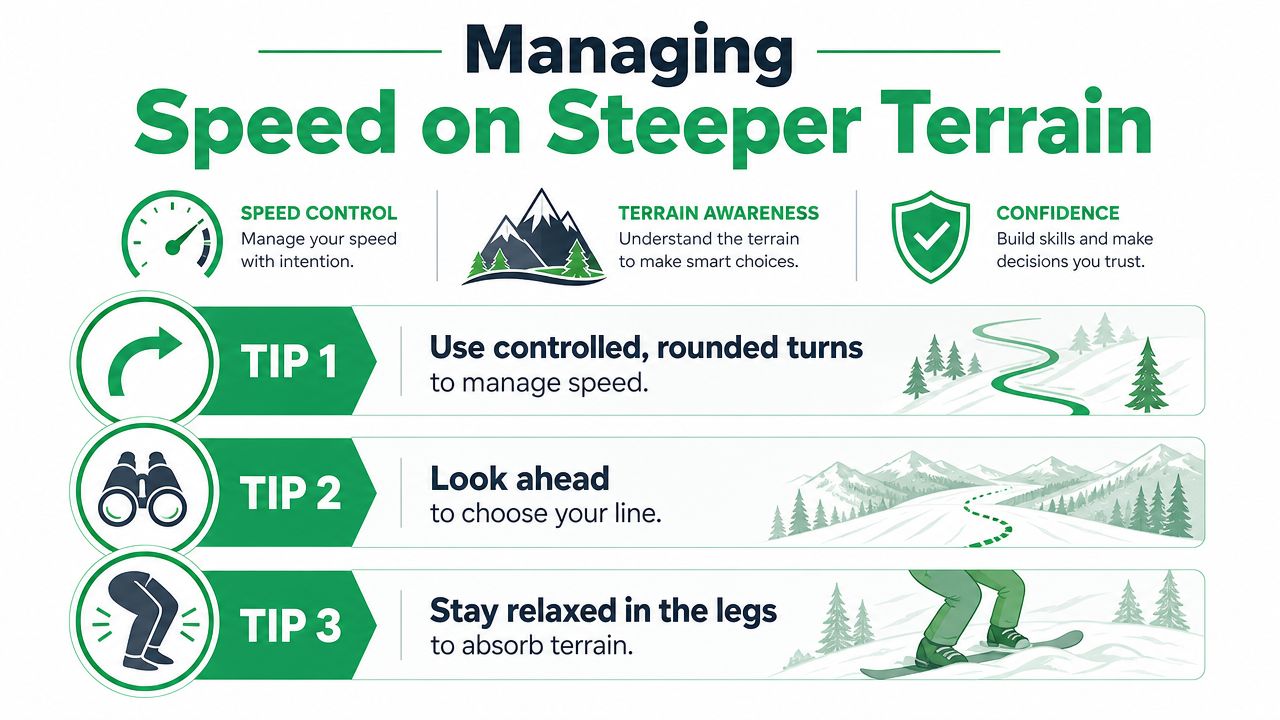
Speed control gets easier when the turns are deliberate. Aspen Snowmass recommends using shorter turns on groomed runs so riders can close a turn quickly in ungroomed terrain, and that logic works well for progression on steeper terrain too. Aspen Snowmass snowboard pro tips
A progression that holds up under pressure
Start on green groomers until the turns feel repeatable. Then move to shorter-radius turns on steeper blues, where the slope asks for a little more commitment without punishing every mistake. After that, blend pivot and carve in terrain where the snow is less tidy, because that's where real-world control shows up.
Flexed knees and ankles matter here because they work like suspension. They absorb chatter, keep the board touching the snow, and let you adjust on the fly instead of bracing against the hill. That's also why confident riders look more relaxed than tense, even when they're moving faster.
A few habits that keep the run calm
- Look ahead early, so you choose a line before you need it.
- Keep the shoulder line a touch open, so the torso doesn't jam the board.
- Stay loose in the legs, especially when the surface turns uneven.
- Take a lesson early, because small errors are easier to fix before they become habits.
Confidence also comes from knowing when to stop before fatigue wins. The rider who ends the session while still making clean turns usually improves faster than the rider who keeps going until the movements fall apart. That's especially true on unfamiliar resort terrain, where the lines, pitch, and snow texture can change quickly.
A good lesson near Lake Bled can turn these ideas into muscle memory much faster than guessing alone. If you want a friendly, professional day on snow with clear instruction and the right local terrain, explore Outdoor Slovenia Activities and book the kind of guided snowboard experience that helps the details finally click.