
You're standing at the bottom of a gentle slope, boots soft, board awkward, gloves already a bit damp, and one question keeps looping in your head, “Am I about to look ridiculous?” That feeling is normal. Many people who book snowboard lessons for beginners are not chasing style points on day one, they're trying to survive the first few clips, the first wobble on the magic carpet, and the first moment the board starts to slide faster than their nerves would like.
The good news is that beginner snowboarding is usually less about talent and more about patience, repetition, and a calm instructor who knows how to keep things small and safe. Most novices need 3 to 5 lessons to learn the basics, and a common beginner budget for those basic sessions sits around €200-350 before rental gear and lift tickets are added, with group lessons typically at €45-65 per day and private lessons at €60-120 per hour (lesson planning benchmark). That may sound like a lot until you realise you're not buying tricks, you're buying confidence, control, and a much calmer first week on snow.
Table of Contents
- What Your First Snowboard Lesson Really Feels Like
- How a Beginner Snowboard Lesson Is Structured
- Stance, Balance and Your First Turns
- Group, Private or Package, Which Lesson Format Suits You
- Falling Safely and Staying Injury-Free
- How Snowboarding Lessons Differ From Skiing Lessons
- Choosing Beginner Slopes, Lifts and Rental Gear
- Realistic Progress and Booking Your First Lesson
What Your First Snowboard Lesson Really Feels Like
The first ten minutes are mostly nerves
The first thing many adults notice is how strange the board feels under both feet. You are not stepping one foot free like in everyday walking, so every small movement suddenly matters, and that can make even flat ground feel oddly exposed. If you are worried about looking inexperienced, you are in good company. Every beginner looks unfinished for a while, and every instructor expects that.
The day usually starts with basic admin, gear checks, and a quick talk about what is ahead. Then comes the first strap-in, the first attempt to stand, and the first laugh at how little your body wants to cooperate. That awkwardness is just the board reminding you that balance needs a few tries before it starts to feel natural.
Practical rule: if the first five minutes feel clumsy, that is not a problem, that is the lesson beginning to work.
Why the first slide feels louder in your head than it is in reality
Nervous adults usually fear speed before technique. They picture a runaway descent, but the actual beginner slope is gentle, controlled, and full of pauses. Your instructor will keep the terrain simple enough that you can stop, reset, and try again without pressure.
There is also the fear of falling, and that one makes sense. Snowboarding puts your wrists, knees, and shoulders in the conversation early, so the first lesson usually includes enough attention to falling and getting up that you do not feel abandoned when the board tips you over. Week one can feel emotionally bigger than the terrain itself, because your mind is learning a new kind of balance while your body is still deciding where to put its weight.
By the end of the first session, you are usually not “snowboarding” in the cinematic sense. You are learning how to stand, move a few metres, stop, and stay calm when the board starts to drift. That is a real win, and it is the right one for day one. Industry benchmarks suggest that repetition matters more than distance at this stage, and that is why the smallest, steadier gains often feel like the biggest relief.
How a Beginner Snowboard Lesson Is Structured
A lesson is built around short, repeatable moments
A first lesson usually starts on flat ground, because snowboarding makes more sense when you are not also managing a downhill slide right away. The instructor checks your stance, shows you how to sit down and stand up with the board, and then has you try a few basic movements before you point downhill. That first block can take a fair part of the session, but it prevents you from trying to learn balance while the board is already moving faster than your confidence.
From there, the lesson usually shifts to the magic carpet or another very gentle lift. Beginners need repetition more than distance, and that is the quiet logic behind the whole structure. A few short glides, a stop, then another glide gives your body a chance to register what the board feels like without piling fear on top of every new movement.
The rhythm usually moves from standing to sliding to stopping
Once you can stand without freezing up, the instructor leads you into the first straight glides. These are kept short on purpose, because the goal is to feel how the board behaves on flat snow and on an edge, rather than to cover distance. After that, you usually work on heel-side and toe-side traverses, which feel more like controlled side-slips across the slope than full turns.
That sequence, flat ground, carpet, glide, edge control, gives your body time to build memory in small pieces. A beginner lesson is closer to learning the rhythm of a new instrument than trying to perform a song on the first try. The instructor keeps the task simple, so your attention stays on balance, pressure, and recovery when the board starts to drift.
A good session also leaves room for the emotional side of week one. Fear makes people tense, and tension makes snowboarding feel harder than it needs to be. If you want a clear overview of what newer riders usually practise after that first day, the Outdoor Slovenia snowboarding tips for beginners explain the early habits that help those first lessons stick.
By the end of the lesson, the instructor usually stops while you still have energy left. That feels a little restrained in the moment, but it is sensible teaching. Finishing before you are completely worn out means your next lesson starts from memory, not from panic.
Stance, Balance and Your First Turns
The body position comes before the steering
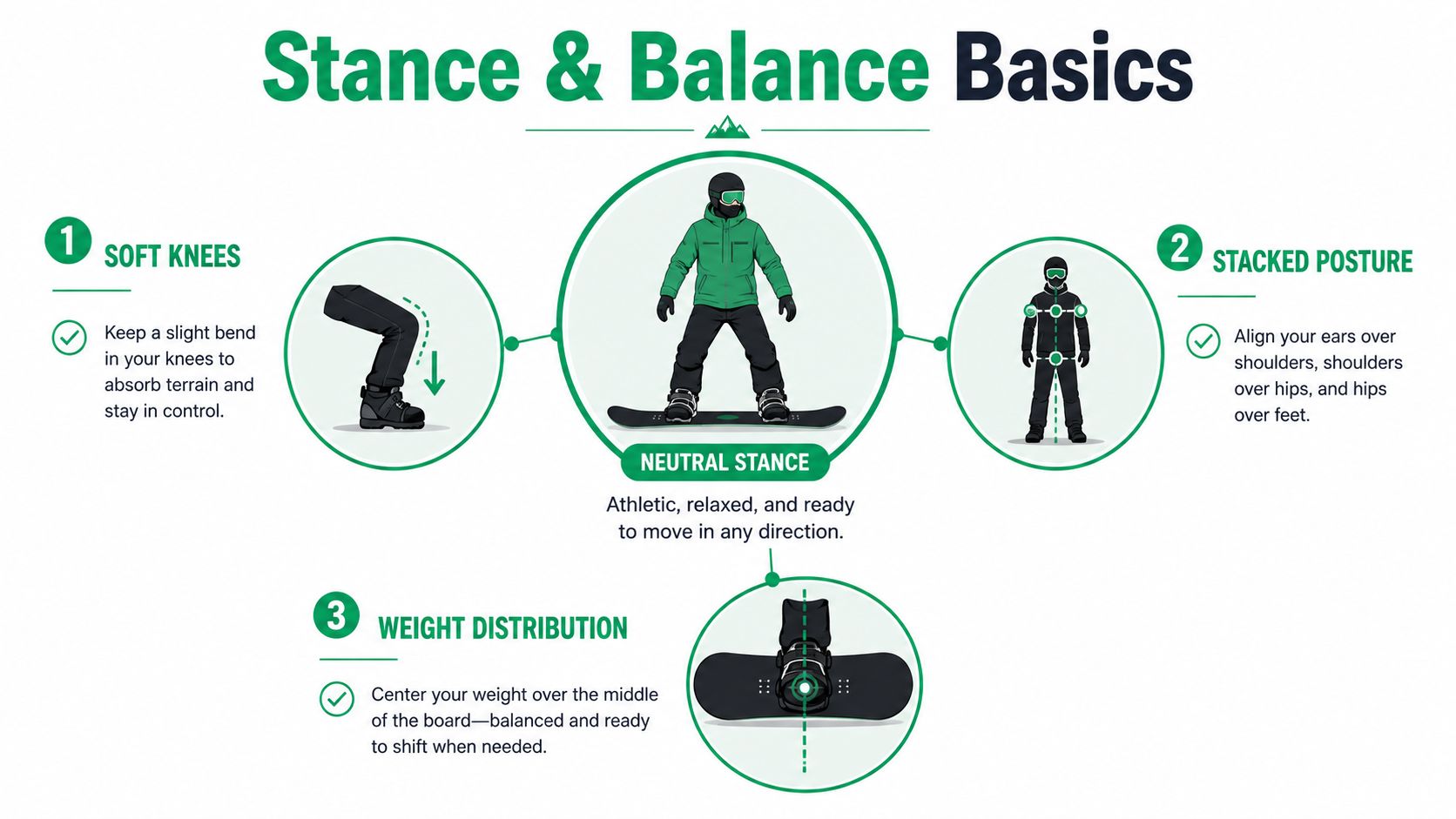
Beginner snowboard coaching usually starts with the same simple idea, keep your body centred and relaxed. Your knees stay slightly bent, your shoulders and hips stay aligned over the board, and your weight moves through the ankles and knees, not through a big upper-body twist. REI's beginner guidance makes that centred, athletic stance the foundation for predictable edge engagement on gentle terrain (REI snowboarding basics).
That stance matters because new riders often try to force the board with their shoulders. The problem is that upper-body rotation creates surprise movement, and surprise movement makes beginners feel as if the board is deciding things for them. A steadier stance gives you control before you ask for turns.
Heel-side and toe-side work are really about pressure, not drama
The first edge drills look simple from the outside. You'll slip a little, traverse a little, stop, then repeat the same movement with the other edge. The instructor is helping you feel how the board responds when pressure shifts from one side to the other.
The trick is not to rush the turn. Learn to feel the board flatten, edge, and slow down before you try to make it do anything clever.
That's why beginner lessons spend time on mellow slopes with lots of repetition. You're not chasing speed or style, you're teaching your nervous system that one edge can hold you, and the other edge can guide you back. Once that happens, the first gentle turns across the fall line start to feel less like luck and more like timing.
For a deeper technique refresher later on, use the guide on how to improve snowboarding. It's the kind of resource that makes sense after your first few wobbly sessions, when the basic movements start to connect.
Group, Private or Package, Which Lesson Format Suits You
The right format depends on what you're bringing to the hill
The first lesson often feels like standing on a moving walkway while trying to remember how balance works. Some riders want a bit of company so the nerves settle faster, while others need the instructor's full attention from the first slide. Group lessons suit the first type of learner, because they share the pace, share the atmosphere, and can watch other beginners make the same wobbly mistakes.
That usually makes group lessons the most accessible starting point. Beginner group pricing often sits around €45-65 per day in the benchmark data. A group works well if you want to learn beside other people and are comfortable with corrections coming in turns, rather than all at once. For a nervous adult, that can feel less intense, because you are not the only person who pauses too long before the next glide.
Private lessons feel different from the first minute. The instructor can watch your stance, your shoulders, and the tiny habits that make a board slip or hold, then adjust the lesson to match what you need. The same benchmark places private lessons at €60-120 per hour, and another beginner guide quotes private lessons at roughly $100-180 per hour in the US market (beginner package overview). That extra focus often suits riders who freeze up easily, because the pace can stay slow enough for the body to catch up with the instructions.
Packages help when you're starting from zero
Bundled formats are useful when the day needs to be simple. If you need the lesson, rental gear, and lift access in one place, a package removes a lot of small decisions before you even step onto the snow. One beginner guide reports first-timer packages around $109-200 in the US, while rental gear alone can run $30-100 per day (beginner package overview). That is why packages often suit true first-timers, especially when you do not own boots, a board, or a pass.
A package can also help the first hour feel less chaotic, because the school has already lined up the pieces that beginners usually juggle awkwardly. If you are comparing where to book, Kranjska Gora ski school options are one example of how a lesson centre can keep the setup contained in one place. A practical way to choose is simple, do you want company, full attention, or the convenience of having the basics handled for you?
Simple choice guide: group for atmosphere, private for confidence, package for convenience.
Falling Safely and Staying Injury-Free
Learning to fall is part of learning to ride
A snowboard lesson shouldn't treat falling as a failure. It should treat it as a skill. The goal is to keep the body compact, avoid straight arms, and let the larger parts of your body absorb the load instead of the wrists taking everything at once.
That focus matters because the injury pattern for first-time riders is real. A PubMed study of first-time snowboarders recorded 273 injuries among 6,585 riders, which is 4%, and snowboarders had a higher share of upper-extremity injuries at 53% than first-time skiers (PubMed study). Another safety fact sheet says novice snowboarders should learn correct snowboarding and falling techniques through lessons, and it notes that many injuries happen in the first week of learning (Sports Medicine Association fact sheet).
Gear and warm-up both matter more than bravado
The easiest protection steps are also the least glamorous. A helmet is standard beginner gear, and wrist guards are especially sensible because so many falls start with a reflex to catch yourself. Some riders also use impact shorts and other padding, but the big point is that protection should make the first lesson calmer, not more complicated.
A short warm-up helps too, especially if you've travelled, sat in a car, or spent the morning stiffening up in rental boots. If you want a quick movement routine before heading out, the warm-up ideas in MEDISTIK's injury-prevention guide are useful context before any active day on snow.
How Snowboarding Lessons Differ From Skiing Lessons
Snowboard lessons ask both feet to learn together
Skiing and snowboarding do not feel alike in the first hour. On skis, your legs can act independently, which often makes the early balance and braking feel more familiar to adults. On a snowboard, both feet are fixed to the same board, so the learner has to understand edge control before the board feels cooperative.
That's why snowboard lessons usually spend more time on a very gentle slope or the magic carpet at the start. The board needs a calmer learning environment because it does not forgive big movements in the same way skis do. The early frustration is common, but it's temporary.
The learning curve is different, not worse
Snowboarding often feels awkward before it feels easy. Skiing can look smoother at the beginning because the stance is more familiar, but snowboarders usually get a more flowing ride once the board edges start making sense. That's the part many adults underestimate. The first hours are heavy on balance and patience, then the sport starts to click in a way that feels surprisingly natural.
So if you're choosing between the two, don't ask which one is universally easier. Ask which one you want to practise. Snowboarding suits people who don't mind a little early frustration in exchange for a single-board feel that becomes very satisfying once the basics settle in.
Choosing Beginner Slopes, Lifts and Rental Gear
The slope should feel wide, quiet and forgiving
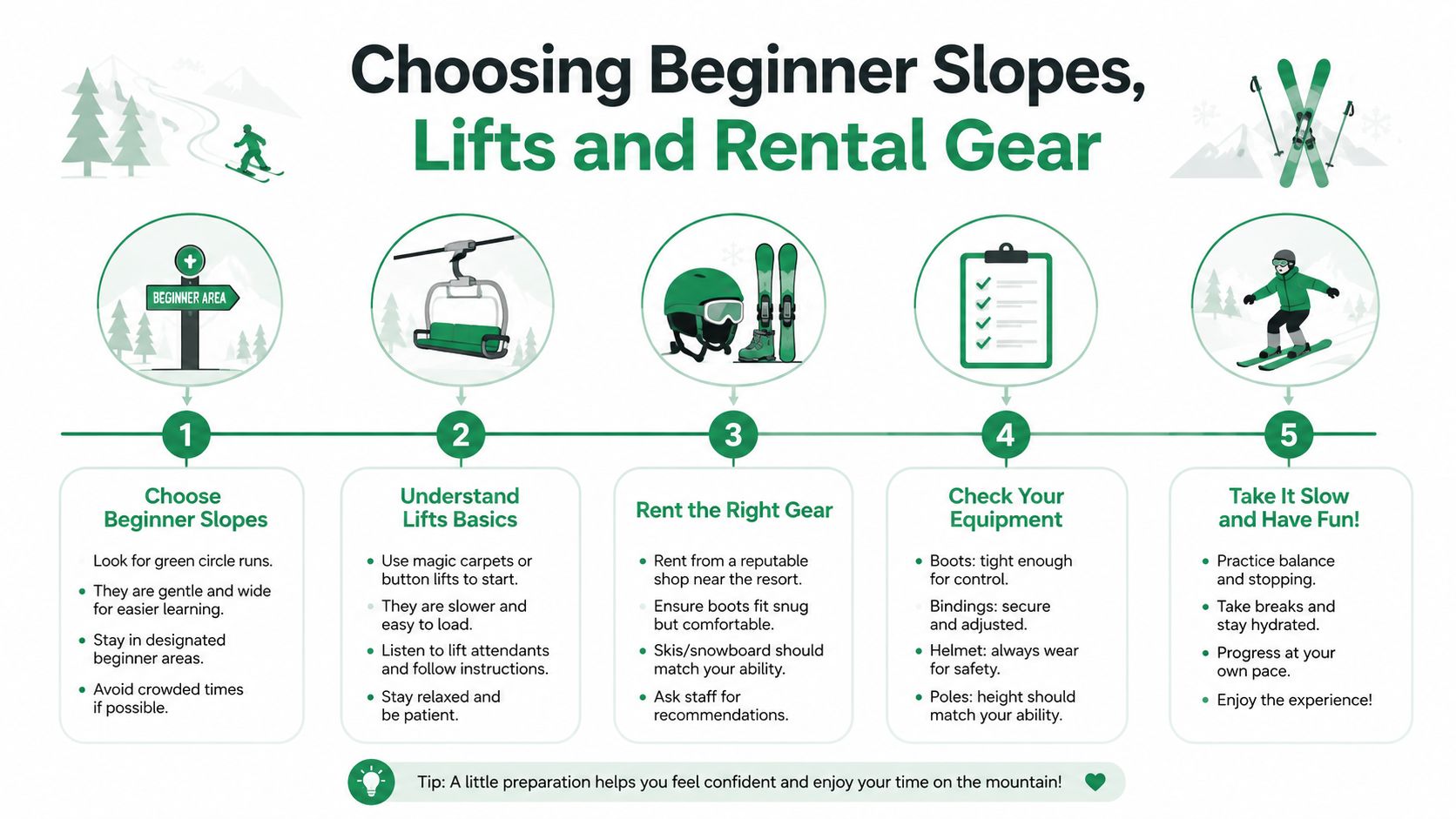
A true beginner slope is gentle enough that you can stop without panic and wide enough that you're not dodging other riders every few seconds. A magic carpet or a short beginner chair is ideal because it lets you repeat the same movement without a long, stressful ride back to the top. If the hill looks busy or steep, it's probably not the right place for your first day.
Rental setup matters just as much. Your board should be matched to your stance and the shop should help you get a comfortable boot fit, because sloppy boots make balance harder before the lesson even begins. For clothing, waterproof trousers, mittens and proper socks matter far more than brand names.
The first lift ride should feel routine, not heroic
At the start, many beginners meet the magic carpet first, then a surface lift, then a small chairlift if the lesson plan calls for it. The point isn't to conquer lifts, it's to make them boring through repetition. Once the lift stops feeling like an event, you've got more energy left for the actual riding.
For travellers in Slovenia who want a rental stop tied to their lesson day, it can help to look at ski rental near me before heading out. The less you have to improvise with gear, the more attention you can give to the board under your feet.
Realistic Progress and Booking Your First Lesson
Week one is about small wins
A first snowboard week usually feels messy before it feels coordinated. Many adults do not leave day one with smooth linked turns. They leave with a few movements that feel less foreign, perhaps a short linked sequence, one clean stop, or the confidence to stand up without freezing. That is progress. It is the kind that matters on a board, because each small success lowers the fear that often tightens your legs and throws off balance.
By lesson three or four, many beginners can manage a short green run with more control, and easy blue terrain often starts to feel less intimidating after several days on snow. Industry benchmarks suggest 3 to 5 lessons for beginners, which fits that gradual pattern. The goal is to work through the awkward stage safely enough that you enjoy the sport long enough to keep going.
Booking with an instructor keeps the first week calmer
Formal lessons help because they turn a confusing first week into a safer, more structured one. Early on, the risk of falling feels bigger than it may look from the outside, and that fear can make beginners tense up. A good instructor helps by breaking the learning into clear steps, checking your stance, and keeping the pace calm enough that you can absorb each correction.
That support matters for the nervous moments too. The first time you point the board across the hill, or the first time you get up after a spill, can feel like a small test of nerve. With an instructor beside you, those moments become part of the lesson instead of reasons to shut down.
If you're coming to Slovenia and want your first snowboard days handled with clear instruction, proper gear, and a supportive pace, book a lesson and let us guide the first wobbly part for you. Outdoor Slovenia Activities runs beginner-friendly winter experiences that help first-timers build confidence on snow without guessing their way through week one.
If you're ready to stop wondering and start riding, visit Outdoor Slovenia Activities and book a beginner snowboard lesson that fits your pace. We'll help you get the right setup, choose the right slope, and take the first day one turn at a time.