
You're staying near Lake Bled or Bohinj, you've seen canyoning photos, and you're wondering whether a gorge full of cold water, wet rock and ropes is sensible for someone with no experience. That hesitation is normal. Most first-timers aren't worried about the adventure itself. They're worried about making a wrong move, slipping, or being pushed into something they can't manage.
So, is canyoning safe for beginners? Guided canyoning is designed to be suitable for first-timers when professional guides choose an appropriate route, provide the right equipment and make decisions around current weather and water conditions. It's still an outdoor activity, not a controlled swimming-pool attraction. Conditions can change, and participants need reasonable fitness, comfort in water and the willingness to follow instructions.
I've guided nervous guests around the Bled area for more than 15 seasons, and the most important lesson is simple: canyoning safety comes from a system, not from bravery. The system includes route management, trained guides, thermal protection, group control, weather checks and clear decisions about when not to enter a gorge.
Slovenia's formal rules make that system especially visible. In protected areas, canyoning groups may need registration, group sizes are controlled and commercial trips can require a wild-water rescuer. Those measures don't remove every variable, but they help prevent beginners from entering technical terrain with too much water, too little support or unsuitable preparation.
Table of Contents
- Introduction Is Canyoning Safe for First Timers
- What Beginner Canyoning Actually Involves
- Real Risks for Beginners and What Causes Them
- How Guides Equipment and Park Rules Keep You Safe
- Are You Ready and How to Choose a Safe Operator
- Your Practical Beginner Checklist Before You Go
- Beginner Friendly Canyoning Around Bled With Outdoor Slovenia Activities
Introduction Is Canyoning Safe for First Timers
You arrive for your first canyoning morning in outdoor clothes, with cold water, wet rock and unfamiliar equipment waiting nearby. The helmet and harness may look technical at first, but the briefing gives each item a clear purpose and shows you how the day will run.
No previous canyoning experience is expected. Your guide demonstrates where to place your feet, how to keep space from the person ahead, and how to approach a slide, jump or abseil. The group moves together, so you are not left to work out the gorge alone.
Guided beginner canyoning is a regulated activity, not a test of bravery. In Slovenia, safety starts before the group enters the water. Operators check the route, weather and water conditions, while protected areas may require park registration, controlled group sizes and support from certified wild-water rescuers.
That system is the difference between a guided first trip and entering independently. Without professional support, you would have to assess water levels, route choices, anchors, exits and changing weather yourself. For a first experience, a guided trip is the sensible option.
The practical answer: the gorge is not harmless, but beginners are protected when trained people assess conditions, set a suitable plan and stop the activity when the conditions are wrong.
The risks remain specific. Wet rock can cause slips, alpine water can become uncomfortably cold, and rain upstream can raise water levels while the sky above the gorge still looks clear. A responsible operator treats these details as go or no-go decisions, made before enthusiasm carries the group into the canyon.
Triglav National Park advises visitors to check official weather information before visiting, including forecasts from ARSO, Slovenia's Environment Agency. For a beginner, that is a useful lesson: safety often depends on a decision made before the first step into the water.
The rest of this guide explains what the activity involves, which risks first-timers should understand, how guides and park rules reduce them, and how to decide whether you are ready. The goal is a calm, informed choice, not pressure to participate.
What Beginner Canyoning Actually Involves
Canyoning means travelling through a gorge shaped by flowing water. Depending on the route, you may walk over uneven ground, wade, swim short sections, slide over smooth rock, make small jumps and descend with a rope. A guide introduces each movement where it's needed, so you don't need to arrive with canyoning technique.
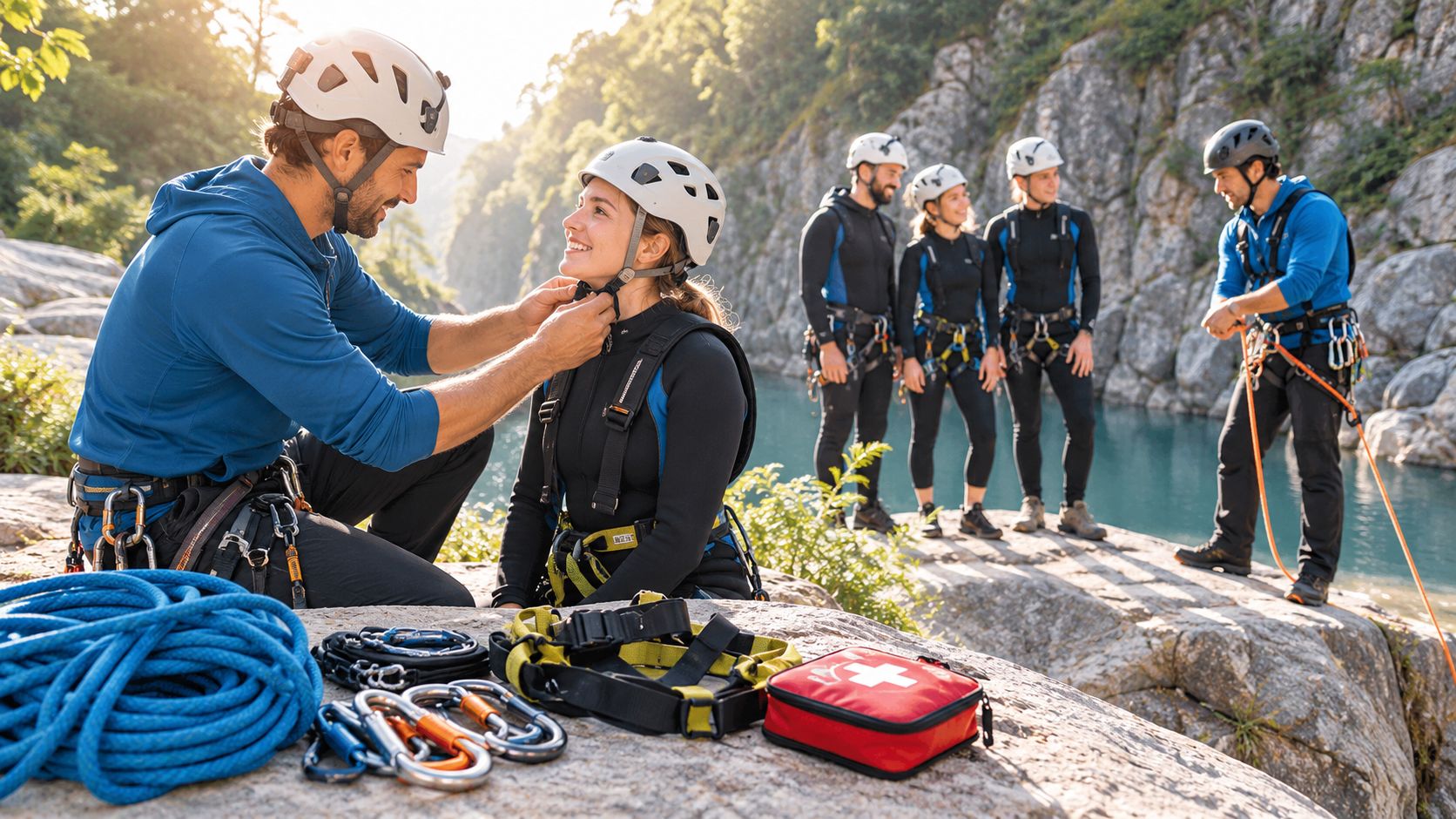
For a beginner, it's helpful to think of the gorge as a natural obstacle course with water, not as a climbing route that happens to be wet. The guide controls the technical parts. You still have to walk, balance and listen, but the guide chooses the safest line through each feature and adjusts the pace to the group.
What you'll usually do
A typical sequence can look like this:
- Gear fitting and briefing. You'll put on the provided equipment and learn the basic movement and communication signals.
- Approach walk. The group reaches the water through a route selected for the activity and current conditions.
- Easy water movement. You may wade, walk on rock or swim through manageable sections.
- Progressive obstacles. Slides, jumps or rope descents are introduced one at a time.
- Exit and changing. The group leaves the gorge together and changes into dry clothing.
The order and features vary by route. A jump isn't automatically compulsory, and a guide may use an alternative technique when a participant isn't comfortable or when water conditions make a feature unsuitable. Safety decisions take priority over completing a fixed list of obstacles.
Beginner routes around Bled and the Julian Alps are selected for approachability, with attention to technical difficulty, water volume, exposure time and the group's ability. Previous canyoning experience is normally not required, but that doesn't mean the activity requires no preparation. You should be comfortable following instructions, moving over uneven ground and being around cold water.
You can find a more detailed introduction to canyoning in Slovenia for beginners before deciding whether the activity matches your travel plans. The important point is that your first trip isn't an exam. The guide gives you the technique, checks your understanding and manages the route as conditions develop.
Real Risks for Beginners and What Causes Them
The most useful safety conversation doesn't focus on dramatic-looking jumps. Beginners are more likely to struggle with wet footing, cold exposure and changing water levels than with the technical idea of abseiling.
Wet rock is naturally slippery, especially when you're tired or rushing. A small slip can become more likely when participants wear unsuitable footwear, look down at the next obstacle instead of the step in front of them, or move too close together. Guides reduce this risk by controlling spacing and showing the group where to place feet, but participants still need to move deliberately.
Cold water creates a different problem. Alpine gorge water can feel icy even during summer, and a wetsuit doesn't make a person invulnerable to cold. Long exposure, slow progress, poor-fitting thermal protection or arriving already exhausted can contribute to hypothermia. That's why beginner suitability depends on thermal protection and a manageable trip length, not just on whether the route has small jumps.
The hazard you can't see
Flash flooding is the most important reason guides check conditions before entering. Rain doesn't need to be falling directly above the gorge. Water from upstream can reach the canyon later, and the level can rise quickly while the group is surrounded by steep walls.
A sunny meeting point therefore doesn't prove that canyoning conditions are safe. Legitimate operators monitor forecasts and water behaviour, coordinate decisions with relevant mountain-weather information and cancel or modify trips when the margin becomes too small. A change of plan is a safety decision, not a failure to deliver the advertised adventure.
Why self-navigation changes everything
A beginner who enters alone has to judge every obstacle without knowing whether a landing pool is deep enough, whether a rope anchor is reliable or whether there's a safer route around a feature. Even a physically capable person can make a poor decision after cold water, fatigue or a confusing gorge layout affects concentration.
Mountain rescue data provides useful context, although it covers mountain incidents rather than canyoning alone. A Slovenia-wide study covering 2011 to 2015 recorded an annual average of 413 rescues, while 2015 included 434 rescue operations. The study recorded injuries, illness, fatalities and incidents without illness or injury, and helicopter rescue was used in 190 cases in 2015. These figures describe the wider alpine environment, not the risk of a guided canyoning trip, but they show why route planning and emergency readiness matter in Slovenian mountain terrain. The findings are available through the published mountain-rescue study.
The lesson for a first-timer is straightforward. Don't judge safety by how exciting a photo looks. Judge it by whether the operator manages water, weather, equipment, route choice and group behaviour before those factors become emergencies.
How Guides Equipment and Park Rules Keep You Safe
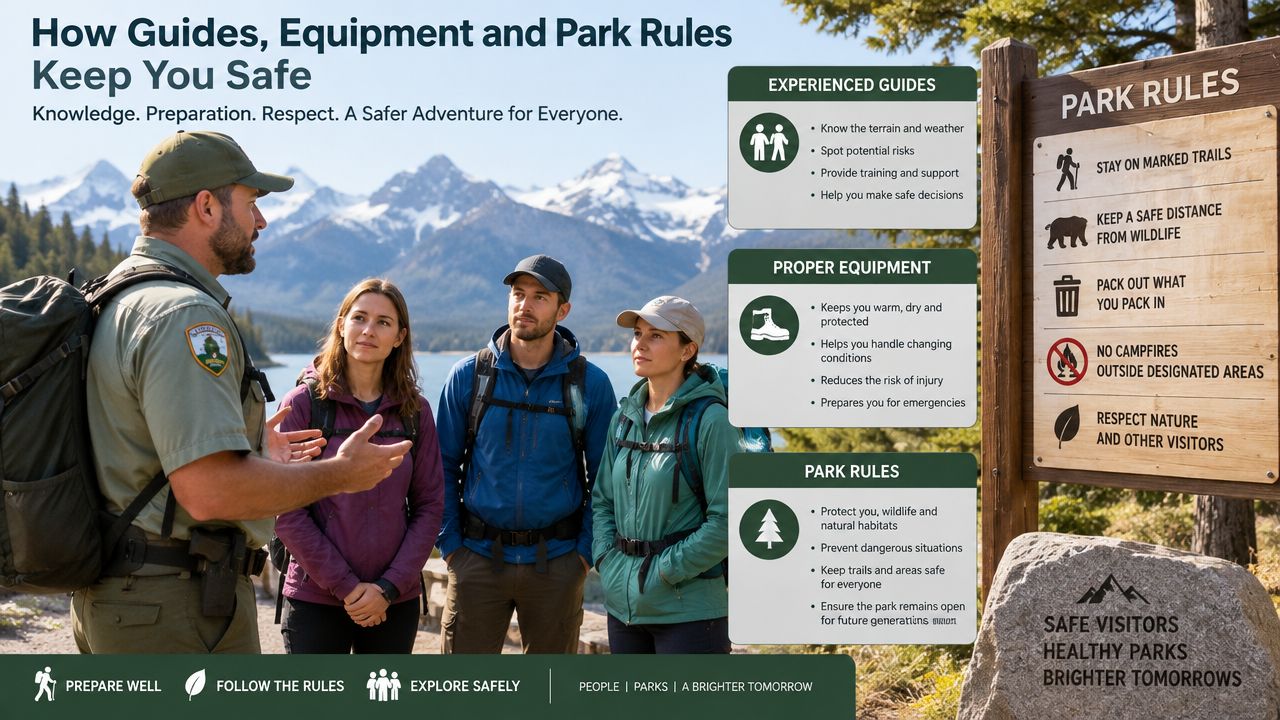
A first descent can feel exposed: cold water, smooth rock and a rope leading into a narrow gorge. Your safety does not depend on one piece of equipment or on courage alone. It comes from several checks working together, including the guide, route choice, equipment, weather decision and park rules.
The guide manages the route
Professional canyoning organisations in Slovenia describe their role as supporting safe, professional and sustainable canyoning. Their training pathways progress from beginner to professional levels, reinforcing a guided approach built around route knowledge, instruction and supervision. The Slovenian canyoning association and its training approach explains that framework.
Commercial canyoning groups in Slovenia are commonly kept to a guide-to-participant ratio of roughly one guide for six to twelve participants, depending on difficulty. A smaller group gives the guide more time to check foot placement, maintain spacing and notice when someone is cold, tired or hesitant. It also keeps communication clearer when water is noisy.
The guide chooses how the route is used that day. A small jump may suit a confident group in stable conditions, while the same feature can be avoided if water rises or a participant is uncomfortable. The safest decision is often a different line, a lower descent or a skipped obstacle.
Equipment protects against predictable exposure
Beginner trips commonly provide a wetsuit, neoprene socks, waterproof footwear, helmet and harness. Participants are usually asked to bring a swimsuit, towel and dry clothes. A beginner canyoning overview describes this preparation and notes that some trips set suitability limits, including a minimum age of 10 for half-day tours, 14 for full-day expeditions, a minimum height of 140 centimetres and a maximum weight of 120 kilograms. Those conditions vary by activity, so provide accurate details when booking.
Each item has a specific job. The wetsuit and neoprene socks reduce heat loss, the helmet protects against bumps and falling debris, and the harness supports controlled rope descents. Equipment helps only when it fits correctly and the participant follows the guide's instructions.
Park rules add another checkpoint
Triglav National Park requires canyoning groups to register in advance. For the Fratarica and Predelica gorges, registration is compulsory, and the park limits groups to nine canyoners, including the guide. Profit-making trips must also include a wild-water rescuer. The requirements appear in the park's official visitor information and canyoning guidance.
The park added an operational rule in 2025: each canyoning group must register at least 30 minutes before arrival at the designated gorge parking area. A group without registration cannot canyon during that time slot. The guidance also requires proof of valid white-water rescue certification for guides. See Triglav National Park's seasonal canyoning notice.
Weather is another go-or-no-go checkpoint. A registered group can still be stopped or redirected if rainfall, water level or forecast conditions reduce the margin for safe movement. This is why park registration and guide judgement work together, like a booking check followed by a final inspection before entering the gorge.
Professional wild-water work follows a formal qualification pathway. The Water Rescuer Slovenia programme is mandatory for professionals working on or near wild waters, including canyoning guides, under the Drowning Prevention Act. These requirements may look administrative, yet they place trained people, group limits and current conditions into the decision before beginners enter the water. The safest beginner experience is often the most regulated one, not the trip presented as the most extreme.
Are You Ready and How to Choose a Safe Operator
A beginner group may reach the gorge eager to start, then discover that the test is simple communication. You will walk on uneven ground, climb over rock, swim short sections and spend time in cold water. Tell the operator before the trip if water causes panic, basic movement is difficult, or a medical condition could affect exertion.
Your comfort matters as much as your strength. A guide can explain a jump, offer another way through, or lower you with a rope, yet you still need to hear instructions and answer clearly. Mention a fear of heights, shoulder problem, previous injury or concern about swimming. The guide can then judge whether the route suits you and adjust the briefing.
A suitable trip should feel like a supervised lesson, not an examination. You do not have to prove that you are fearless. You do need to tell the truth about how you move, react and cope with cold water.
Age and body-size limits differ between activities. Some beginner trips set a minimum age of 10 for half-day tours and 14 for full-day expeditions. Other activity descriptions may require at least 140 centimetres in height and no more than 120 kilograms in weight. Treat these as examples, not universal rules. Check the current activity information and ask the operator before booking.
Questions that reveal the safety standard
| Question to Ask | Why It Matters for Beginners | Good Answer Sounds Like |
|---|---|---|
| Is the guide qualified for wild-water work? | Moving water requires supervision from someone trained for its changing conditions. | The operator explains the guide's relevant certification and role. |
| How is the group size managed? | Clear spacing and prompt assistance are easier in a controlled group. | The operator states a ratio or group limit directly. |
| What equipment is included? | Thermal protection and technical equipment affect comfort and movement. | The operator lists the wetsuit, neoprene socks, footwear, helmet and harness. |
| Are jumps compulsory? | Nervous beginners need to know whether another route is available. | The guide assesses each feature and explains suitable options. |
| How do you make weather decisions? | Rain upstream can alter canyon conditions quickly. | The operator checks forecasts and can modify or cancel the outing. |
| Is park registration handled where required? | Registration indicates that the operator follows protected-area procedures. | The company explains how the group meets the relevant park rule. |
| What should I bring? | Dry clothing and a towel make the return more comfortable. | The operator confirms a swimsuit, towel and a complete change of clothes. |
Be cautious when an operator talks only about thrills and gives vague answers about weather, qualifications, group management or registration. Exciting language alone proves little. Visible compliance is more reassuring than dramatic marketing, because it shows that safety decisions happen before and during the trip.
Your Practical Beginner Checklist Before You Go
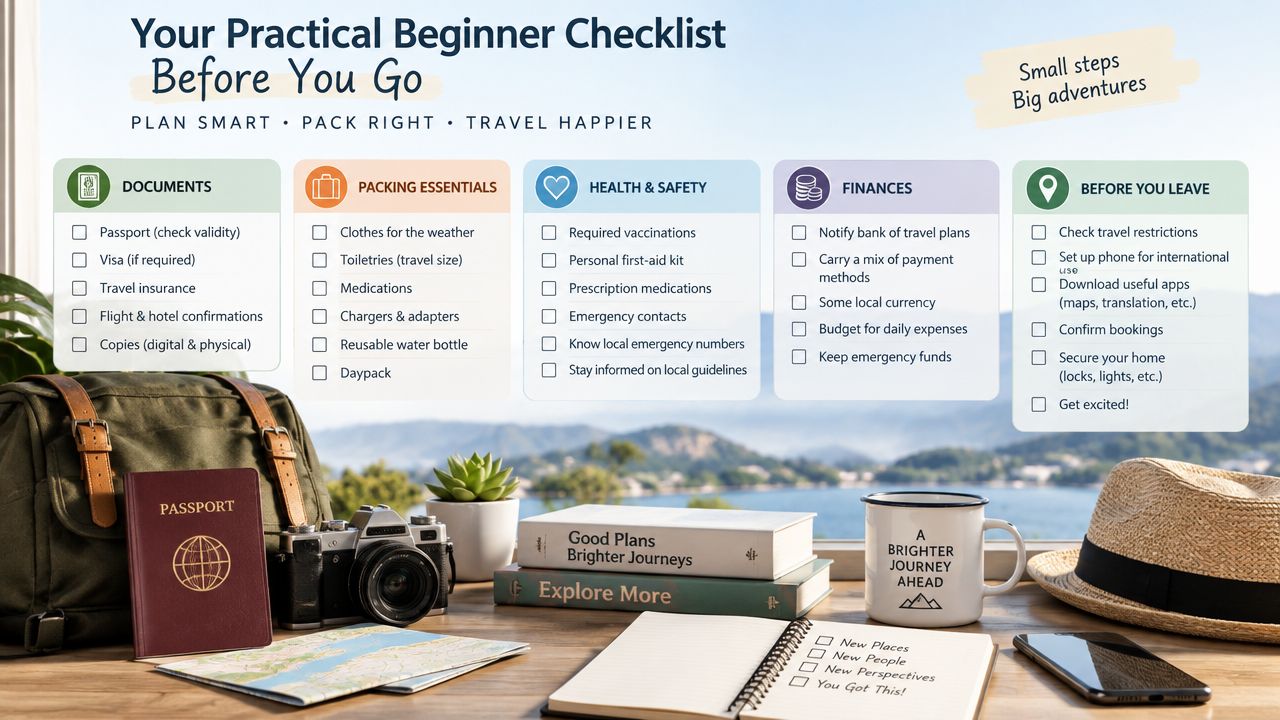
Preparation starts when you book, not when you reach the river. Read the current activity information, check the participation requirements and answer questions about swimming comfort, fitness, height, weight and medical conditions accurately. Ask for clarification if you don't understand what the trip includes.
Pack the personal items that technical equipment doesn't replace:
- Swimsuit: Wear something comfortable underneath the wetsuit.
- Towel: You'll need it after leaving the water.
- Dry clothes: Bring a complete change for the journey back.
- Secure personal items: Leave valuables behind unless the operator gives you a safe storage option.
Technical equipment is commonly provided, including a wetsuit, neoprene socks, waterproof shoes, helmet and harness. You can review practical clothing advice in this guide to what to wear for canyoning.
Prepare your body without overtraining
You don't need a special training programme for a beginner trip. Arrive rested, hydrated and ready to spend time walking, balancing and moving over uneven ground. Light everyday activity can help, but the more important preparation is avoiding a late night, dehydration or arriving with an injury you haven't mentioned.
Tell the guide if cold water affects you quickly or if you're nervous about heights. A calm explanation before entering the gorge is much more useful than trying to hide the concern until you reach the first obstacle.
Listen during the briefing
The dry-land briefing is where the guide explains communication, movement and group spacing. Pay attention to where to wait, when to move and how to respond if the person ahead needs extra time. In a gorge, clear spacing helps prevent collisions and gives the guide room to assist.
Jumps should be explained before you decide whether to do them. The guide checks the feature, gives body-position instructions and offers an appropriate alternative where the route allows one. Abseiling is taught step by step, with the guide managing the rope system while you follow the movement instructions.
Before entering the gorge, you should know how to stop, how to communicate discomfort and who to follow.
The guide also explains what happens if conditions or the group change. Water levels, weather and participant ability can all affect the route. A responsible team may shorten, modify or cancel the activity rather than continue with a plan that no longer fits the conditions.
Finally, keep your focus on the next movement, not on trying to look confident. Careful feet, steady breathing and honest communication are more useful than speed. For current equipment, meeting and participation details, check the relevant activity page before you travel.
Beginner Friendly Canyoning Around Bled With Outdoor Slovenia Activities
Beginner-friendly canyoning around Bled starts with route selection, not with a promise that every participant will do every obstacle. The guide considers current water levels, weather, the group's ability and how long people will be exposed to cold conditions. That's why the same area can feel manageable for one group and unsuitable for another on a different day.
OUTdoor Slovenia Activities is based in the Lake Bled area and has operated since 2008. Canyoning is one of its core activities, and guided trips are intended for many first-timers who don't have previous canyoning experience. The company states that technical equipment is provided, with photos and videos included where applicable, and free pickup is available in the Bled area for applicable activities.
For visitors staying around the lake, canyoning near Lake Bled can fit naturally into a wider Julian Alps itinerary. Small groups and professional guides make it easier to ask questions, slow down when needed and receive individual instruction. The important detail is that the route remains subject to current conditions, rather than being treated as a fixed product that must continue regardless of water or weather.
If you're still asking, “is canyoning safe for beginners?”, the honest answer is that it can be, provided you choose guided canyoning, meet the participation requirements and accept that the safest decision may be to change the plan. You don't need to prove your courage. You need to choose a properly managed trip and communicate clearly.
Outdoor Slovenia Activities provides guided, beginner-friendly canyoning around Bled with professional guides, technical equipment and condition-based route decisions. Visit Outdoor Slovenia Activities to review the current canyoning trips and choose an option that matches your experience, fitness and travel plans.