
We once met a family at Planina Blato just after sunrise. The children were excited, the parents were slightly unsure, and by the time they reached the first open views above the pasture, the whole day had shifted from nervous planning to pure mountain joy.
Table of Contents
- Welcome to the Valley of the Seven Lakes
- Choosing Your Triglav Lakes Hiking Route
- Multi-Day Itineraries With Mountain Hut Stays
- The Best Seasons To Hike Triglav Lakes
- Trail Difficulty And Fitness Requirements
- Essential Gear And Packing List
- Getting There And Guided Trip Options
- Triglav Lakes Hike FAQ
Welcome to the Valley of the Seven Lakes
The Triglav Lakes Valley has a way of changing your pace. Forest gives way to limestone, pasture paths turn alpine, and then the lakes begin appearing one by one in a setting that feels older and quieter than most of the Julian Alps.
Locally, this is the Valley of the Seven Lakes, even though the basin holds more water bodies than the name suggests. What makes the area memorable isn't only the lakes themselves. It's the feeling of moving through a long karst valley where every turn reveals another shelf of rock, another patch of dwarf pine, another change in light.
Why this valley feels different
The terrain here wasn't shaped by a single force. The lakes sit in depressions over a massive karst shelf, formed through glacial retreat and karstification, which is also why the hydrology is so fragile and why the area has been protected since 1924. That protected status isn't symbolic. It exists because even small disturbances can damage the ecological balance, and swimming is strictly forbidden in the lakes according to the Triglav Lakes protection overview.
If you're carrying a camera, this is one of those routes where restraint matters as much as technique. Bright rock, dark water, fast cloud movement, and reflective surfaces can fool even experienced travellers, so it helps to brush up on essential landscape photography techniques before you go.
The best photos here usually happen when you stop chasing the biggest panorama and pay attention to layers, water colour, and the shape of the limestone around you.
A protected alpine landscape
This isn't a lake district in the casual sense. It's a protected alpine system inside Triglav National Park, and that changes how we should walk through it. Stay on marked trails, don't step down to shorelines for a better angle, and don't treat the lakes like wild swimming spots.
A few habits work especially well here:
- Keep to the path: Karst terrain erodes quickly, especially on shortcuts and soft edges near wet ground.
- Respect the water: The lakes are the heart of the valley, but they are not for bathing, washing, or cooling tired feet.
- Tread softly: You'll get a stronger sense of the place, and you'll notice more of the alpine atmosphere that makes this trail so special.
For many visitors, Triglavska Jezera Pot becomes the hike they remember most from Slovenia. Not because it's the highest or hardest route, but because it feels complete. Forest, pasture, karst, huts, water, and big mountain space all come together in one journey.
Choosing Your Triglav Lakes Hiking Route
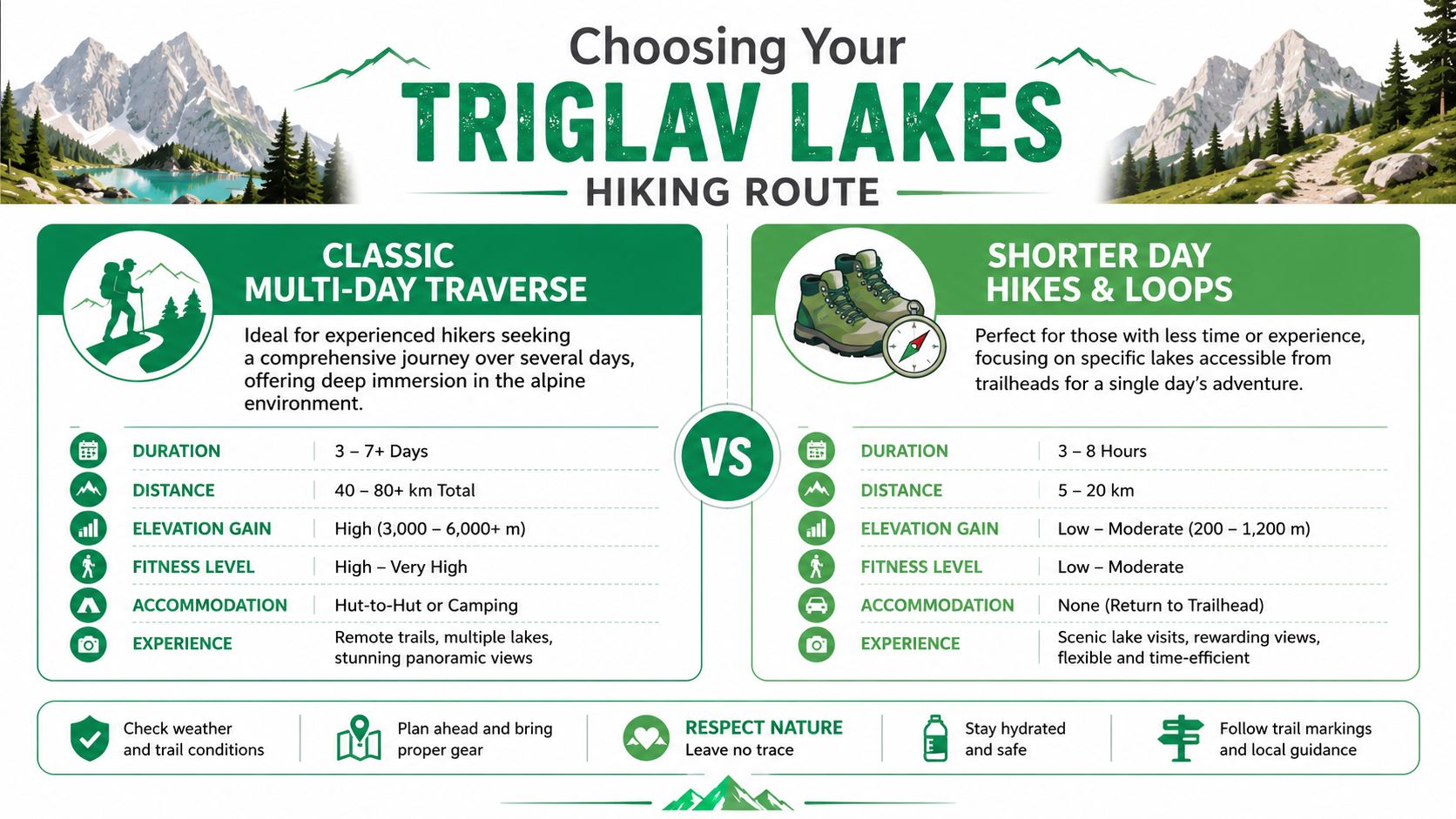
It's best to decide early whether you want a rewarding day hike or a more committing alpine circuit. On Triglavska Jezera Pot, that choice matters more than many visitors expect because the character of the route changes sharply once you leave the easier valley approach.
The classic out-and-back from Planina Blato
For first-time visitors, the most sensible option is the popular route from Planina Blato to Koča pri Triglavskih jezerih. It starts at 1,147 m and rises to 1,685 m, covering 7.49 km with about 538 metres of ascent, and the usual hiking time is 2 hours and 40 minutes according to the Planina Blato route description. It also attracts over 150,000 hikers annually, which tells you two things at once. The trail is well loved, and in peak periods you shouldn't expect solitude.
This version of the hike works well if you want:
- A clear goal: Reach the hut, enjoy the valley atmosphere, and return the same way.
- A beginner-friendly alpine day: You still need decent fitness and proper footwear, but the navigation is straightforward.
- A family-focused outing: Children who are used to walking can enjoy it, especially with early starts and realistic pacing.
If you'd like a broader overview of walking options in the park before choosing, this guide to Triglav National Park hiking is a useful place to compare the feel of different routes.
The full circular option for stronger hikers
The circular route is a different proposition. It's the version hikers choose when they want a fuller tour of the basin and surrounding passes, not just the classic approach to the hut.
What works well about the circuit is obvious. You see more terrain, the day feels more adventurous, and the route connects Planina Blato, Planina pri Jezeru, and Planina Ovčarija in a complete mountain loop. Depending on the exact variant, the full circuit runs 15 to 18 km.
What doesn't work for many casual visitors is underestimating the upper section. Once the route rises toward the more exposed alpine ground, you're dealing with rougher limestone, steeper lines, and much bigger consequences for poor timing or bad weather.
Practical rule: If you're asking whether you can "just see how it goes" on the circular route, the classic valley hike is probably the better choice.
The easiest mistake on Triglavska Jezera Pot is choosing the more ambitious option because the lower trail feels comfortable. The smarter approach is to match the route to your least confident group member, not your strongest one.
Multi-Day Itineraries With Mountain Hut Stays
An overnight stay changes the whole experience. Instead of treating the valley as a target to tick off, you get time for the quieter parts of the mountain day: early light near the hut, evening calm after day hikers have gone down, and a much more relaxed pace on the steeper sections.
How to think about pacing
A multi-day plan works best when each day has one clear job. Climbing day, exploring day, descent day. People get tired when they try to turn every stage into a long sightseeing march.
Hut stays also suit mixed-ability groups surprisingly well. Stronger hikers still get the mountain atmosphere they want, while steadier walkers can spread the effort over more time. If you're considering an overnight near the lakes, details on the Sedmera Jezera hut area help you understand how the stop fits into a broader trip.
A few things usually make the trip smoother:
- Book early: Popular huts fill quickly in the main hiking season.
- Carry less than you think: Heavy packs turn a pleasant valley trail into a grind.
- Arrive with time to spare: Mountain huts are better enjoyed when you aren't rushing in late and tired.
Sample Triglav Lakes Hiking Itineraries
| Day | 2-Day Itinerary | 3-Day Itinerary |
|---|---|---|
| Day 1 | Hike from Planina Blato to the valley hut at a steady pace. Pause at the pastures rather than pushing straight through. Settle in early and enjoy the evening atmosphere around the lakes. | Hike from Planina Blato with an easy pace and longer breaks. Treat the first day as an acclimatisation day rather than a fitness test. Overnight in the hut area. |
| Day 2 | Short morning walk near the hut, then descend carefully while legs are still fresh. The return usually feels easier on paper than it does on tired knees, so allow time. | Spend the day exploring nearby sections of the valley without a full pack. Use the extra time for weather flexibility, photography, and a slower hut experience. |
| Day 3 | Not applicable. | Descend to Planina Blato by the most comfortable marked option for your group. Start early and keep the final day conservative. |
The main trade-off is simple. A 2-day trip is more efficient, while a 3-day trip is more immersive and forgiving. Families and beginners often enjoy the 3-day rhythm more, especially if the goal is to experience Triglavska Jezera Pot rather than merely complete it.
Huts are part of the route, not just somewhere to sleep. They give you weather flexibility, a safer margin for tired hikers, and a much deeper feel for the valley.
What doesn't work well is arriving unprepared for hut life. Bring cash if needed, keep expectations simple, and remember that alpine huts are practical mountain shelters first, comfort stays second. If you embrace that, the overnight becomes one of the best parts of the journey.
The Best Seasons To Hike Triglav Lakes
The biggest planning mistake on this trail is trusting the word "easy" without asking when. Seasonal timing changes the character of Triglavska Jezera Pot more than the map suggests.
When beginners usually enjoy it most
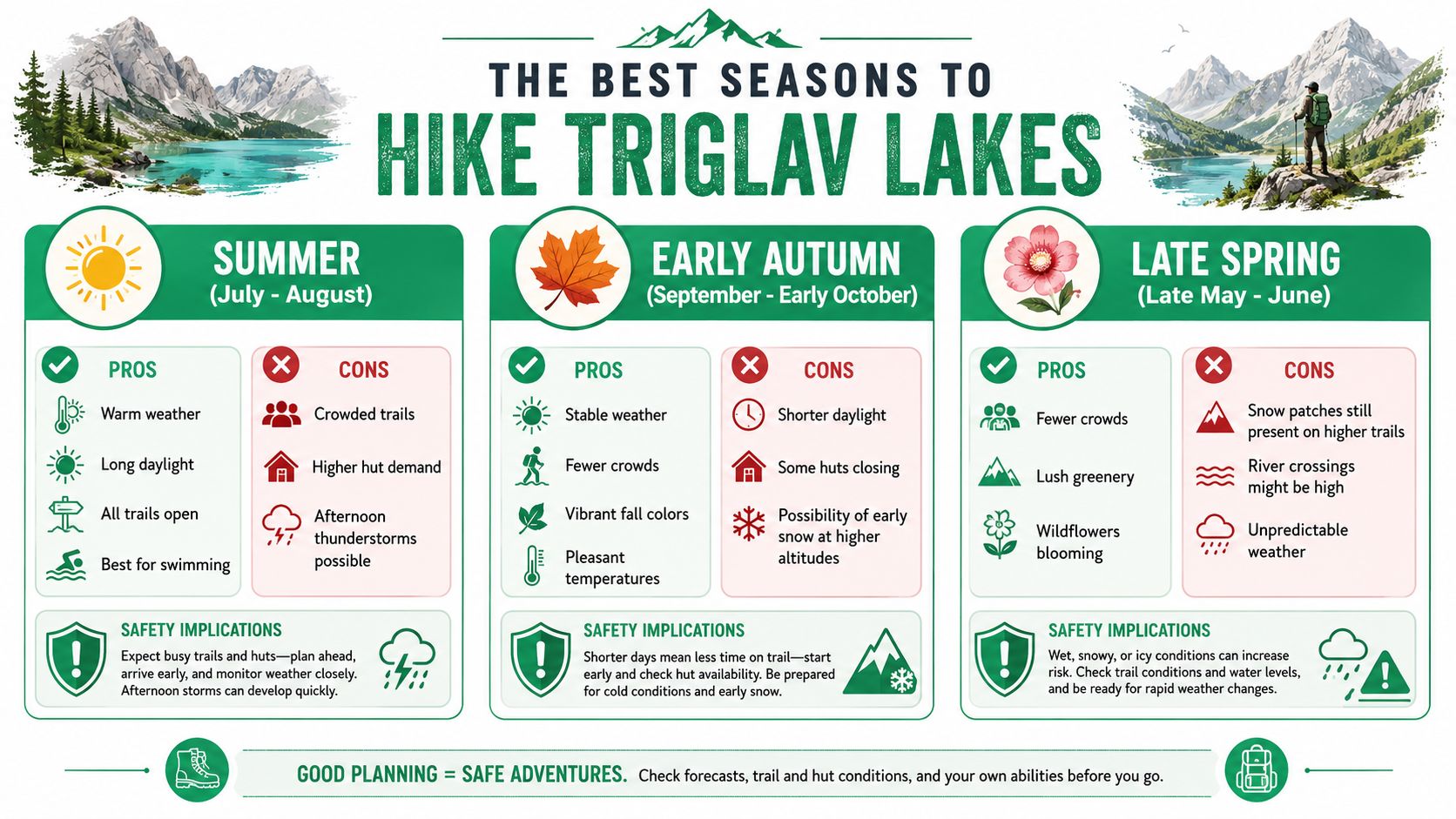
For most visitors, the most reliable period is late June through September. That's when the route is most likely to be free of lingering snow on the standard approach, the day length is generous, and the logistics are simpler.
July to September is also the busiest period on the trail, as noted in the route data already cited above. That doesn't make the hike less worthwhile. It just means you'll want an early start, especially if you're hoping for quieter moments near the hut and along the lower sections.
The seasonal trade-offs are straightforward:
- Late June and early summer: Usually greener, fresher, and very pleasant if the trail has dried out properly.
- High summer: Best for stable access and hut rhythm, but busier.
- September: Often a lovely choice for walkers who prefer calmer light and slightly less traffic.
Why shoulder seasons catch people out
This route is often talked about as if it stays equally accessible all year. It doesn't. The alpine karst valley becomes hazardous with mud and snow from late October to mid-June, and that can turn what many people expect to be a 3.5-hour hike into a 5+ hour ordeal for unprepared beginners, as described in this seasonal trail conditions note.
That matters most for visitors arriving from Lake Bled or other lowland bases. If you've spent the week around lakeside paths and scenic drives, it's easy to underestimate how different a shaded alpine slope feels under spring snow or autumn slush.
What usually works in shoulder season is caution, not optimism. If conditions are uncertain, choose a lower objective. If the path is wet, muddy, or holding snow in forest shade, don't assume it will improve higher up.
Early autumn can be beautiful, but once nights turn colder, small icy patches on limestone can change the whole tone of the walk.
For beginners and families, the safest call is simple. Treat summer and early autumn as the main season, and treat late spring and late autumn as conditional mountain periods that require much more care.
Trail Difficulty And Fitness Requirements
The honest answer is that Triglavska Jezera Pot is both easier and harder than people think. Easier, because the main valley approach is achievable for many walkers with decent preparation. Harder, because "easy" in the Slovenian Alps never means flat, casual, or risk-free.
What easy means in the Slovenian Alps
The main trail to the hut is classified as an easy route in local hiking terms. That classification is helpful, but only if you read it in context. It means the route is marked and non-technical under suitable conditions. It doesn't mean you're strolling around a lakeside promenade.
On the ground, hikers still deal with:
- Steady climbing: The ascent is continuous enough that untrained walkers feel it.
- Rocky footing: The surface changes, and your ankles need support.
- Mountain timing: Weather, daylight, and energy management matter.
This is why non-Alpine hikers sometimes struggle despite reading that the route is suitable for beginners. The label is accurate. The interpretation is often not.
Where the route becomes serious
The full circular route includes a technical ascent to Vrata pod Zelnarico at 2,190 m with cable-secured sections. That segment is classified as demanding and can take 5 to 6 hours, requiring alpine footwear and comfort with exposure. It's a sharp contrast to the easier main valley path.
That difference is the key fitness question. If you're considering only the standard route, you need solid walking fitness, patience on climbs, and enough strength for the descent. If you're considering the full circuit, you need more than fitness. You need composure on exposed ground and experience moving carefully on rough alpine terrain.
A realistic self-check looks like this:
- Good match for the main route: You can hike uphill for several hours, you wear proper boots, and you don't panic on uneven terrain.
- Poor match for the demanding circuit: You dislike steep drops, you've never used cable-secured paths, or you only hike occasionally on mellow trails.
- Best approach for mixed groups: Keep the objective modest and leave technical variants for another trip.
Most problems on this trail don't start with lack of fitness. They start when hikers choose a route above their mountain experience.
If you're fit but inexperienced, the standard valley hike is usually a great decision. If you're experienced and sure-footed, the bigger loop can be highly rewarding. Confusing those two categories is what causes trouble.
Essential Gear And Packing List
Good kit won't make the trail easy, but poor kit can make a good day miserable very quickly. On Triglavska Jezera Pot, the basics matter more than fancy extras.
What matters most on this trail
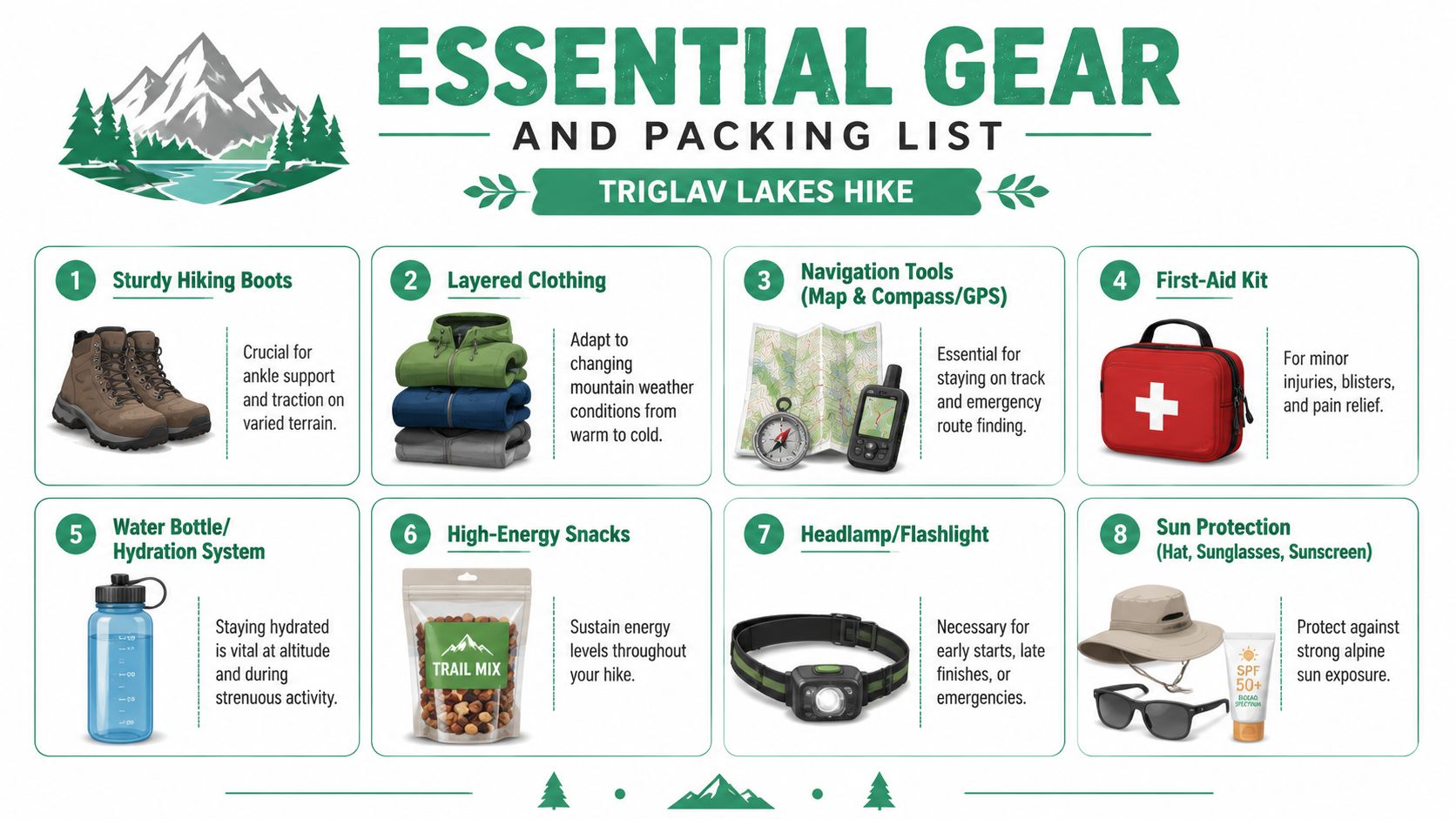
The single most important item is sturdy footwear. Karst rock, loose stones, wet roots, and long descents all punish flimsy trainers. Wear broken-in hiking boots or approach shoes with reliable grip.
Use this checklist before you leave:
- Sturdy hiking boots: They give ankle support and help on uneven limestone.
- Layered clothing: A base layer, warm mid-layer, and waterproof shell are more useful than one heavy jacket.
- Map and navigation backup: Even on marked trails, phones shouldn't be your only plan.
- First-aid kit: Blister care is as important as anything else.
- Water system: Carry enough for the full day.
- High-energy food: Snack early, not only when you feel weak.
- Headlamp: Delays happen.
- Sun protection: Alpine light is stronger than many visitors expect.
Food is where many day hikers underpack. A sandwich and one sweet bar often isn't enough once the climb and return both start adding up. If you want ideas that go beyond the usual emergency chocolate, Counter Assault's hiking food recommendations offer practical inspiration for calorie-dense trail snacks.
Extra items for hut stays
For an overnight, keep adding only what improves safety or hygiene. It is common to pack too much clothing and not enough useful small items.
Bring these extras:
- Sleeping bag liner: Standard for hut overnights.
- Small towel and toiletries: Keep them compact.
- Earplugs: Shared sleeping rooms can be lively.
- Cash and documents: Always worth having in mountain huts.
- A dry bag or pack liner: Weather shifts fast, and soaked spare clothes are no use to anyone.
What doesn't work is carrying a huge pack filled with backup outfits, bulky camera gear, and "just in case" items. Light, organised, and weather-ready beats overloaded every time.
Getting There And Guided Trip Options
The most common access for international visitors is from the Lake Bled area, with the trailhead reached via the Bohinj side. If you're driving, start early. Mountain parking and trailhead logistics are always easier before the main flow of hikers arrives.
Reaching the trailhead
Planina Blato is the usual starting point for the classic route. The drive is manageable, but mountain roads, parking routines, and morning timing can feel more stressful than expected if you're unfamiliar with the area.
This map-based overview of the Triglav Lakes route layout helps when you're trying to understand where the trailhead sits in relation to Bohinj and the valley routes.
If you're organising the day yourself, keep three things in mind:
- Start early: It improves parking, temperature, and trail atmosphere.
- Check conditions, not just forecasts: Mountain ground conditions matter as much as sunshine.
- Build in margin: Descent times are often underestimated.
Why many visitors prefer support
For confident independent hikers, the route is straightforward enough in good conditions. For families, first-time Alpine visitors, or anyone uneasy with mountain logistics, local support can make the day far more relaxed.
The value isn't only navigation. It's decision-making. A good local guide reads pacing, weather, footwear, group energy, and turnaround timing before small issues become big ones. That's especially useful on a trail like this, where the official "easy" label can encourage people to push further than they should.
The strongest reason to avoid improvising is simple. This hike is much more enjoyable when you aren't spending the whole day solving transport, route choice, hut timing, and safety questions on the move. When those details are handled well, you can focus on the lakes, the terrain, and the mountain experience you came for.
Triglav Lakes Hike FAQ
A lot of hikers reach this point with the same question. Is Triglavska jezera pot really as easy as people say?
Sometimes yes. For many first-time Alpine hikers, that label is too optimistic unless the trail is dry, snow-free, and the plan is modest. That matters most from October to June, when mud, lingering snow, icy patches, and short daylight can turn a pleasant valley walk into a much more serious day.
Common practical questions
Can you swim in the Triglav Lakes?
No. Swimming in any of the lakes is strictly prohibited by Triglav National Park rules, because these are sensitive alpine waters and they recover slowly from human impact.
Is Triglavska Jezera Pot good for beginners?
Yes, the main valley approach can suit beginners in stable summer conditions, with suitable footwear and a realistic turnaround point. The longer circular versions are a different commitment. They add distance, fatigue, and route-finding pressure, which catches out hikers who are new to Alpine terrain.
Is it suitable for families?
Often yes, especially for families who already enjoy longer walks. The safest family days start early, keep the goal flexible, and treat turning around as good judgment, not failure.
Do I need proper boots?
For most walkers, yes. Trail shoes with solid grip can work in dry summer conditions, but smooth-soled city trainers are a poor choice here. Rocks, roots, wet sections, and muddy ground demand better traction than many visitors expect.
Are mountain huts worth it?
Yes, if you want a more relaxed pace and a better margin for weather, energy, and children's needs. Huts also break up the day well for hikers who want the experience of the valley without forcing a long return in one push.
Will I have constant phone signal?
No. You may get coverage in some places, but you should plan as if you will not. Download maps in advance, agree on decisions before setting off, and do not rely on your phone for rescue, route choices, or timing.
Can I bring children?
Yes, on the main route, if they are already comfortable on uneven trails and the adults keep the day conservative. In practice, children usually manage better with regular food, steady pacing, and a clear destination than with a long, ambitious plan.
What's the most common mistake?
Treating the official rating as the whole story. On this hike, difficulty often comes from conditions underfoot, accumulated distance, and tired legs on the descent. Starting late and carrying too little food, water, or warm clothing are close behind.
If you'd like to experience Slovenia's mountains, rivers, canyons, and lakes with a professional local team, explore Outdoor Slovenia Activities. They organise beginner-friendly adventures from the Lake Bled area, with guides, equipment, transport support, and a strong focus on safe, well-organised days outdoors.